#southkoreaplanstorequiretethercirclelocalreserves
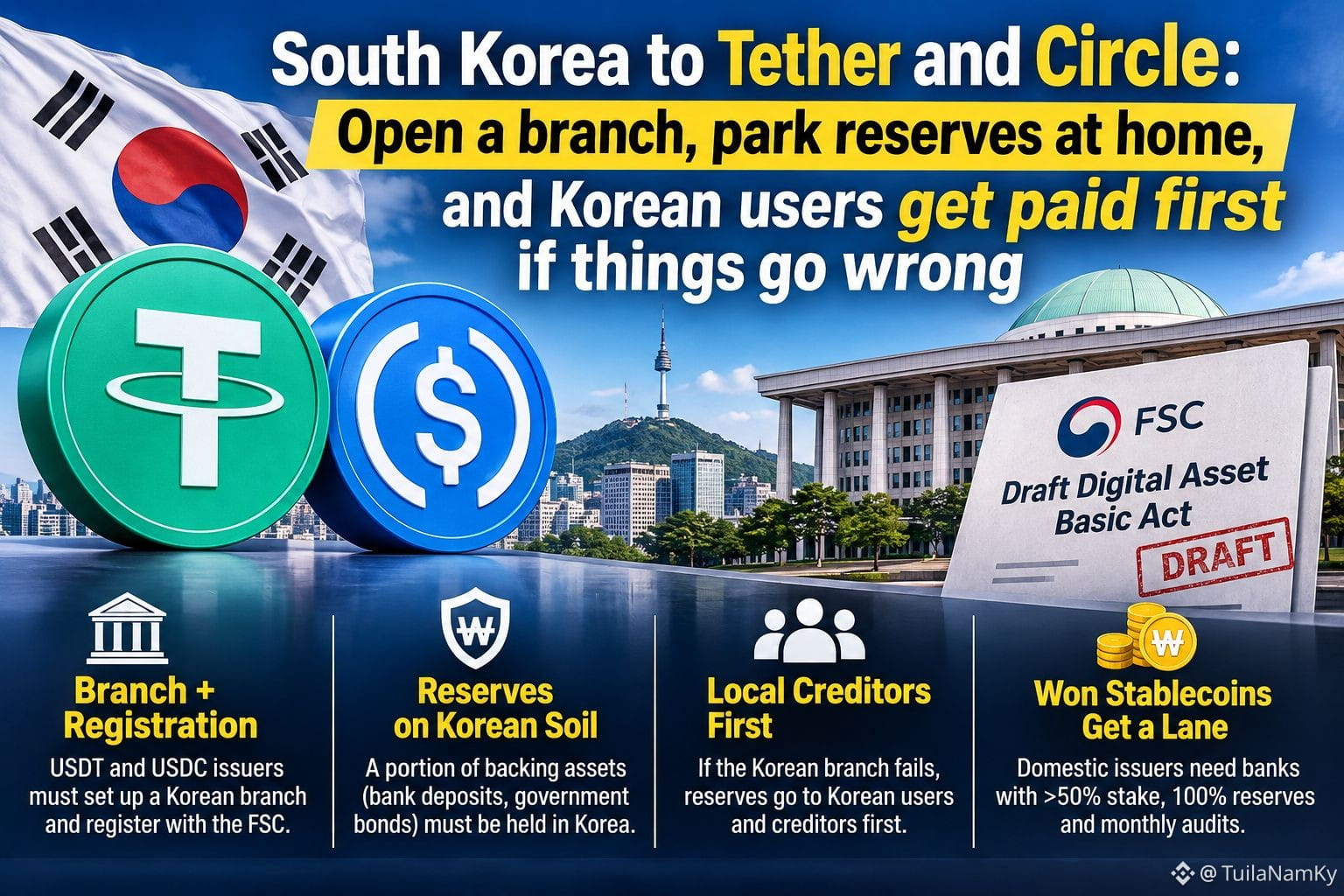
South Korea to Tether and Circle: Open a branch, park reserves at home, and Korean users get paid first if things go wrong
Seoul just stopped asking nicely. The FSC's draft Digital Asset Basic Act, published Nov 26, tells foreign stablecoin issuers that direct issuance and redemption for Korean users comes with a local address and local collateral.
📌 The facts:
Branch + registration: USDT and USDC issuers must set up a Korean branch and register with the FSC before offering mint/redeem services to residents.
Reserves on Korean soil: A portion of backing assets (bank deposits, government bonds) must sit with Korean banks or custodians, ring-fenced from the company's own funds. Size is tied to the amount circulating in Korea and the home-country regime.
Local creditors first: If the Korean branch fails or is wound down, the reserves held in Korea go to Korean users and creditors before anyone else sees a cent.
Won stablecoins get a lane: Domestic issuers need banks holding over 50% of the consortium, 100% reserves and monthly audits. Cozy for banks, obviously.
It's still a draft heading to the National Assembly, so nothing changes tomorrow. But the direction is hard to miss: "our reserves are offshore, trust us" is losing its charm in large retail markets.
Square Insight: Localizing reserves protects users better than a PDF attestation ever did. The price is higher compliance costs and stablecoin liquidity split into regional pools, which is not exactly what "global dollar" was supposed to mean.
Korea trades more crypto per capita than almost anyone, so if this template spreads across Asia, does the dollar stablecoin become a patchwork of local-rule tokens, or do issuers just pay the toll and move on? Where do you land: $USDT and $USDC adapt, or $BTC quietly picks up the slack?
NFA / DYOR