
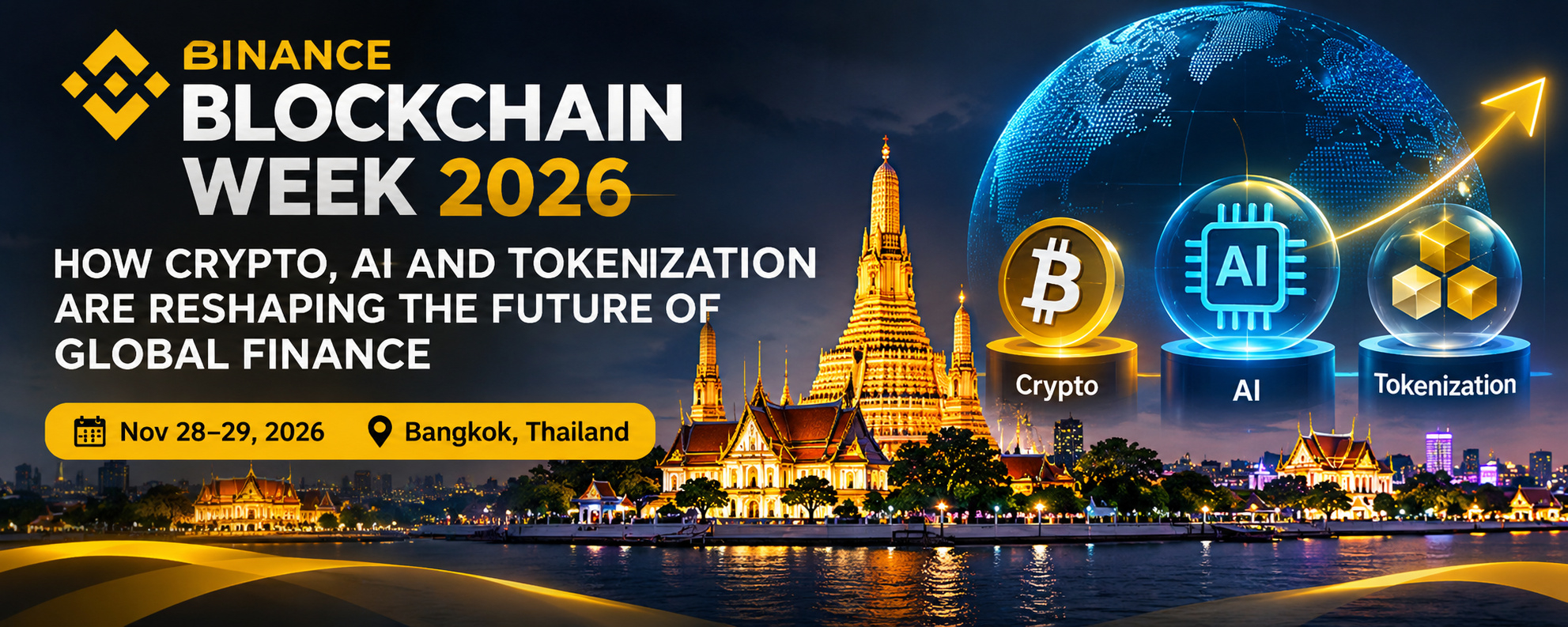


What interests me most about Binance Blockchain Week 2026 is how different the conversation around crypto has become. A few years ago, almost everyone was talking about Bitcoin prices, altcoin rallies and the next bull market. Today, some of the biggest financial institutions are discussing how blockchain could become part of everyday finance.
On November 28–29, Bangkok, Thailand, will host Binance Blockchain Week 2026 at the Queen Sirikit National Convention Center. This year's theme, “Evolve,” reflects how far the industry has come and how much work still needs to be done.
With organizations such as BlackRock, Nasdaq, Visa, Mastercard, Franklin Templeton and Tether expected to participate, I'm curious to see how traditional financial institutions approach the next stage of blockchain adoption.
These companies already serve millions of people through existing financial systems. Their growing interest in blockchain suggests that digital assets are becoming increasingly relevant beyond the crypto community.
The first day will focus on the evolution of capital. Binance Co-CEO Richard Teng is expected to discuss bringing digital finance to another three billion people.
That's an ambitious goal, especially when many people around the world still struggle to access basic financial services.
Government representatives from Kazakhstan, Bhutan, Ghana and Thailand are also expected to participate. I'm particularly interested in hearing how different countries approach digital assets, considering that regulatory uncertainty remains a major challenge for the industry.
Another discussion I'll be following closely is real-world asset tokenization.
The idea of accessing stocks, government bonds and other traditional assets through blockchain is becoming increasingly relevant. Companies like BlackRock and Ondo Finance are already exploring this opportunity.
Imagine being able to access certain financial assets outside conventional market hours, with fewer intermediaries and more efficient settlement processes.
Of course, there are still challenges. Investors need proper legal protection, sufficient liquidity and confidence that their digital assets represent genuine ownership.
Stablecoins are equally important. Most crypto traders know them as a convenient way to protect their capital during volatile market conditions, but their usefulness goes far beyond trading.
For someone sending money to family members in another country, reducing transaction costs and waiting times could make a meaningful difference.
With Visa, Tether and Celo expected to contribute to these discussions, I'm interested in seeing how traditional payment networks and blockchain infrastructure could work together.
The second day will explore another subject that has attracted considerable attention recently: artificial intelligence.
Binance Co-CEO Yi He is expected to discuss the company's broader financial ambitions, while other industry participants will examine how emerging technologies could reshape financial services.
AI could help people process financial information, automate payments and manage risks more efficiently. Blockchain could support these activities through transparent records and programmable transactions.
Projects and companies including Pyth Network, RedStone, Babylon, BNB Chain, Google Cloud and Alibaba Cloud are expected to bring different perspectives to these conversations.
Personally, I would rather see practical demonstrations than ambitious promises. Combining two popular technologies sounds exciting, but the results need to offer something genuinely useful.
I also appreciate that Binance Blockchain Week is expected to explore humanitarian applications of blockchain, with UNICEF participating in discussions around digital infrastructure and aid distribution.
It's refreshing to see conversations that aren't entirely focused on making money. If blockchain can improve transparency and help financial assistance reach vulnerable communities more efficiently, that would represent meaningful progress.
The Blockchain 100 Awards, scheduled for November 29, will also recognize creators contributing to cryptocurrency awareness and financial education.
As someone who follows crypto content regularly, I believe creators have an important responsibility. Sharing accurate information, explaining complicated developments and encouraging meaningful discussions can help newcomers understand this industry without becoming distracted by unrealistic expectations.
Through the #EvolveAtBinanceBlockchainWeek campaign, the wider community can also share its expectations, opinions and observations throughout the event.
What I really want from this year's conference is a clearer understanding of where crypto is heading.
We've experienced enough speculative excitement, temporary trends and ambitious promises. What matters now is whether blockchain can deliver reliable products that ordinary people actually need.
I want to see stablecoins making international payments easier, tokenization opening new financial opportunities and artificial intelligence helping people make more informed decisions.
Binance Blockchain Week won't solve every problem facing the industry in two days. However, bringing developers, policymakers, financial institutions and everyday crypto users together could help move these conversations forward.
For me, the biggest sign of crypto's evolution won't necessarily be Bitcoin reaching another all-time high.
It will be the moment when people start using blockchain because it makes their lives easier, rather than because they expect a token's price to increase.
That's the kind of evolution I'm looking forward to seeing at Binance Blockchain Week 2026.