


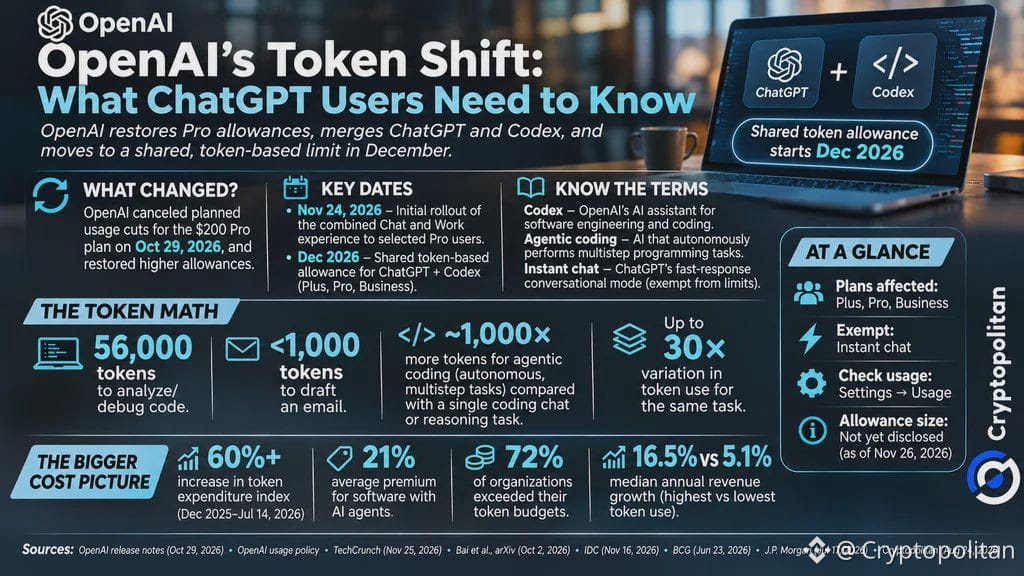
OpenAI is no longer cutting usage limits for Pro subscribers. The company has also started bringing ChatGPT and Codex, its AI coding assistant, together. Starting December 2026, all Plus, Pro, and Business plan subscribers will have a single token cap for both services.
OpenAI’s decision is part of a rising debate on how AI companies ought to charge for their services. It is becoming increasingly difficult to maintain the fixed monthly subscription fees as AI agents are assuming complex and expensive tasks.
Pro limits restored, then merged
OpenAI confirmed in its October 29, 2026, release notes that it would no longer cut usage limits for its $200 Pro plan. The company also doubled Work and Codex allowances for subscribers who previously had lower limits, bringing them in line with other Pro users.
Less than a month later, OpenAI began testing a combined Chat and Work interface. Product lead Thibault Sottiaux announced on November 24 that the experience was rolling out to a small group of Pro subscribers.
OpenAI is not the only company that integrates both casual conversations and complex AI processes in the same platform. Anthropic launched its chatbot Claude and its productivity tool Cowork on one interface back in September.
One meter for Chat and Codex
Under OpenAI’s new usage policy, Plus, Pro, and Business subscribers will share one allowance for ChatGPT and Codex starting in December 2026.
OpenAI will keep track of usage in tokens, which are the basic components of information that AI models generate and process. More complex tasks and advanced models normally require more tokens, and as a result, subscribers will have less tokens for other tasks.
Regular conversations in Instant mode, however, will not count toward the shared limit. Subscribers can continue using Instant even after running out of their allowance. They can also check how much usage they have left and when their limits reset under Settings → Usage.
The question is how much allowance subscribers will actually have. As of November 26, OpenAI did not inform about the total size of the allowance available to users. A company representative told TechCrunch on November 25, that in general, subscribers will not exceed their allowance any earlier than they do at the moment. Only a few of the most active users may run out of allowance some time before others.
Why subscribers are pushing back
Certain subscribers raise doubts on whether their subscription payment will still provide them access to advanced reasoning models after the introduction of shared usage limits by OpenAI.
Responding to forum discussions dated November 20 and November 23, OpenAI Support acknowledged the skepticism regarding subscription value and flexibility. A support representative stated that feedback will be conveyed but could not assure any changes in policy.
Subscribers also worry about losing tokens every time they have to ask ChatGPT to fix a mistake.
The token math behind the squeeze
Token consumption can vary widely depending on the task, making AI usage difficult to predict.
A study by Longju Bai and colleagues, titled How Do AI Agents Spend Your Money?, examined eight advanced AI models. The researchers first published their findings on April 24 and updated them on October 2, 2026.
According to the research results, it was established that agentic coding, in which AI independently fulfills several programming steps, consumes approximately 1000 times more tokens as compared to common coding conversation or any task that only requires one reply.
Even repeating the same task produced differences of up to 30 times in token consumption. Using more tokens did not guarantee better results.
J.P. Morgan Private Bank’s July 17 analysis, citing Wolfe Research, offers another comparison. Analyzing and debugging code can take around 56,000 tokens, while drafting an email requires fewer than 1,000.
The bank also cited a token expenditure index that climbed more than 60% between December 2025 and July 14, 2026.
 ChatGPT’s shift to shared token allowances: What paying subscribers need to know
Hybrid pricing and the value question
Businesses are also finding it difficult to budget for AI. According to IDC’s November 16, 2026, pricing analysis, companies were willing to pay an average of 21% more for software with built-in AI agents. However, 72% of the 1,666 organizations surveyed had exceeded their token budgets in the previous year.
High token consumption is not necessarily a sign of overspending. Boston Consulting Group’s June 23 token-based competition study found that technology companies with the highest token consumption recorded median annual revenue growth of 16.5%. Companies with the lowest consumption recorded 5.1%. However, the study did not establish whether greater AI usage drove revenue growth.
For AI providers, the challenge is making subscription pricing sustainable. On August 24, 2026, Cryptopolitan reported that SemiAnalysis estimated heavy users could get around $14,000 worth of API usage from OpenAI’s $200 subscription and $8,000 from Anthropic’s similarly priced plan.
The gap between subscription fees and the value of AI usage helps explain why providers are moving toward hybrid pricing, which combines fixed subscription fees with metered usage. However, stricter limits could also give subscribers a reason to explore cheaper, more token-efficient alternatives.
The smartest crypto minds already read our newsletter. Want in? Join them.