
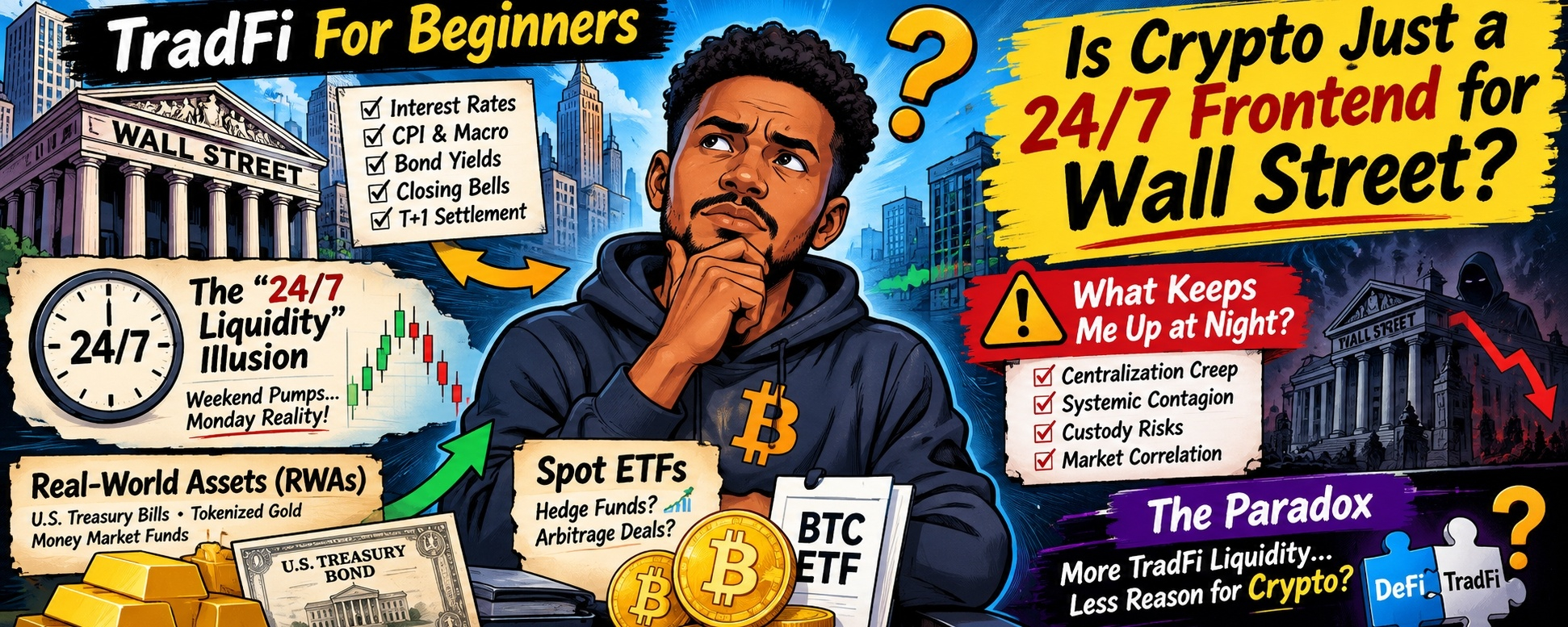

I spent the last 48 hours scrolling through the #TradFiForBeginners feed on Binance Square, and honestly, it made me realize most of us in crypto are looking at traditional finance completely backwards.
For years, I treated Wall Street like a slow, dusty museum that Web3 was eventually going to bulldoze.
Then I actually started tracking how liquidity moves between legacy markets and on-chain protocols—and it completely broke how I used to read a $BTC chart.
If you’ve spent your entire investing life inside MetaMask wallets, perpetual DEXs, and 24/7 orderbooks, stepping into Traditional Finance (TradFi) feels super clunky.
You suddenly hit closing bells, T+1 settlement delays, and accredited investor gates.
Yet, whether we like it or not, that "legacy" plumbing is now the primary engine driving crypto market structure in 2026—and I’m still wrapping my head around what that actually means for regular traders like us.
The "24/7 Liquidity" Illusion ⏰
When I first started trading $BNB and mid-cap altcoins, I loved that the market never slept.
Sunday night pumps felt pure—just raw, unfiltered crypto supply and demand without suits getting in the way.
What I didn't realize back then is that weekend price action is mostly a low-liquidity mirage waiting to get erased the second New York wakes up on Monday morning.
In TradFi, capital doesn't move because of a Discord announcement; it moves on a rigid macro calendar.
Interest rate decisions, CPI prints, and Treasury yields dictate the global cost of capital.
When the Federal Reserve tightens liquidity, institutional risk desks don't care how fast a Layer-1’s consensus mechanism is.
They hit a single "de-risk" button across their entire book, and $BTC gets sold right alongside tech stocks.
I used to stare at 15-minute RSI indicators all day—now I just check bond yields first, and it’s honestly a little depressing how much more predictive that is.
Why Real-World Assets (RWAs) Actually Click Now 🏦
For a long time, "tokenization" sounded like a corporate buzzword used to pitch boring enterprise chains nobody used.
I was totally skeptical until I started testing on-chain Treasury protocols and tokenized commodities myself during choppy sideways weeks.
Think about what happens when you hold idle stablecoins like USDT orUSDC when the market goes dead.
In pure DeFi, you used to have to chase sketchy, circular token emissions just to squeeze out 4% or 5% yield.
Now, TradFi bridges let you tap directly into US Treasury bills—literally the benchmark risk-free rate of the traditional world—straight from your self-custody wallet.
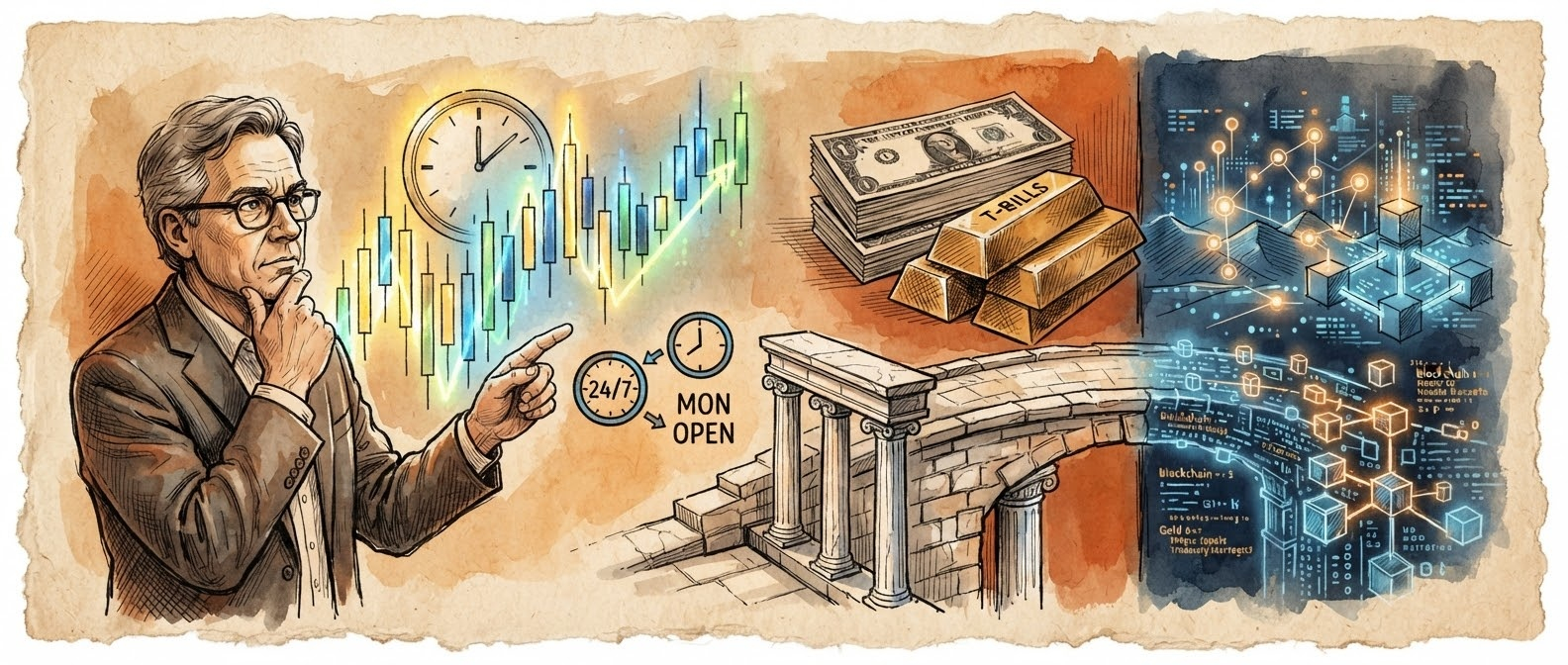
It’s the same story with tokenized gold like PAXG orXAUT.
Watching how institutional desks use $ETH as the settlement layer for tokenized money market funds made something click for me:
TradFi isn't replacing DeFi, and DeFi isn't killing TradFi—DeFi is slowly becoming the backend settlement rail for TradFi's balance sheet.
(Wait—except here’s the catch that nobody talks about: that entire RWA bridge only works as long as on-chain convenience outweighs custodial haircut risk. The second a major issuer freezes redemptions or Treasury yields drop below native DeFi demand, that capital evaporates right back into pure on-chain risk.)
Spot ETFs Aren't What Retail Thinks 📊
Every beginner hears that "institutional money is coming," usually followed by green rocket emojis.
When I actually dug into how spot BTC andETH ETFs operate behind the scenes, I realized it’s way more mechanical—and cold-blooded—than most of us want to admit.
TradFi asset managers don't "HODL" out of conviction or memes.
They run basis trades, arbitrage spreads, and quarterly portfolio rebalancing.
When you see massive daily inflows into a spot ETF, half the time it isn't a pension fund making a directional bet that $BTC is going to the moon.
It’s a hedge fund buying the spot ETF while simultaneously shorting $BTC futures on the CME to lock in a risk-free funding spread.
Honestly, I’m still not sure if that makes ETF inflows bullish or just noisy—half the time it feels like we’re celebrating hedge funds farming a 6% spread off retail hype.
What Actually Keeps Me Up at Night ⚠️
As wild as this convergence is, I’d be lying if I said watching Wall Street swallow crypto liquidity doesn't make me nervous.
The real threat here is centralization creep and systemic contagion.
Crypto was built as an opt-out mechanism—a lifeboat away from the exact banking fragility we saw during past credit crunches.
The deeper BTC andETH get woven into TradFi collateral frameworks, the more correlated we become to traditional market blowups.
If a major prime broker implodes in Tokyo or New York, they won't hesitate for a second to liquidate their crypto ETF holdings at 9:30 AM EST to cover a margin call on equities.
On top of that, tokenized RWAs introduce off-chain counterparty risk.
A smart contract can be 100% audited and immutable, but if the custodian holding the physical gold bars or Treasury bonds in a vault gets frozen by a regulator, your on-chain token is suddenly just a digital IOU.
We traded trustless code for institutional liquidity, and most beginners don't even realize they signed that deal.
The Paradox We Haven't Solved 💡
I’m not abandoning DeFi, and I’m definitely not opening a dusty brokerage account that closes at 4:00 PM.
I still check the macro calendar before touching leverage, compare DeFi yields against Treasury rates, and wait for Monday’s traditional open before trusting any Sunday night breakout on SOL orETH.
But stepping back, I can’t shake this contradiction:
Crypto needed TradFi liquidity to escape irrelevance, yet the more we absorb Wall Street’s plumbing, the less reason there is for crypto to exist as an alternative at all.
Are we actually building a parallel financial system—or are we just building a 24/7 frontend for the exact same banks?
#TradFiForBeginners #Write2Earn #MacroCrypto #RWA
Not financial advice. Always DYOR.