


Traiex reviews mostly cover trading. See how Express Buy, P2P, wallet transfers, crypto sales and the TRAIEX Card work on the platform, with fees and checks
Traiex Crypto Exchange: How Digital Assets Move Between Trading, Transfers and Payments
Traiex is built not only for typical crypto trading. The crypto exchange lets users buy digital assets by card through outside providers. It also has a P2P marketplace, where traders can deal with each other directly, and a Mastercard for purchases. All these options are available through one account.
Traiex Crypto Exchange: One Account, Different Financial Routes
The Traiex crypto exchange also runs payment services. A spot trade or a futures position changes what exactly a customer holds. Other services convert one asset into another or take money out of crypto, for example to pay in a shop or send to a bank account.
Let’s say someone needs USDT. They can pay for it by card through a provider or buy it from another user on the P2P desk. If they already own other coins, they can simply swap them. In each case the counterparty, pricing and confirmation steps differ.
Where the USDT ends up depends on the service and the transaction instructions.
Traiex Reviews: Navigation and Trading Experience
Most Traiex reviews on SmartCustomer are about how easy it is to get around the site. Users write that the navigation is simple and that order details are easy to read. They also mention that manual trading is kept apart from automated strategies.
So these Traiex reviews describe mostly the trading experience. They don’t cover card spending, P2P deals or bank payouts.
Buying Crypto With Fiat
To buy crypto for fiat on Traiex, users go to Express Buy in the Buy/Sell Crypto section. First they enter the amount and currency and pick a coin. Then they choose a provider or a payment method. Before the money is charged, the screen shows the rate and fees, how much crypto is expected and which wallet will receive it.
Express Buy is available only after ID verification, and payment methods depend on the region and the provider.
The rate and fees here are set by the provider, so the spot trading fee doesn’t apply.
Who Handles Each Stage of the Transaction?
Even one card purchase can involve three parties. The exchange gives the interface and keeps the order record, and the coins go to its wallet. The provider is the one who checks the customer, accepts the payment and processes the purchase. And if a bank or card issuer is part of the payment method, it has to authorize the payment on its own side.
So an approved payment doesn’t always mean the coins are already in the account. The provider may still be processing the purchase.
If a purchase gets stuck, the first thing to look at is the provider’s status. It shows whether the payment was successful, declined or is still waiting for verification. Then the customer can contact the provider or the exchange’s support team and give them this status together with the order reference.
P2P Trading and Payment Methods
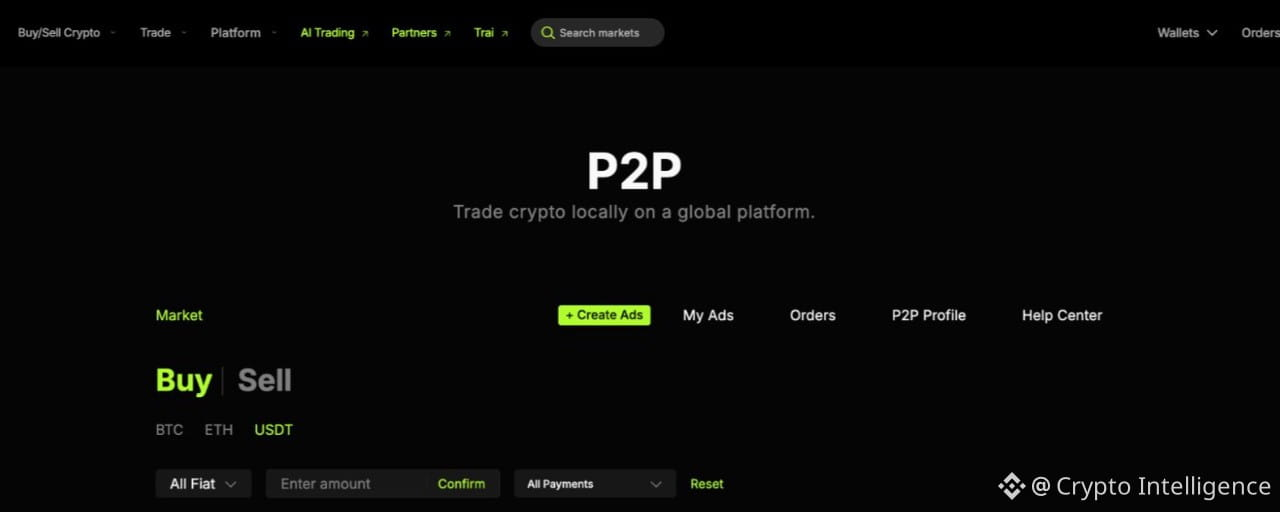
P2P on Traiex works like a board where users post their ads. Buyers look at the price, limits and payment method and check the seller’s track record. To take part, a user needs to complete KYC, turn on two-factor authentication and create a P2P nickname.
Traiex P2P marketplace showing cryptocurrency offers, prices and payment terms
When an order is opened, the platform locks the seller’s crypto in escrow. The buyer then sends fiat with the payment method agreed in the order. The seller checks their bank or payment account and releases the coins only after the money has really arrived.
So a “payment sent” mark or a screenshot of a transfer don’t prove much by themselves. Escrow protects only the crypto, and the fiat payment can be confirmed only by the seller. For cases when the buyer has paid but the money hasn’t arrived, the order has an option to ask for help and open a dispute.
How Funds Move Within Traiex
Traiex is a custodial exchange, which means it holds customer assets itself. Funds for different services are kept on separate balances. In the Wallets section, users have a Spot Wallet and a Futures Wallet. Capital for AI Trading is shown separately, in the automated trading workspace, and the card has its own balance too.
The total balance and the available balance also differ. Money tied up in orders, open positions or pending operations is shown, but can’t be used elsewhere. For example, a user with USDT on the Spot Wallet can’t pay with the card until they top the card up.
To move assets between their own wallets, for example from Spot to Futures, users have Transfer. Send to is for sending assets to another customer by their username, UID or a saved recipient. In the history both operations appear as internal records, and often they don’t have a blockchain TxID.
Selling Crypto and Withdrawing Funds
To sell crypto for fiat on Traiex, the customer first chooses the asset and the amount. After that they pick a payout currency and a provider with payout methods that work in their region. Before they confirm, the screen shows the rate, all charges, the net fiat amount and the limits. The payout goes through a provider, so it has the same stages as buying, only in reverse order.
When crypto is sold for a card or bank payout, the coins are delivered first, then converted, then the payout is processed and finally credited. So the coins can leave the account long before the money gets to the bank. And if a route works for buying in some country or currency, it doesn’t mean it will work for selling.
Withdrawing crypto is a different process. Here the user chooses the asset and a network that the recipient supports. Then they add the address, a Memo or Tag if needed, and the amount. The form shows the minimum and the fee, and also how much will actually be received. Once confirmed, the request appears in the transaction history. The TxID shows up later, when the transfer is broadcast. But the funds count as delivered only after both the network and the receiving service confirm them.
TRAIEX Card and Everyday Payments
The TRAIEX Card is a Mastercard. In supported regions it is issued both as a virtual and a physical card. In supported regions it is issued both as a virtual and a physical card. The card currency, availability and conditions depend on the program and the specific card. The card doesn’t take money. The card doesn’t take money from the trading wallets. It has a separate balance, and the user tops it up with supported assets, which are converted at the moment of top-up.
With the card, users can pay for supported purchases and, if the program allows, withdraw cash from ATMs. Both work within the program and regional limits. There are two verification levels, Standard and Extended. For Extended, the issuing bank may run an additional check.
The card top-up fee is 2%. Before confirming, users can review the source amount, conversion rate, fee and amount to be credited to the card balance. If a user pays in a currency that is not the card’s own, there may be a conversion fee of up to 1%. A completed top-up appears as a separate entry, and the available card balance changes along with it.
Trading and Other Conversion Options
On Traiex, users can place market and limit orders on the spot market across trading pairs. Futures also have margin and leverage, though the collateral for open positions can’t always be transferred out. CFDs let traders follow the prices of stocks and commodities without buying the asset itself.
Convert doesn’t use the order book. Where it’s available, it swaps one crypto asset for another based on a quoted calculation. OTC gives a separate quote with the rate and both amounts. There’s no separate OTC commission, since the cost is already included in the price.
For automated cryptocurrency trading there is AI Trading. It has two strategies, Base and Pro. Both work on spot without leverage and use capital that is set aside for them. To use them, a user needs a 365-day subscription paid upfront. If a strategy is stopped, it won’t open new trades, but the positions that are already open stay until they close. Other automation tools include DCA orders, TWAP execution and a Grid bot for futures. There is also the Traiex assistant. It can explain terms and prepare actions, but it never starts a transfer or a withdrawal on its own.
Fees Across Trading and Payment Services
The main points are collected in the current fee summary.
ServiceWhat sets the costWhere to checkSpotTrading fees: maker and taker 0.005%TerminalExpress Buy, provider salesProvider rate and feesOffer before paymentP2PAd price and any chargesOrder termsOTCCost included in the quoteQuoted amountsExternal withdrawalNetwork fee and minimumWithdrawal formTRAIEX Card2% top-up, up to 1% conversionCard formAI TradingSubscription, trading fees, platform share of positive daily resultsSelected plan
Verification, Security and Regional Rules
To open an account on Traiex, an email and a password are enough. What other account verification is needed depends on the service. For Express Buy it’s an ID check. For P2P, the user has to complete KYC, turn on two-factor authentication and create a nickname. The card has its own eligibility rules, and companies go through a separate KYB review.
For identity checks the exchange uses Sumsub, and Chainalysis and Elliptic screen crypto transactions. External transfers are monitored too, so the user may get follow-up requests. And after changing account security settings, temporary limits may apply.
The exchange doesn’t work with citizens or residents of several countries, including Russia, the United States, Canada and Belarus. In other countries some services, like P2P, provider payments or the card, may still be restricted.
What to Consider Before Using the Platform
On the Traiex crypto exchange, trading and payment services share one login. Still, a balance in the account, a payment confirmation and a completed bank payout are different records. The provider’s status and the transaction history help trace an operation, but only the receiving account shows whether the money has arrived.
FAQ
How is Express Buy different from P2P trading?
Express Buy is a purchase from a provider at its rate. In P2P, the buyer chooses another user’s offer and pays the seller directly.
Can users move funds directly from the exchange to the TRAIEX Card?
Only through a top-up. Supported assets are converted and credited to a separate card balance.
Is selling crypto for fiat the same as withdrawing crypto?
No. A sale ends with a fiat payout through a provider. A withdrawal sends crypto to a blockchain address.
Why might funds be visible but unavailable for another transaction?
They may be committed to orders, positions, strategies or pending operations. The available balance shows what can move right now.