$ASTER: Buyer Count vs Order Weight
Does a larger group of buyers always push $ASTER price higher?
A common misconception is that more buyers means a stronger bid.
The Hypothetical Mechanism
Imagine a crowd at a door. Ten tiny people may push less than one large truck. Quantity of participants does not equal total force. Volume gauges trade activity but not participant identity.
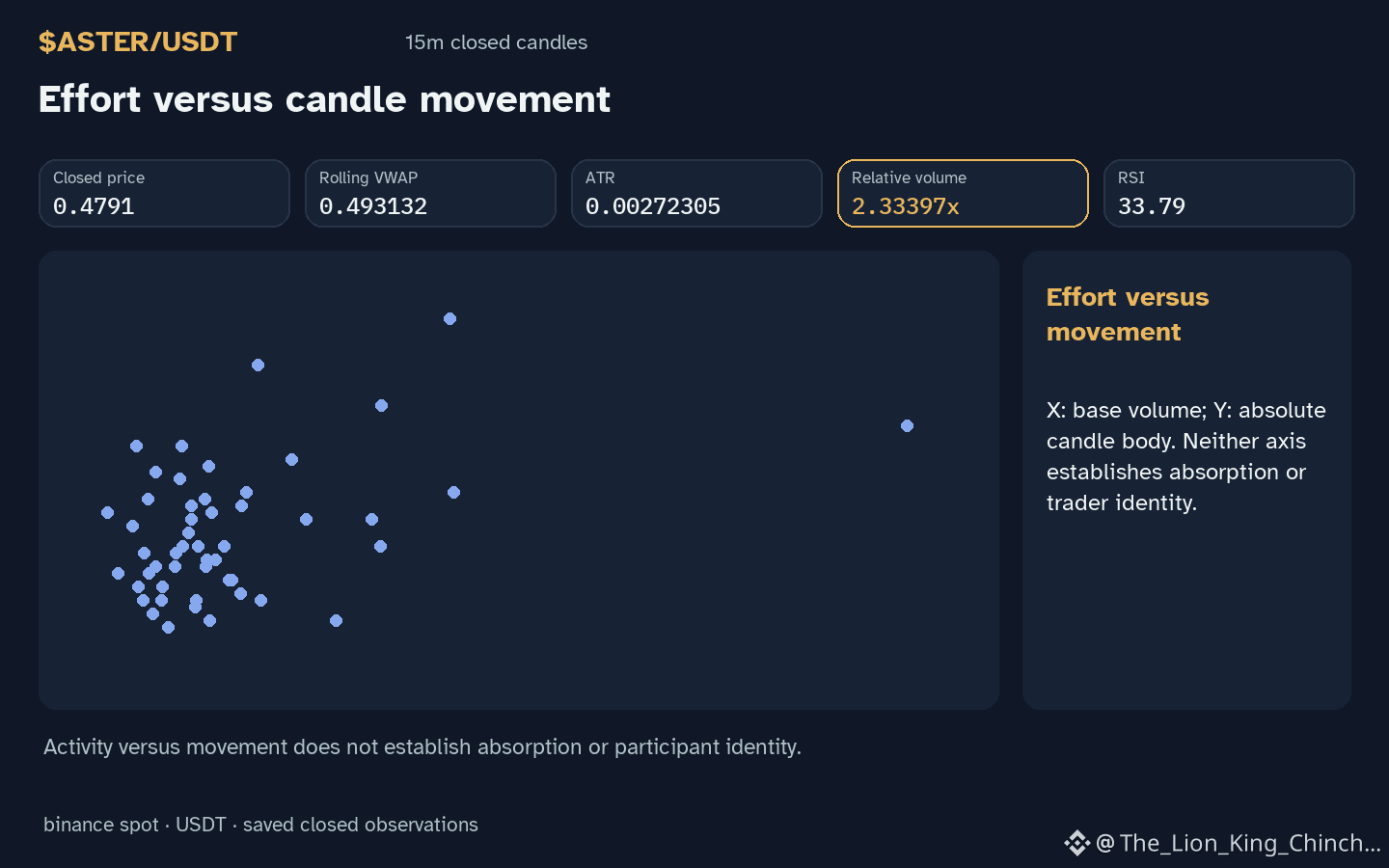
In $ASTER, the hourly direction is down while volume is above its baseline. Relative volume is 2.33x baseline. This shows active trading but not who controlled the trades.
The supplied RSI is 33.8 and the current price is 0.4791. Squeeze the metaphor. A heavy seller can execute the same share size as many smaller buyers. The bigger order moves price harder regardless of head count.
This is not a statement about real $ASTER traders. It is a thought experiment about order weight.
Where the Analogy Fails
A counterexample is a marketplace with strict limits. If everyone has the same order cap, participant count approximates force. Without that rule, one massive limit order swamps many small ones.
Self-check
Ask if the observation measures size or number. The chart does not display order splits or participant logs. Do not infer a hidden crowd from a candle.
Reassessment Condition
Interpretation breaks if future bars show steady price movement into the 0.4931 bound with the same volume pattern. That mismatch would weaken the heavy-order theory.
Probabilistic market research, not a recommendation or guaranteed return.
The comparison to keep in mind: $BTC has hourly direction down and volume above its baseline; $ATM has hourly direction down and volume above its baseline. This alone does not establish correlation.
#ASTER #BTC #ATM #CryptoLearning