

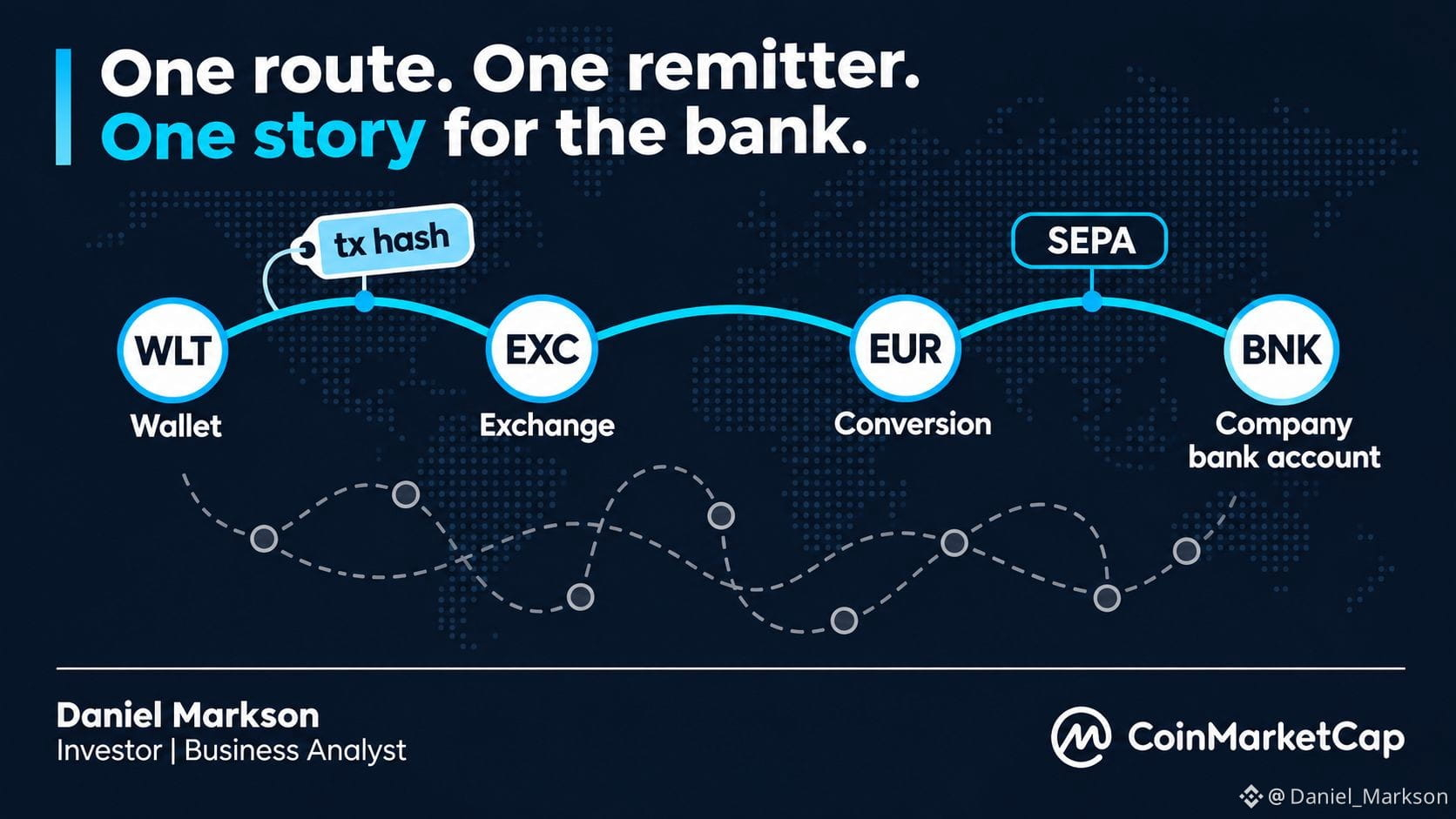
🧳 The Luggage Tag Rule: Keeping Your $BTC Transaction History Crystal Clear That letter from the bank usually shows up a few weeks after the first big transfer from a crypto platform. Short, polite, and basically asking where the money came from. I don't wait for it to land. I treat it as something that's coming and get my source-of-funds docs ready before the first big withdrawal, not after. Here's what I keep in the pack: 🔘 Exchange account statements for the period 🔘 Conversion confirmations 🔘 Withdrawal records matched to bank transactions On-chain transaction hashes for every deposit used in a conversion. And the fewer stops along the way, the less chance of losing track. That's why I prefer using one off-ramp for large transfers. If I use WhiteBIT On/Off Ramp, 90+ EUR pairs could let me convert directly to euros without swapping through another asset first. Then the fiat goes straight to the company's bank account via SEPA. And the whole document pack stays simple enough to send the same day the bank asks for it. https://institutional.whitebit.com/payments-for-businesses Think of it like a luggage tag on a connecting flight ✈️ Lose the tag, and your bag becomes just another black suitcase at lost and found. Same with crypto. Without the transaction hash, it's much harder to prove where the $BTC came from. And the fewer stops along the way, the less chance of losing track. 👇 Which document would be the hardest for you to pull together right now? Disclaimer: This is not financial or investment advice. Do your own research before making any decisions. Use at your own risk. #BTC Price Analysis# #Bitcoin Price Prediction: What is Bitcoins next move?#
Join global crypto users on Binance Square
⚡️ Get latest and useful information about crypto.
💬 Trusted by the world’s largest crypto exchange.
👍 Discover real insights from verified creators.
Email / Phone number