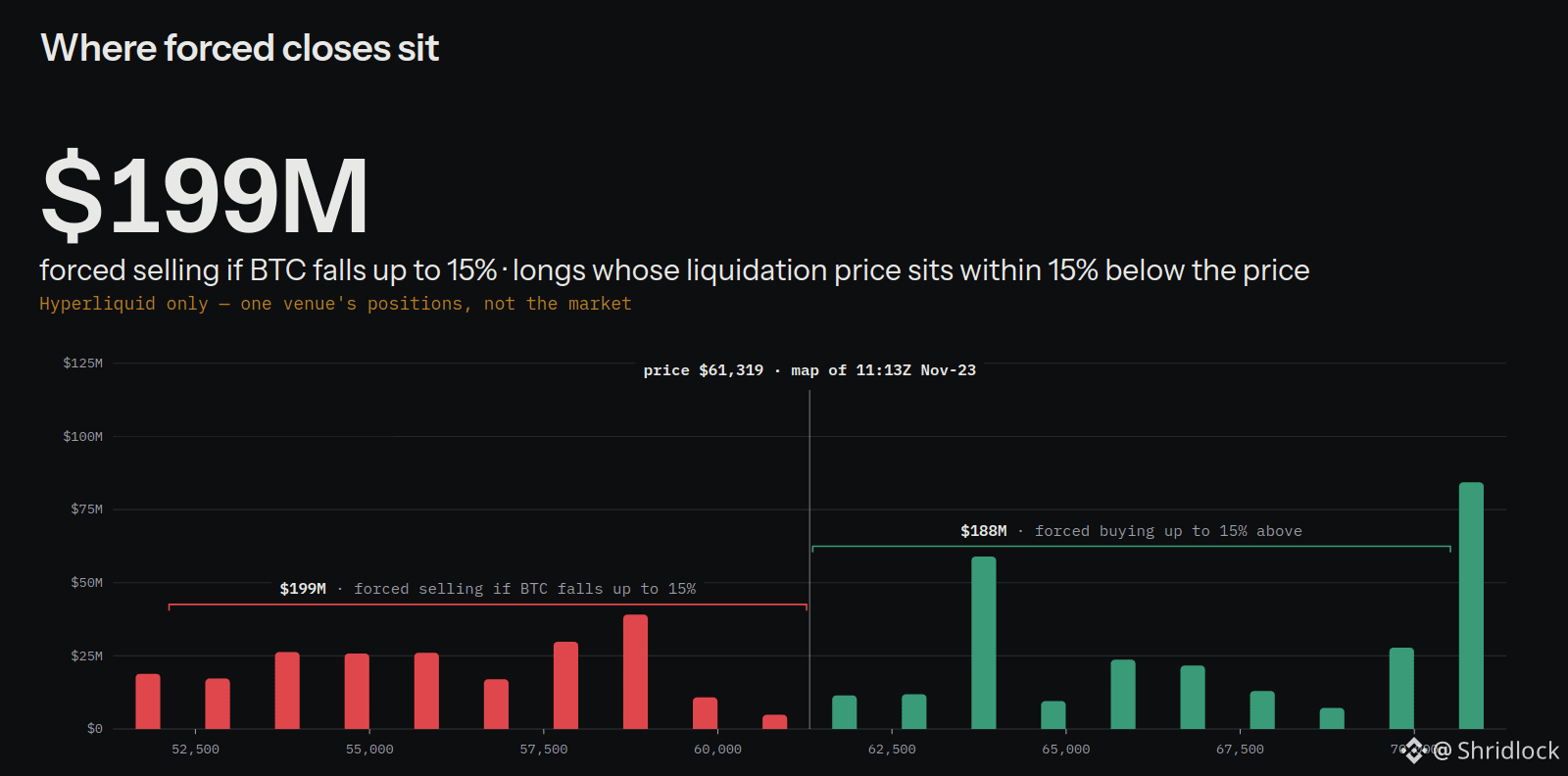
Anyone can see that 199M USD of BTC longs on Hyperliquid would be force-sold if the price falls 15% from 61,319 USD. On an offshore exchange only the exchange sees that about its users. Outsiders can only guess.
Who sees your stop and your liquidation price? Four kinds of exchange, four answers.
1. A stock exchange. Whoever keeps the orders may not reveal them to a favoured trader. In the US that wall has been law since 1934.
2. An offshore crypto exchange. It sees every order, stop and liquidation price. If its group has a trading firm, whether that firm sees them too depends on a wall you cannot inspect. In the Netflix series The Altruists, FTX promises one (ep. 4): "separate the databases and change all the passwords." Nobody outside could check it. Then FTX switches off liquidation for its sister firm Alameda (ep. 6). A firm that cannot be liquidated can keep its trade open while the price passes everyone else's liquidation prices. Hong Kong now lets a sister firm make markets on a licensed platform only behind that wall, and an outside firm must confirm the wall works. Hong Kong has licensed 13 platforms. None of the 17 exchanges where we track open BTC futures bets is among them.
3. An exchange on a public chain, like Hyperliquid. No wall, because nothing is hidden: anyone can read every position, its liquidation price and every open order, stops included. That is how we draw the map in the picture: Hyperliquid, Nov-23, 11:13 UTC, where 188M USD of shorts would be force-bought if the price rose 15%. Whoever hunts your liquidation reads it too. And Hyperliquid still has someone in charge: the validators who run it can pause the bridge and cancel a pending withdrawal.
4. An exchange that puts it in writing. Some exchanges write in the terms you accept that a firm of their own group may trade on the exchange and be on the other side of your trade. We found such terms at venues that hold 45% of the open BTC futures bets we track.
A wall by law, a wall on trust, no wall at all, or a line in the terms. Which is best for you? We don't know.