


Cardano has spent years developing its blockchain with a heavy focus on research, security, and decentralization.
Now the network is preparing for another major upgrade.
Leios is designed to increase Cardano's transaction processing capacity, with recent testing showing promising results.
But I went looking at the network's current financial activity.
And there's a gap worth discussing.
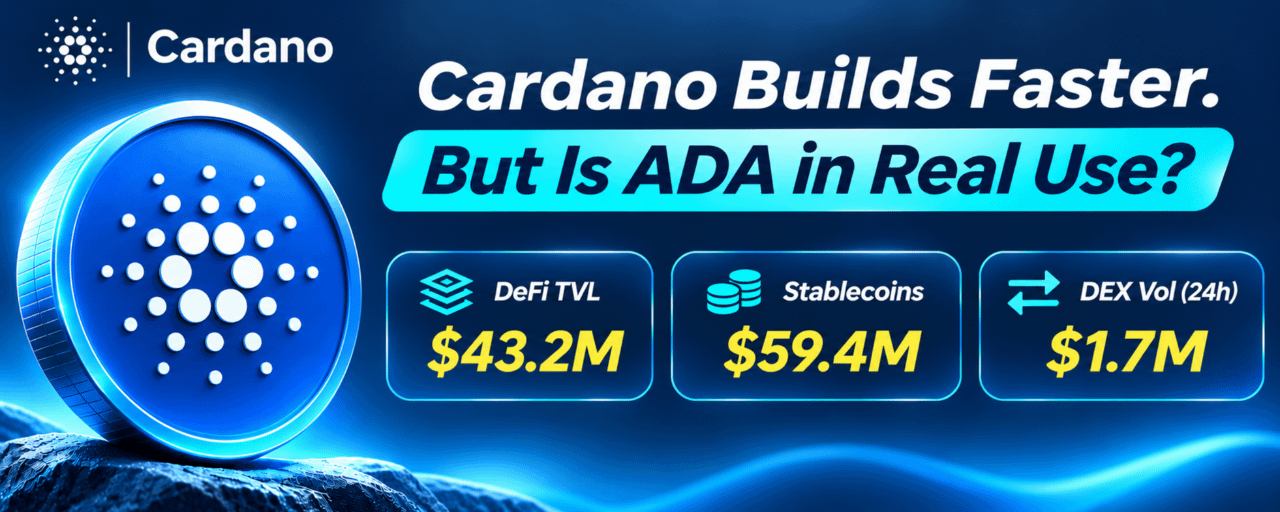
According to DeFiLlama, Cardano had approximately $43.2 million in DeFi total value locked on November 23, 2026.
Stablecoin supply stood near $59.4 million, while decentralized exchanges processed around $1.7 million in volume over the previous 24 hours.
Those aren't particularly large numbers for a blockchain that's been operating for years.
And they raise an interesting question.
If Cardano becomes significantly faster, what applications will actually need that additional capacity?
The technology itself is progressing.
Leios aims to increase throughput by changing how the network processes and endorses transaction data.
Recent development reports show continued progress on consensus implementation and testing.
But Leios isn't fully deployed on mainnet yet.
A successful prototype doesn't automatically mean production performance will match every benchmark.
There's another development I find more relevant to near-term adoption.
In February, USDCx went live on Cardano through Circle's xReserve infrastructure.
That gave users access to liquidity backed by USDC, making it easier to move dollar-denominated value into Cardano applications.
And in October, the Cardano Foundation announced that CIP-0113, a programmable token standard, had launched on mainnet.
The standard allows token issuers to define rules around transfers and other actions.
That could be useful for regulated stablecoins and tokenized financial assets.
But infrastructure availability is only the starting point.
A bank being technically able to issue a token on Cardano doesn't mean it's already processing substantial transaction volume there.
I'd want to see actual deployments, active users, and recurring financial activity.
Now consider ADA itself.
Unlike governance tokens that aren't required for everyday transactions, ADA is the native asset used for network fees, staking rewards, and certain deposits on Cardano.
That creates a direct relationship between network activity and demand for ADA.
But the relationship has limits.
Transaction fees are relatively small, and Cardano's staking rewards currently draw from both transaction fees and a reserve of ADA set aside under its monetary policy.
That reserve declines over time.
As the network matures, transaction fees will need to contribute more to the resources available for rewards and treasury funding.
This is one reason I pay attention to fee generation.
DeFiLlama recorded approximately $982 in Cardano chain fees over the latest 24-hour reporting window.
That's a small amount compared with the scale of the network.
It doesn't mean Cardano is about to run out of staking rewards. The reserve system is designed to release ADA gradually, and a single day's fees can't predict long-term sustainability.
Still, it shows how much work remains if the network wants usage-related fees to become a larger part of its economics.
Cardano also has something other chains are still working to develop: an established on-chain governance system.
ADA holders can participate in governance through delegated representatives, and the treasury can support development and infrastructure projects.
That gives the community a way to direct resources toward adoption.
But spending treasury funds doesn't guarantee that funded projects will attract users.
I'd rather measure what those investments produce.
How much new stablecoin liquidity stays on Cardano? Are DeFi applications attracting borrowers and traders? Will Leios support activity that generates meaningful fees?
Cardano has already spent years proving it can keep building.
The next thing I'd like to see is stronger evidence that people are using what it builds.
