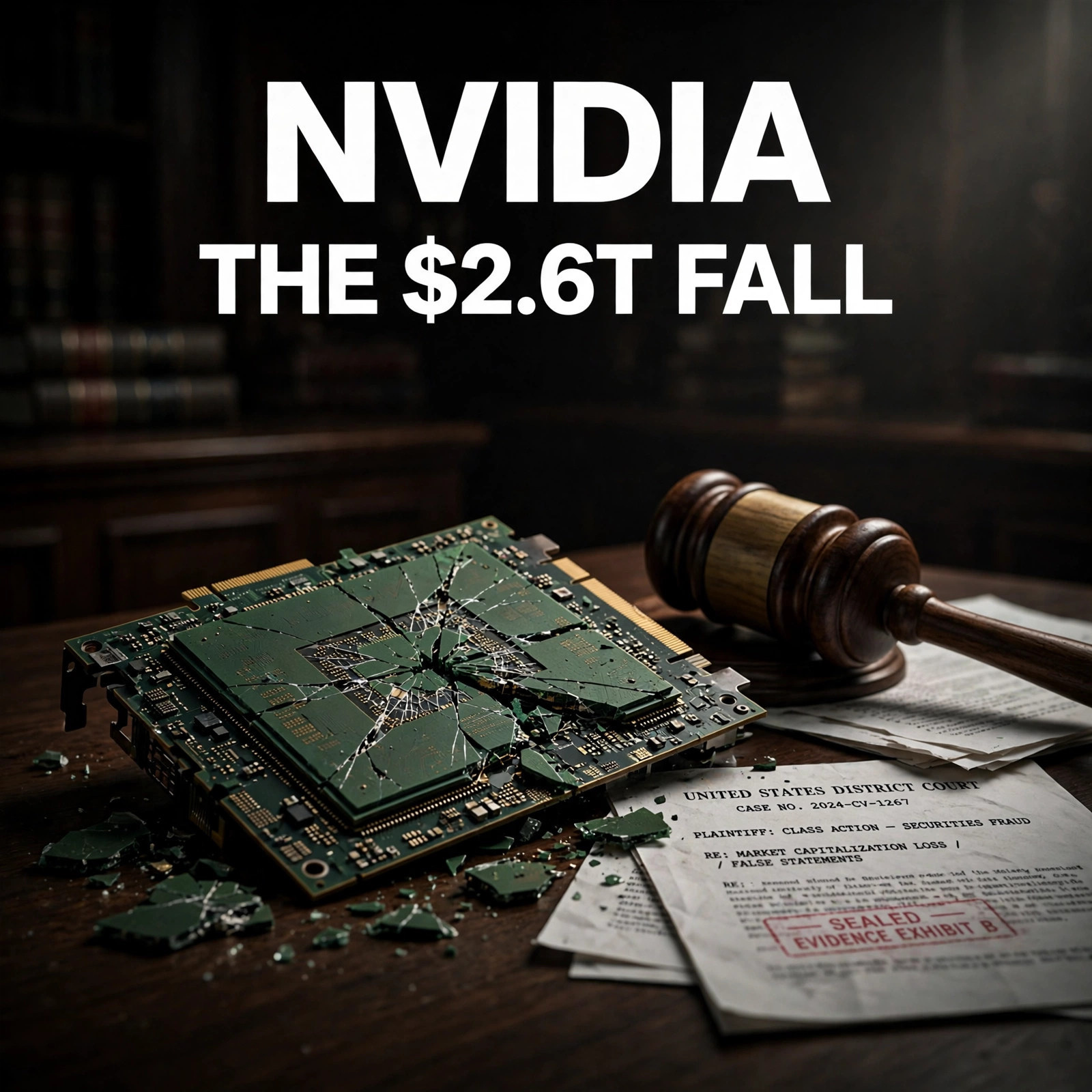

Nvidia: Record Quarter, SEC Probe, and a $2.6 Trillion Fall
Nvidia has just lived through the strangest month in its history. On 17 November it reported the biggest quarter ever posted by a chipmaker. Three days later its stock crashed 14% in a single session to a 52-week low. In seven weeks it has lost about $2.6 trillion of market value — more than the entire value of most companies on earth.
This is what happened, in order, and what is still to come.
1. The numbers that didn't save it
Nvidia's fiscal third quarter (August to October 2026) was, on paper, extraordinary. Revenue reached $115.8 billion, up 103% year over year, beating Wall Street's $109.33 billion estimate by about $6.5 billion. Adjusted earnings per share were $2.68 against $2.47 expected. Data centre revenue — the heart of the AI business — hit $107.6 billion, up 110% and about 93% of all sales. The company guided fourth-quarter revenue to about $130 billion, above the $125.2 billion consensus, and approved another $150 billion in share buybacks. Its next-generation Vera Rubin platform generated about $20 billion in its first quarter of production shipments, against $11 billion for Blackwell's first quarter.
The market's answer: shares rose about 2% after hours, fell 3.3% the next day, then plunged 14.01% on Friday 20 November to close at $125.53. The numbers were never the problem. Trust was.
2. The probe
The Wall Street Journal first reported on 17 November that the SEC was investigating Nvidia. On 20 November, Reuters reported — citing two people briefed on the matter — that enforcement staff are examining potential accounting issues, the first time the probe has been reported to focus on accounting. The New York Times reported on Saturday that the inquiry is in its early stages. The SEC has declined to comment, and Nvidia has not commented on the Reuters report.
What is actually being examined is not yet public. One possibility raised in reporting is how Nvidia reports revenue by geography — in fiscal 2026 it recorded $19.7 billion in revenue from customers headquartered in China. That is a possibility, not an established fact. What is established: an investigation is not a finding. No charges have been announced, and many such inquiries close without penalties.
3. The leadership crisis
The probe landed on a company already in crisis. Founder and CEO Jensen Huang resigned on 12 November, ending a 33-year run, after the board investigated his personal conduct. CFO Colette Kress is interim CEO, and the board has ruled out Huang's return, hiring executive search firm Heidrick & Struggles to find a permanent successor. The board has also retained law firm Wachtell as counsel.
Huang has now agreed to testify in public before the US Senate on 3 December, at the request of Banking Committee chair Tim Scott, with Commerce Secretary Howard Lutnick testifying too. He has also agreed to a closed-door interview with three House committees on 1 December — his first testimony since resigning.
The legal pressure does not stop there. California's attorney general served Nvidia with an investigative subpoena on 19 November, examining whether advanced chips reached China and whether investors were misled. The Justice Department is reviewing Nvidia's $12.9 billion acquisition of Hugging Face. Treasury Secretary Scott Bessent has given the board ten days to answer whether questionable sales inflated earnings. A proposed shareholder class action was filed on 9 November in federal court in San Jose.
4. The market
Friday 20 November was Nvidia's seventh straight day of declines and its seventh consecutive weekly loss — a streak not seen since 2008, and its worst week since 2008. Its worst single day since January 2025. Over the seven weeks the stock has fallen 46%, and about $2.6 trillion of market value has gone. At the close on 11 November, the day before Huang's resignation was announced, Nvidia was worth $4.19 trillion; by Friday it had lost $1.04 trillion of that. It is now worth about $3 trillion, the fourth most valuable company in America after Apple, Microsoft and Alphabet.
The sell-off spread. AMD fell 13% and Micron 14% on Friday. The Nasdaq fell 5.3%, the S&P 500 fell 3.7% into a correction, and the PHLX semiconductor index fell 10.7%.
5. What happens next
Three dates now matter. Nvidia's GTC Washington conference runs 30 November to 3 December. Huang's House interview is 1 December and his public Senate testimony is 3 December. And the delayed quarterly 10-Q filing is due around 4 December — interim CEO Kress said it will be filed in the coming weeks, and UBS says management linked the delay to the investigation.
Record revenue, record buybacks, and a 52-week low in the same week. The market is no longer pricing Nvidia's numbers. It is pricing whether those numbers can be trusted — and the next three weeks will decide that question ❓