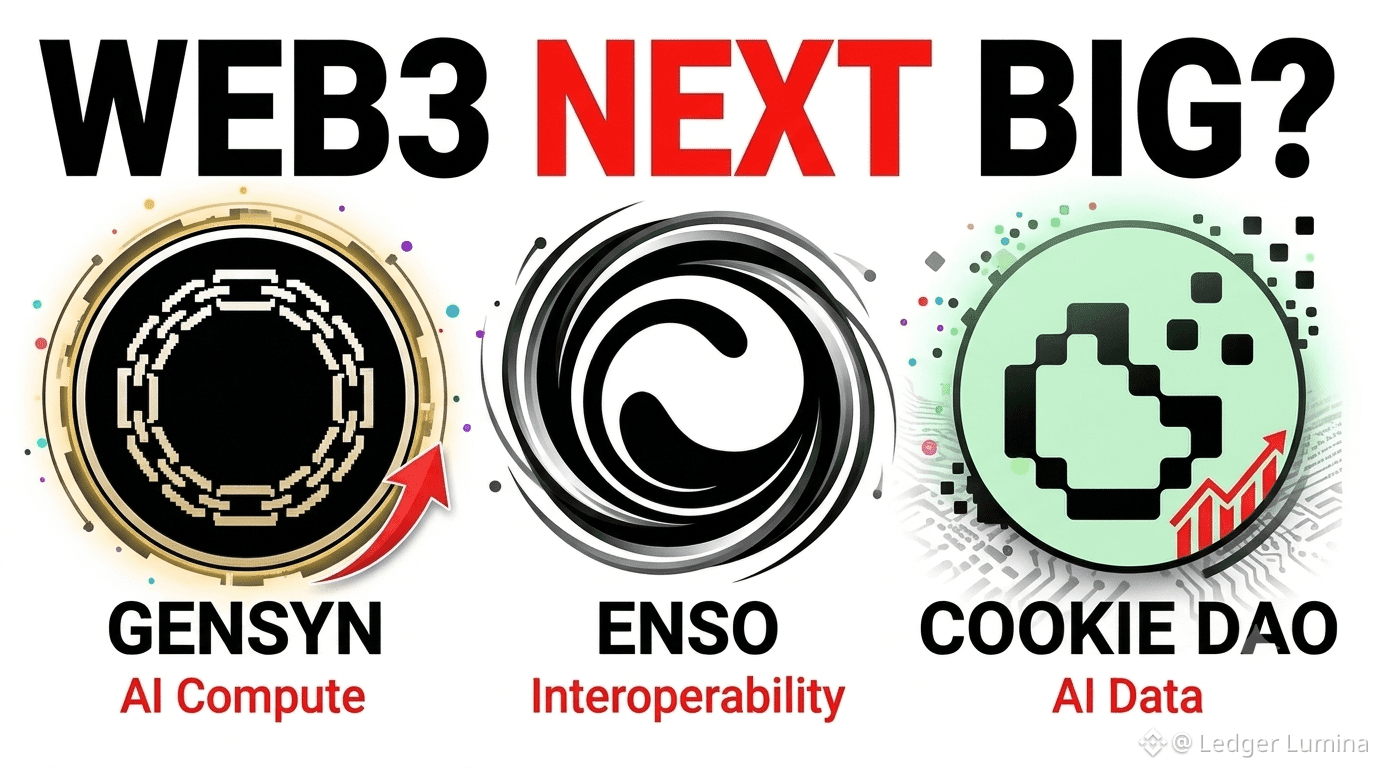
The Trifecta of Next-Gen Web3 Infrastructure:
Compute, Execution, and Intelligence
As the cryptocurrency landscape matures, the market is shifting away from isolated, single-purpose blockchains toward an interconnected, intelligent ecosystem. At the center of this evolution are three critical bottlenecks: the high cost of AI computation, the complexity of multi-chain user experiences, and the fragmentation of real-time market data.
Three emerging infrastructure protocols—Gensyn, Enso, and Cookie DAO—are tackling these foundational challenges head-on, forming the core pillars of a smarter.
1. $AIGENSYN : Democratizing AI Compute
Artificial intelligence relies heavily on massive computational power, a resource currently monopolized by centralized cloud giants like AWS and Google Cloud. This centralization creates steep costs, hardware bottlenecks, and strict gatekeeping for developers.
Gensyn addresses this by building a Layer-1, trustless protocol that turns spare global hardware into a decentralized AI supercomputer.
How it works: The network connects anyone possessing idle GPUs or CPUs ("Solvers") directly with machine learning engineers who need power for training and inference.
Trustless Verification: Rather than forcing every node to re-run massive datasets to verify accuracy, Gensyn uses probabilistic cryptographic proofs and game-theoretic incentives—relying on Verifiers and Whistleblowers—to audit computations efficiently.
The Impact: By lowering barriers to entry with features like gasless transactions and seedless onboarding, Gensyn transforms compute into an open, globally tradable commodity, ensuring the future of AI remains accessible.
2. $ENSO : Frictionless Cross-Chain Execution
For years, Web3 adoption has been slowed down by fragmentation. Developers have had to spend months manually integrating and auditing smart contracts across dozens of disparate blockchains, while users face clunky, multi-step bridging and swapping processes.
#LearnWithLedgerLumina #ENSO #AIGENSYN