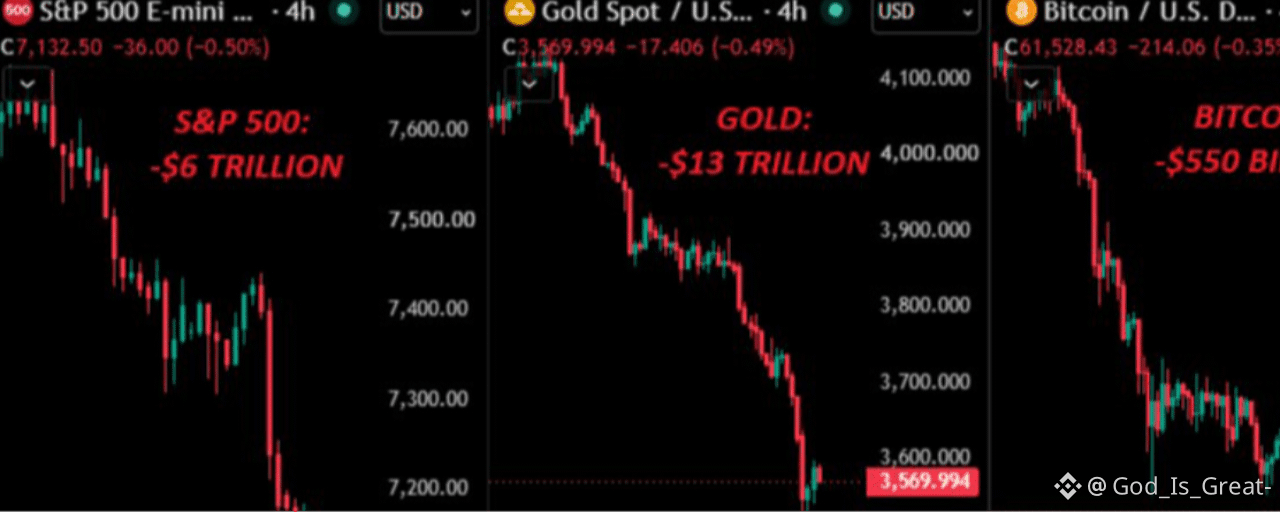

The US stock market is facing one of its most challenging periods in recent years. American stocks have lost an average of approximately $225 billion in market value every trading session for 31 consecutive sessions. Since the S&P 500 reached its latest record high on October 6, the market has erased nearly $6 trillion in value.
However, according to a new analysis from The Kobeissi Letter, the current selloff may represent a normal market correction rather than the collapse of an AI investment bubble.
Several major factors are contributing to the decline, including massive technology spending, political uncertainty, Federal Reserve policy, geopolitical tensions, and weakening investor confidence.
1. Massive AI Spending Raises Investor Concerns
One of the biggest concerns surrounding the current market correction is the enormous amount of money major technology companies are investing in artificial intelligence infrastructure.
Amazon, Alphabet, Meta, and Microsoft increased their combined capital expenditure by $36.9 billion during the third quarter, reaching a record $201.9 billion.
This represents more than double the spending recorded during the same period last year and a 356% increase since the first quarter of 2024.
Over the past three years, major technology companies have invested approximately $1.6 trillion in infrastructure and AI development.
While these investments demonstrate confidence in the future of artificial intelligence, investors are increasingly asking an important question:
When will these massive investments generate meaningful financial returns?
The concern is not necessarily that AI technology will fail, but that companies may be spending faster than their revenue and profits can justify.
2. Corporate Earnings Remain Surprisingly Strong
Despite the market downturn, corporate earnings have not shown the same weakness as stock prices.
According to the report, S&P 500 companies delivered 31.9% year-over-year earnings-per-share growth in the third quarter, representing the strongest growth in at least four years.
Companies have also exceeded earnings expectations for 13 consecutive quarters.
This creates an interesting situation: stock valuations are declining even as corporate earnings remain strong.
Historically, strong earnings can provide support during market corrections because investors eventually reconsider companies with solid financial performance.
However, strong earnings alone do not guarantee an immediate market recovery.
3. Political Uncertainty Creates Additional Pressure
Political developments are another factor influencing investor sentiment.
The Kobeissi Letter argues that the Democratic victories in the midterm elections weakened what it describes as the "Trump Put" — the market assumption that President Donald Trump would intervene politically or economically to support markets during periods of significant weakness.
Investors are also concerned about potential AI regulations under a Democratic-controlled government beginning in January 2027.
Some market participants fear that aggressive restrictions could slow the development of major American AI companies.
However, the report considers these concerns potentially exaggerated.
A major US restriction on artificial intelligence could give China a competitive advantage in the global AI race, making an outright ban economically and strategically difficult.
4. Federal Reserve Policy and Geopolitical Risks
Monetary policy is adding another layer of uncertainty.
Federal Reserve Chair Warsh has emphasized the importance of bringing inflation back toward the central bank's 2% target.
US inflation has reportedly remained above that target for 67 consecutive months.
At the same time, the ongoing Iran conflict is creating geopolitical uncertainty and potentially increasing pressure on energy markets and global economic conditions.
Higher interest rates can make borrowing more expensive, reduce corporate investment incentives, and place pressure on stock valuations.
The bond market is also attracting attention.
Investment-grade corporate bond issuance is expected to reach approximately $175 billion in November, representing a 27% increase compared with the same month last year.
That would make it a record November for investment-grade bond sales.
5. Anthropic's IPO Adds to Liquidity Concerns
Another unusual factor is the enormous demand surrounding Anthropic's IPO.
According to the report, institutional demand reached approximately $400 billion, while retail orders reached $100 billion.
Combined demand approached $500 billion, nearly eight times the company's initial $64.4 billion fundraising target at $78 per share.
Such enormous demand highlights how much capital investors are willing to allocate toward major AI opportunities.
However, during a period of market stress, large capital commitments and competing investment opportunities can create additional liquidity pressures across financial markets.
6. Nvidia and AMD Become Major Sources of Market Uncertainty
Semiconductor stocks are also facing significant pressure.
Nvidia has reportedly experienced a dramatic decline, while uncertainty surrounding the company's leadership and future expectations has intensified market concerns.
A November 19 short-seller report also accused AMD of smuggling chips into China. However, these allegations remain unsubstantiated based on the information presented in the report.
The broader technology sector is experiencing a major valuation reset.
According to The Kobeissi Letter, technology stocks' forward price-to-earnings ratio has fallen to its lowest level since March 2020.
Nvidia's reported valuation has also compressed significantly, reflecting investors' growing skepticism about future earnings expectations.
The central issue is whether AI-related revenue growth can justify the enormous valuations and investment commitments that have accumulated across the technology sector.
7. Market Fear Reaches Extreme Levels
Several market indicators suggest that investor confidence has deteriorated considerably.
The VIX volatility index has increased more than 100% from its October low.
On November 5, the VIX recorded its largest one-day increase since February 2018.
Hedge funds experienced their largest six-week net outflow from technology stocks in more than a decade.
Investors are increasingly reducing exposure to high-growth technology companies.
These developments indicate that institutional investors are becoming more defensive.
However, extreme fear does not automatically mean the market has reached its bottom. Volatility can remain elevated, and further selling pressure is possible.
8. Is a 30% Stock Market Crash Coming?
Despite the significant decline, The Kobeissi Letter argues that the current situation should be viewed as a correction rather than the beginning of a major financial collapse.
The analysis suggests that even another 10% decline could remain within the historical range of a healthy market correction.
It also challenges predictions of a 30% or larger market crash.
Several negative factors are already influencing market prices, including:
Higher interest rates.
Aggressive AI regulation concerns.
Questions about AI investment returns.
Geopolitical uncertainty.
Weakening institutional sentiment.
Uncertainty surrounding major technology companies.
If these concerns are already reflected in valuations, any improvement in economic conditions or corporate earnings could create positive surprises.
9. What Could Happen Next?
The next phase of the market will likely depend on liquidity, interest rates, corporate earnings, and investor confidence.
Bullish Scenario:
If inflation begins to decline, financial conditions improve, and AI companies demonstrate stronger returns on their investments, investors could gradually return to technology stocks.
Quality companies with strong balance sheets and sustainable earnings growth may attract significant buying interest.
Bearish Scenario:
If interest rates remain elevated, geopolitical tensions intensify, and AI investments fail to generate expected returns, selling pressure could continue.
Further institutional outflows may also increase volatility and push stock valuations lower.
Neutral Scenario:
The market could enter an extended consolidation period as investors wait for clearer signals from the Federal Reserve, corporate earnings, and the global economy.
Final Thoughts
The loss of nearly $6 trillion in US stock market value is significant, but it does not automatically mean the AI boom is over.
The current correction reflects a combination of expensive technology investments, changing political expectations, monetary policy uncertainty, geopolitical risks, and declining investor confidence.
Interestingly, corporate earnings remain strong despite the market weakness.
The key question is no longer simply whether artificial intelligence will transform the global economy. It is whether the enormous investments being made today will generate enough profits to justify their costs.
If liquidity returns and major technology companies continue delivering strong earnings, the market could eventually recover.
For now, investors should remain cautious, monitor key economic indicators, avoid emotional decisions, and focus on companies with strong fundamentals.
The next major market opportunity may emerge when fear begins to fade — but timing the bottom remains extremely difficult.
Disclaimer: This article is for informational and educational purposes only. It is not financial advice. Always conduct your own research (DYOR) and manage your risk before making investment decisions.
#USStockMarket #SP500 #NVIDIA #artificialintelligence #marketcrash