Eight days ago $BARD ripped from $0.0801 to $0.1430 in a single hour. Then it spent five days giving the whole thing back.
After the Nov 12 blast it closed under $0.12 on Nov 14, then bled all the way to $0.0837 — a hair above its $0.0804 all-time low. Yesterday it sat flat between $0.084 and $0.087 all day, on hourly bars of $11k to $49k. Nobody was watching.
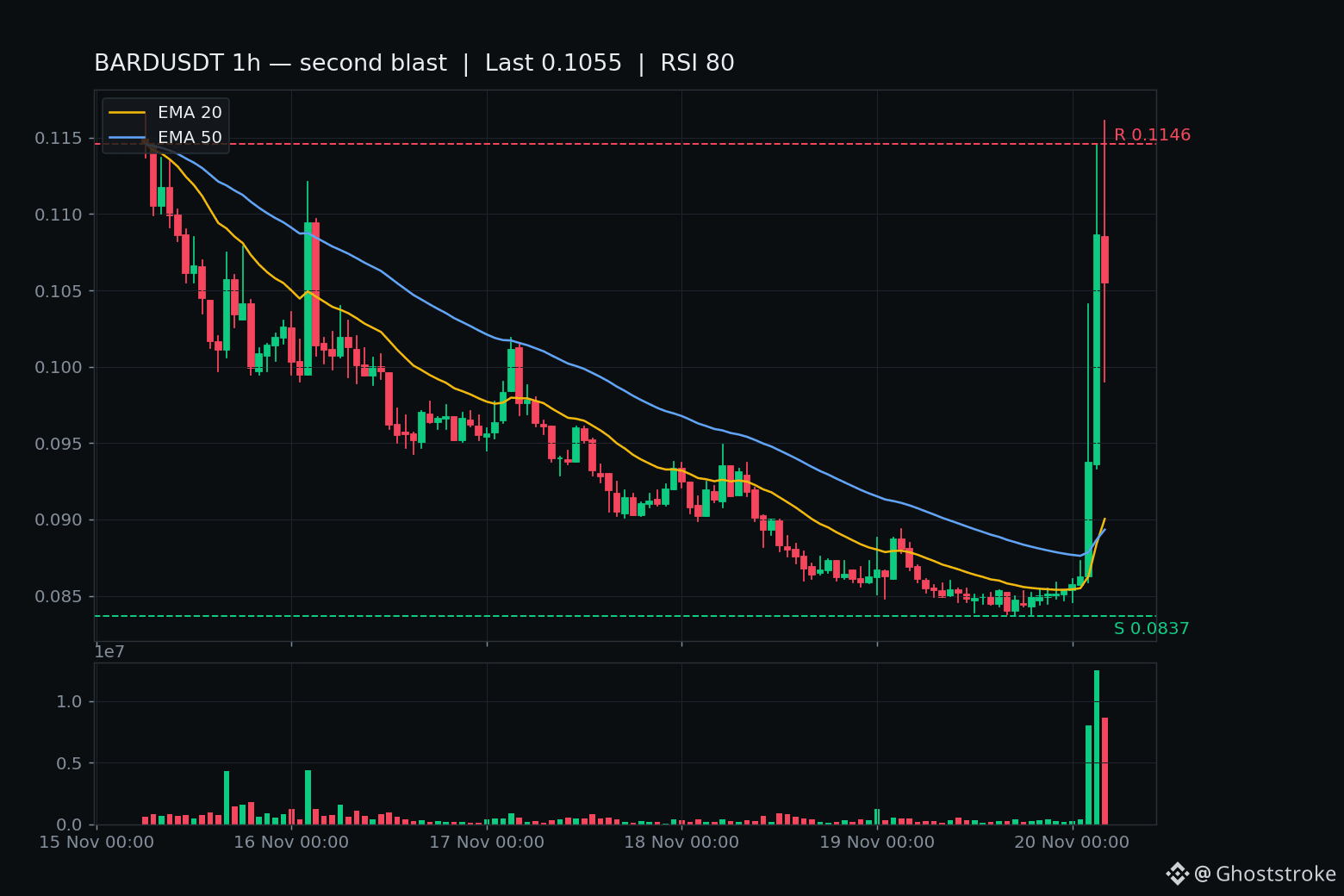
This morning someone came back. 02:00 UTC: $0.0863 to $0.0937 on 8 million tokens, about 30x a normal BARD hour. 03:00 UTC: tagged $0.1146, closed $0.1086 on 12.5 million — the biggest bar of the week. 04:00 UTC: tagged $0.1161, closed $0.1055. Live now $0.1080, up 25% on the day, $3.9 million Binance volume in 24 hours.
The chart is screaming hot: 1h RSI 80, price way above EMA20 $0.0900 and EMA50 $0.0893. CoinGecko has it at rank #419, $45.4 million market cap, 419 million of 1 billion tokens out — 42% circulating, the rest still overhead. It's 93.6% below its $1.70 all-time high, and down 13.8% on the week even after this morning. The move is hours old, not a trend.
No verified catalyst. The newest real headlines are Nov 13 pieces about Aave collateral uncertainty — nothing timed to this morning. This is flow, not news.
And the warning writes itself: the first blast died exactly like this. The Nov 12 morning spike flushed inside the hour, and the whole $0.1430 top unwound in two days. Lose $0.0937 — the 02:00 close — and it's back to the $0.0837 shelf fast. Below that, there's nothing until a new all-time low. The other way, $0.1146 is the ceiling to beat on a close, and $0.12 is the line that ended the last attempt.
The 06:00 UTC close (11:30 IST) decides the next chapter: above $0.1146, the second attempt is real. Under $0.0937, it's the same script, second showing.
Not a call. A warning label with numbers.
Second attempt, or same script — which one are you betting on?