

#IsAnthropic’s$1.5TMarketCapJustified?
A $1.5 trillion valuation isn't something I'd accept just because a company is building impressive AI products. I've watched enough market cycles to know how quickly investors can get carried away when a new industry starts attracting serious money. First comes the excitement, then the funding announcements, and eventually someone has to explain how all that spending turns into actual profit. That's the question I'd be asking about Anthropic.
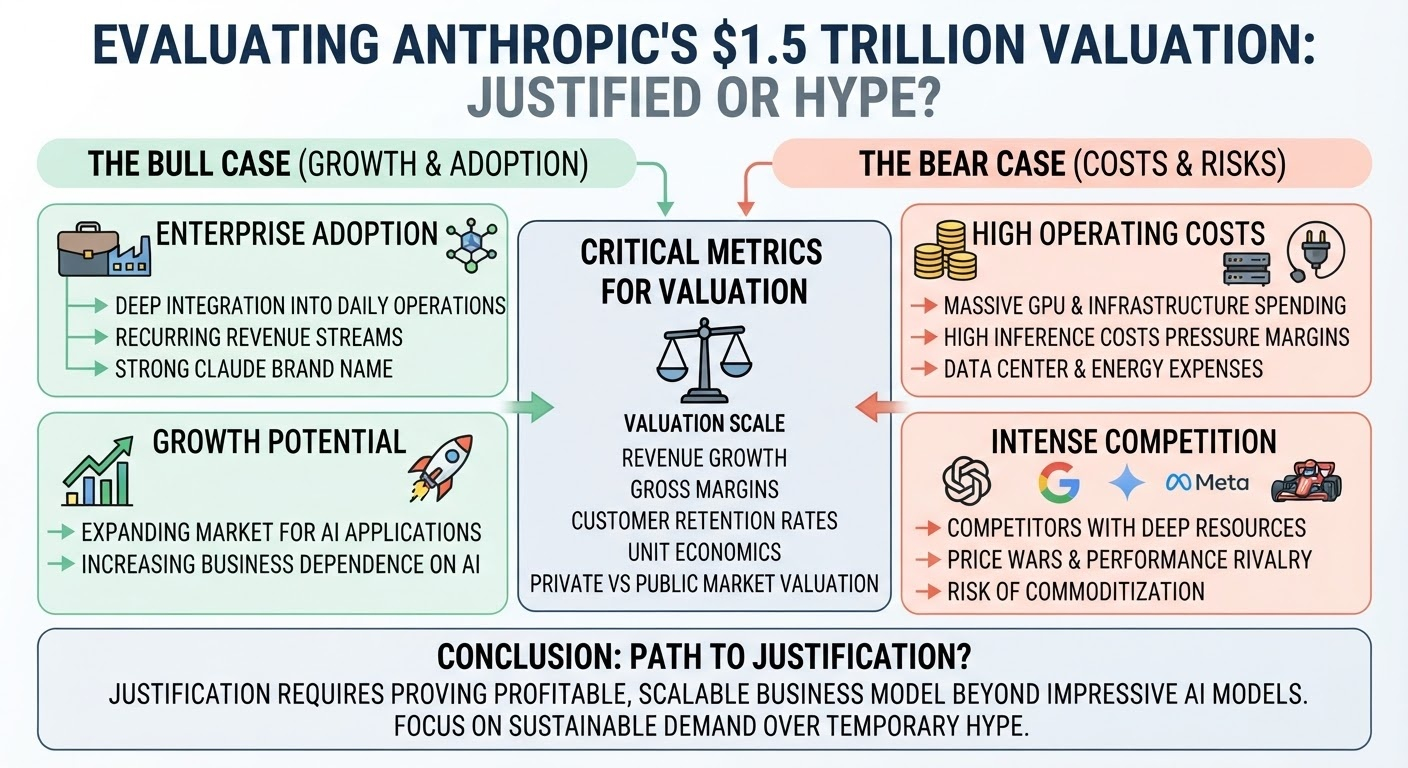
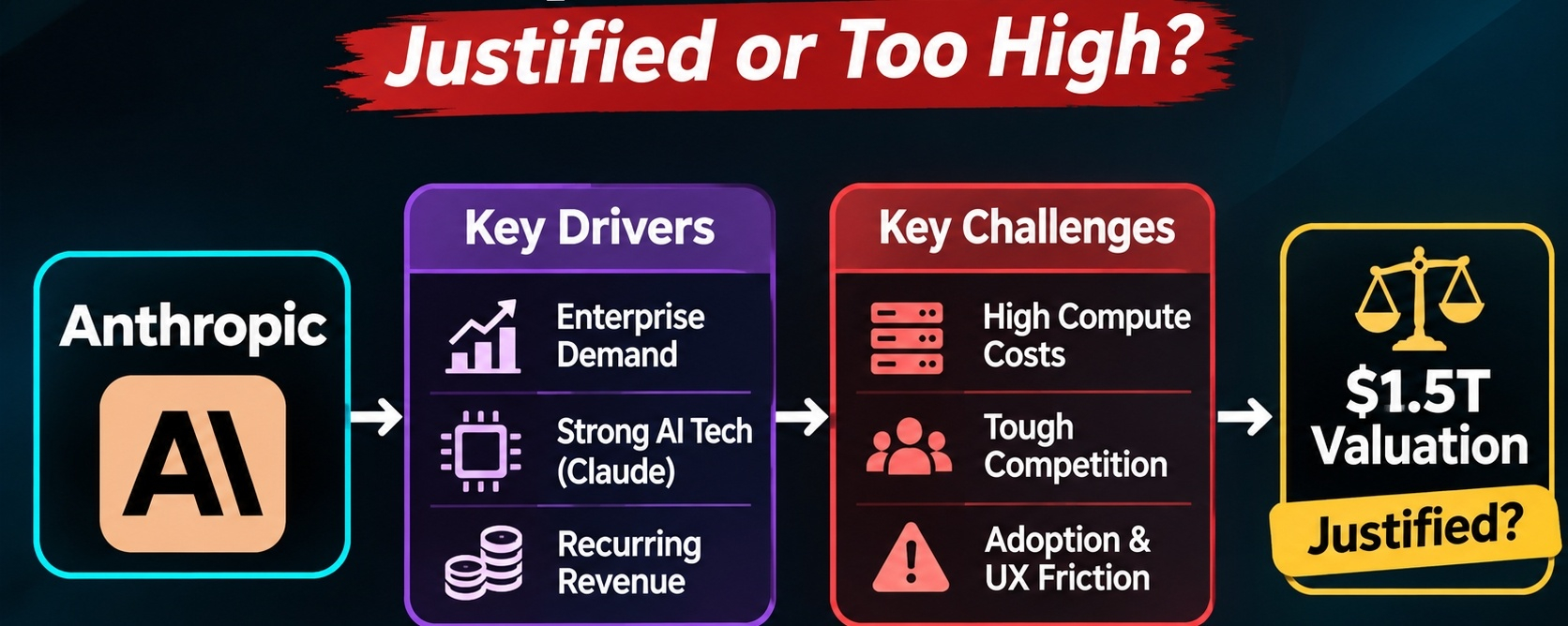
There's no denying that Claude has become a serious name in AI. Businesses are using it for coding, research, automation and internal operations. This isn't just people opening a chatbot, asking a few random questions and forgetting about it the next day. Enterprise adoption matters because companies can become recurring customers, particularly when AI gets integrated into their daily operations. If employees start depending on these tools to get their work done, there's a real opportunity to build a profitable business around them.
But I've got a problem with treating adoption as proof of financial success. Running powerful AI models costs a fortune. GPUs, computing capacity, data centres and electricity all add up, and inference costs can put real pressure on margins as usage grows. More customers sound great until you look at what it costs to serve them. A company can report impressive growth while spending enormous amounts of capital just to keep its infrastructure running (something investors shouldn't brush aside when discussing trillion-dollar valuations).
Competition makes the calculation even harder. OpenAI, Google and Meta have the resources to keep pushing their own models, improving performance and competing on price. Anthropic might have an advantage in certain areas today, but that doesn't guarantee customers will stick around forever. Enterprise buyers care about performance, security, API reliability and integration costs. If another provider delivers similar results for less money, switching becomes a very realistic option.
There's a practical side to AI adoption that doesn't get much attention in valuation discussions. Getting a model into a company's existing systems can be a headache. Developers have to deal with API limitations, documentation, security requirements and compatibility issues. Then there's the user experience. If the product creates too much friction, employees won't use it consistently, regardless of how impressive the underlying model looks. I've seen similar problems across crypto projects, where teams spend heavily on development but underestimate wallet connections, gas fees and basic usability. A technically strong product still needs people who actually want to use it.
I'd also pay attention to customer retention rather than just headline adoption numbers. Are businesses paying for Claude because it's delivering measurable value, or are they experimenting with multiple AI providers while budgets are available? There's a big difference between a customer signing up and a customer renewing a contract year after year. The same principle applies to crypto: temporary activity driven by incentives doesn't tell you much about sustainable demand. You need to see whether users return when the rewards disappear.
The financial details matter even more at this valuation. Revenue growth, gross margins, infrastructure spending, capital requirements and customer concentration would all be on my checklist. I'd also want clarity around the actual valuation being discussed. Anthropic is a private company, so a reported private-market valuation isn't automatically equivalent to a public-market capitalization. Funding rounds and secondary transactions can produce headline numbers that don't necessarily reflect what the entire business would command in an open market.
Could Anthropic eventually justify $1.5 trillion? It's possible, particularly if AI becomes deeply embedded in business operations and the company manages to turn its technology into a durable, profitable service. But that's a future scenario, not something I'd treat as established fact today.
My approach would be simple: watch the financial performance, customer renewals and margins before buying into the valuation story. Impressive models are worth paying attention to, but I'd want to see the business economics before calling Anthropic a $1.5 trillion company.