
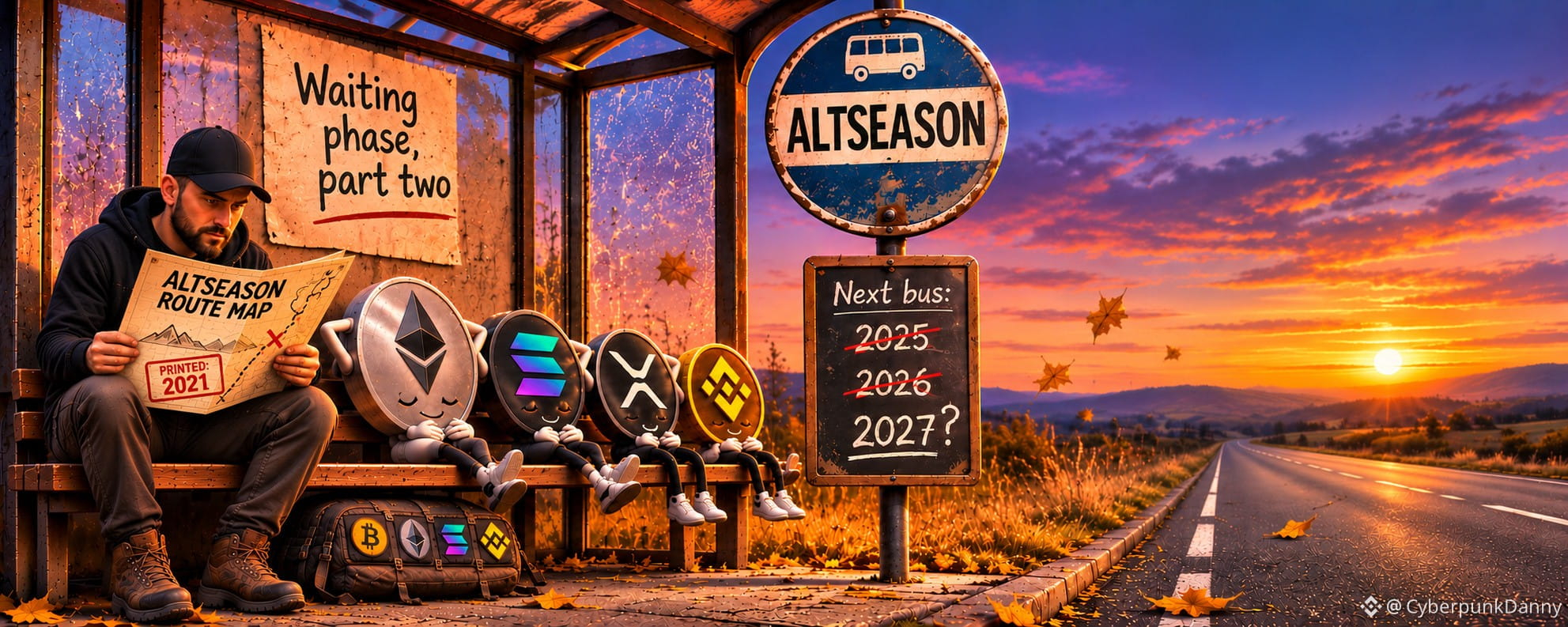

Every time Bitcoin crashes, someone on my timeline announces that altseason is just around the corner. I've been waiting at that corner for about three years now.
This week the theory is back. Bitcoin wicked down into the low $60Ks, the market is bleeding, and a few voices are saying this is exactly the moment money will rotate into altcoins. The bigger the dump, the bigger the altseason. Sounds beautiful.
I wanted to believe it. My bags needed it even more. Instead of just hoping, I went looking for who is saying it, what the data shows, and whether we've heard this story before.
Spoiler: we have.
The Theory: "Bitcoin Dumps, Then Alts Pump"
The idea goes like this. Bitcoin drops, people sell into stablecoins, the stablecoins sit and wait, and then that money rotates into altcoins. On-chain analyst Joao Wedson describes it as Bitcoin moving first and altcoins following afterward, with big players rotating capital from BTC to alts and back again.
Here's what the altseason theory often leaves out: money moving into stablecoins doesn't guarantee it will return to altcoins. Some investors may buy Bitcoin again. Others may stay in cash or leave crypto entirely. Rotation is a possibility, not a promise.
And to be fair, there was a moment this month when it looked real. Right after the US midterm elections, ETH jumped over 5% to around $2,400 while Bitcoin rose 3% to $80,000. Some analysts said the time for altseason had finally arrived.
That was about two weeks ago. Bitcoin is now some $15K lower. The altseason lasted roughly as long as my discipline after a green candle.
The Plot Twist: We Heard This Exact Story Last Year
Here's the part that made me laugh, and then made me a bit uncomfortable.
In November 2025, during that crash, the same theory was everywhere. One popular analyst said money was rotating into stablecoins to prepare for altseason: Bitcoin dumps, money goes to stables, stables wait, then rotate to alts. "We're in the waiting phase." Another wrote that every week another indicator pointed to a massive alts rally, but that it looked like we'd only get it in 2026.
Well, it's November 2026. I'm still in the waiting phase. All my alts are in the starting gate, ready to go. Honestly, at this point the waiting phase has better staying power than most altcoins.
Same month, same crash, same promise, one year later. That's not analysis anymore. That's a tradition.
What the Data Actually Shows
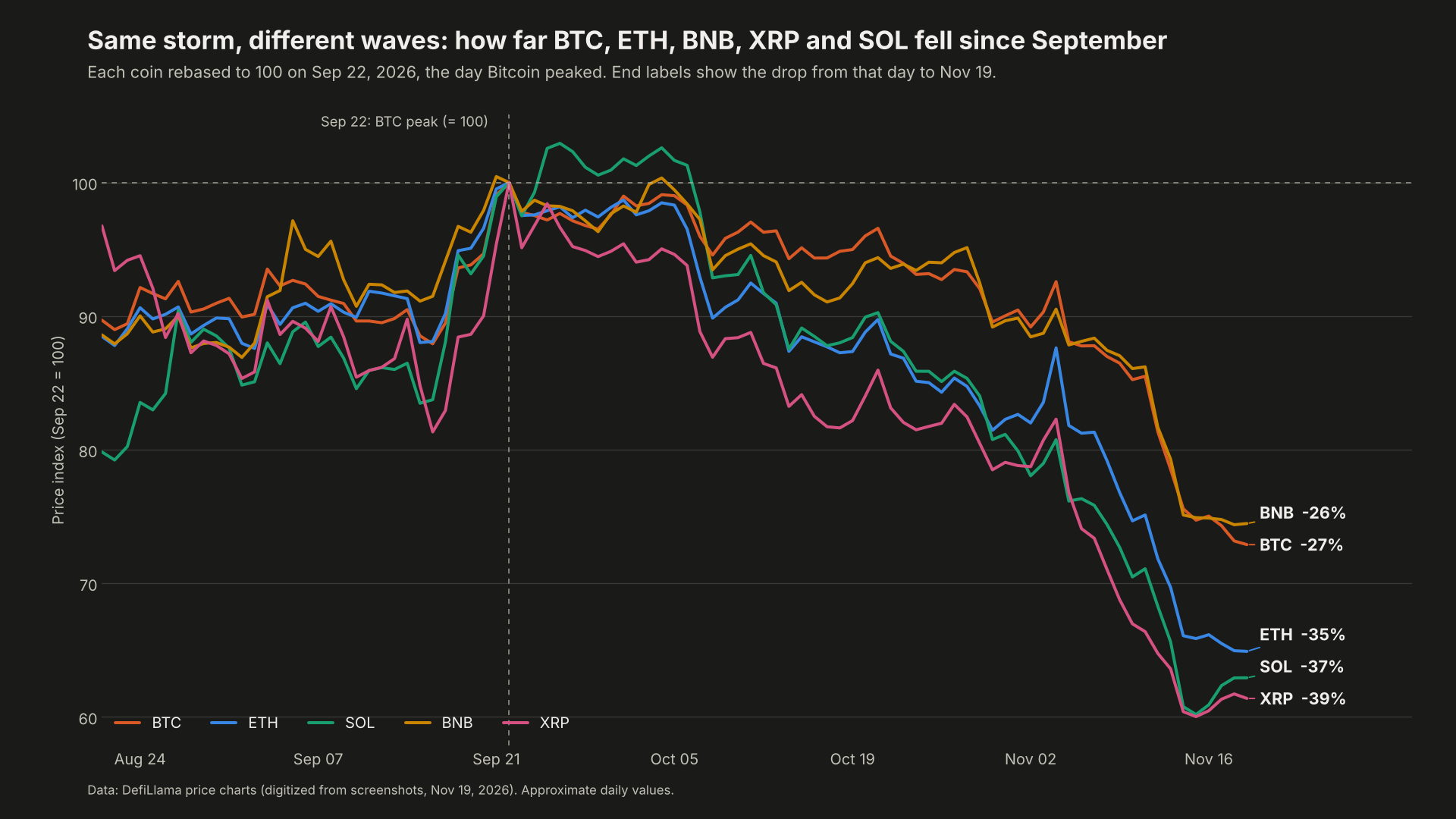
So I stopped listening to the timeline and looked at the numbers. They say altcoins aren't ignoring Bitcoin's crash. They're following it, and falling harder.
In October, $ETH and $BTC had a correlation of 0.95, which means they moved almost in lockstep. But Bitcoin fell 1.85% while ETH fell 10.3% and $SOL 11.9%.
In one week of October, a basket of 141 altcoins dropped 14% on average, while Bitcoin dropped about 3%.
By early November, around 70% of altcoins were trading below their 200-day moving average. A month earlier, most of them were above it.
ETH/BTC, the classic altseason leader, closed at 0.0284 on November 8, its weakest level since July.
Since Bitcoin's Sep 22 peak, $BNB is down about 26% and $BTC about 27%, while $ETH lost 35%, $SOL 37% and $XRP 39% (see the chart above).
And here's another reality check. In mid-November, the Altcoin Season Index was still stuck in the 40s out of 100. A reading of 75 is generally considered altseason. So whatever my timeline is celebrating, the broader market hasn't confirmed it yet. The index is backward-looking: it measures performance over the previous 90 days. By the time it crosses 75, an altcoin rally may already be well underway.
So the honest picture is this: altcoins aren't an alternative to Bitcoin right now. They're Bitcoin with extra leverage. Same direction, bigger moves, and in a falling market, that's not the kind of extra you want.
Why Altcoins "Blindly Follow" Bitcoin
I used to think this was unfair. Good projects should go their own way, right? My POL bag certainly thought so. But when I looked closer, the logic is simple.
In a panic, everything gets sold. When liquidations start, people sell what they can, not what they've analysed. Your carefully researched altcoin gets dumped right next to a dog coin.
Risk leaves through the riskiest door first. When money leaves crypto, it leaves small caps and altcoins before Bitcoin. That's why alts fall faster.
Altseason needs cheap money. Major altcoin rallies have often followed periods of strong Bitcoin performance, when liquidity and confidence were high enough for investors to take more risk. Sometimes Bitcoin was still rising. Sometimes it had already started moving sideways. Today we have the opposite: fears of higher rates, ETF outflows and Bitcoin falling.
What the Analysts I Trust Are Saying
Ben Cowen is clear, as usual. He sees 4 to 8 more weeks of weakness, possibly toward $54K. And he doesn't expect a real altseason until around 2028, unless a crisis forces central banks to ease. Even if Bitcoin enters a new bull market in 2027, he thinks it could keep outperforming altcoins until money gets cheaper.
Earlier this year, Crypto Kaleo said altcoins typically break out only after Bitcoin makes new all-time highs, and advised "a bit more patience" for a real altseason.
And back in December 2025, Jeff Ko from CoinEx predicted that no traditional altseason would happen in 2026, only a few "blue-chip survivors." So far, the year has proven him right.
So, Is There Any Truth in It?
A little. But the order is wrong.
A Bitcoin crash doesn't trigger an altseason. It can prepare one: it flushes out leverage, scares away tourists and creates cheap prices. But historically, altseason came later, after Bitcoin stopped falling, moved sideways or made new highs, and money started spilling over into riskier coins.
So the question isn't "Will this crash start altseason?" It's "When the crash is over, will there be enough money and confidence left to rotate?"
Here's my checklist for when I'll start believing:
Bitcoin stabilises first. Not one good day, but weeks of calm.
ETH/BTC makes higher highs for weeks, not one green candle.
The Altcoin Season Index goes above 75. Not an early signal, but the final confirmation that it's real.
Money gets cheaper. Rate cuts or liquidity coming back.
Until then, any "altseason is here" tweet goes into the same folder as "POLYGON to $10."
What I'm Doing About It
Same as always. Boring on purpose.
Bitcoin stays the foundation. This year proved again why half of what I put into crypto goes to BTC. When markets panic, Bitcoin has often held up better than many altcoins. That relative resilience is one reason I keep it at the center of my portfolio.
My dip bag isn't for altcoins yet. I'll look at alts once my checklist turns green, not when my timeline turns hopeful.
No chasing. I've already learned the FOMO lesson with TON. Thanks to my keyboard, it was a cheap lesson. Next time I might not be so lucky.
Final Thought
Maybe altseason is coming. Maybe it's still months away. Or maybe this cycle won't give us the broad rally everyone keeps promising.
I don't know.
But I've spent three years waiting for that corner to appear. I've learned that hope is a terrible substitute for a plan.
So I'll keep watching the data, holding my core positions, and resisting the urge to chase every green candle.
If altseason finally arrives, I hope I'll recognize it. And I'll finally get to test my ability to sell. I've had enough time to learn to sell on time, haven't I?
And if it doesn't?
At least I won't spend another year buying every rumor about it.
What do you think? Is this crash the start of altseason, or are we just in the "waiting phase," part two?
$BTC $ETH $BNB $SOL $XRP #Altseason #Bitcoin #Altcoins #CryptoMarket #DYOR
Not financial advice.
Just my own research, my own bags and my own waiting phase.
DYOR, and then DYOR some more.