
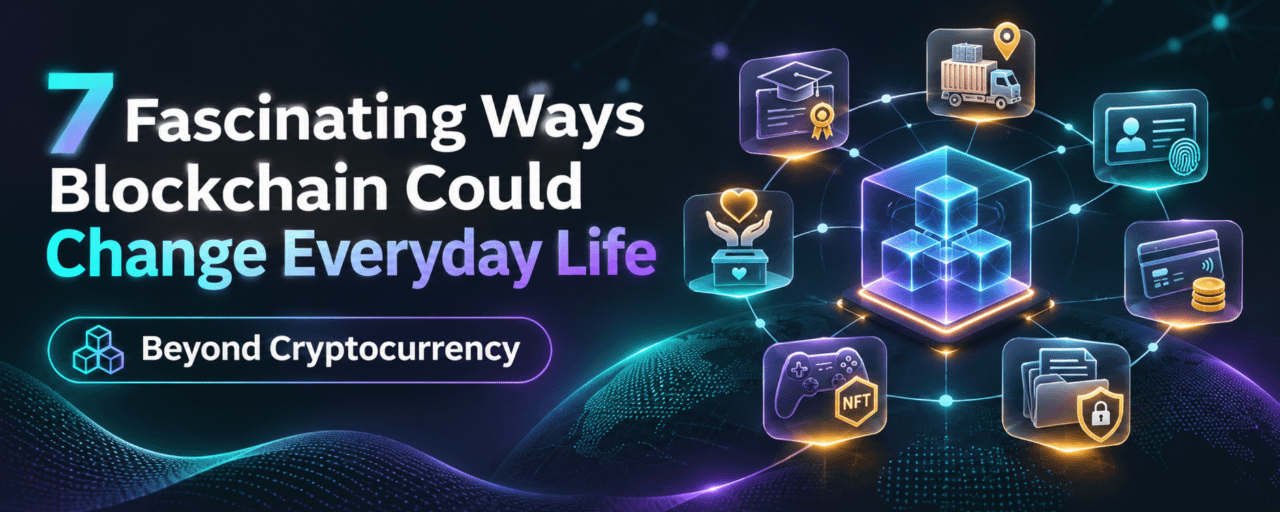

Imagine purchasing a product and being able to verify where it came from, receiving a digital certificate that is easier to authenticate, or proving ownership of a valuable digital item.
These possibilities demonstrate why blockchain technology deserves attention beyond cryptocurrency prices.
While Bitcoin introduced a decentralized approach to digital money, networks such as Ethereum and Solana expanded the possibilities of programmable blockchain applications.
Here are seven fascinating ways blockchain could influence everyday life.
1. Making Educational Certificates Easier to Verify
Traditional educational certificates can be difficult to authenticate, especially when institutions operate in different countries.
Blockchain-based verification systems could help employers and universities confirm the authenticity of digital credentials.
Instead of storing sensitive personal information on a public blockchain, institutions could record cryptographic proofs that help verify documents.
This approach could make certain verification processes more efficient while reducing opportunities for document fraud.
2. Understanding Where Our Food Comes From
Imagine scanning a code on a package of fruit and exploring its journey from the farm to the supermarket.
Blockchain-based supply chain systems could help record information about production, transportation, storage, and distribution.
Potential benefits include:
Improved product traceability
Greater supply chain transparency
Faster identification of contaminated products
Better verification of product origins
However, the reliability of such systems still depends on the accuracy of the information entered.
3. Transforming Digital Ownership
In many online environments, access to digital items depends entirely on the platform that provides them.
Blockchain technology introduces alternative ways to record and verify ownership.
Programmable networks such as Ethereum and Solana allow developers to create systems involving digital collectibles, artwork, membership credentials, and other digital assets.
Although blockchain records can help establish control over a token, they do not automatically grant copyright or other legal ownership rights.
Understanding that distinction is essential.
4. Creating Automated Agreements
Smart contracts are programs that operate according to predefined instructions.
On Ethereum, developers can use these programs to automate certain agreements and processes.
Potential applications include:
Digital ticketing systems
Automated payment arrangements
Membership verification
Digital marketplace transactions
Smart contracts can reduce the need for intermediaries in certain situations. However, their effectiveness depends on reliable code, accurate data, and appropriate legal frameworks.
5. Exploring Alternative Payment Systems
Bitcoin demonstrated how digital value could be transferred through a decentralized network.
Other blockchain networks explore different approaches to transaction speed, cost, and functionality.
These technologies could support new payment services and alternative financial infrastructure.
Nevertheless, real-world adoption depends on accessibility, regulation, transaction costs, security, and user protection.
Technology alone cannot solve every financial challenge.
6. Improving Transparency in Charitable Donations
People often want to understand how their charitable contributions are being used.
Public blockchain records could help organizations provide greater visibility into certain financial transactions.
Donors may be able to examine transfers and follow the movement of digital funds.
However, blockchain cannot independently guarantee that donations have been used for their intended real-world purposes.
Transparent reporting and independent oversight remain important.
7. Supporting the Next Generation of Digital Gaming
Blockchain-based gaming introduces new possibilities for digital ownership and verifiable in-game assets.
Networks such as Solana are designed to support applications that require frequent transactions.
Developers can explore systems involving digital collectibles, player-controlled assets, and interactive marketplaces.
The challenge is creating experiences that are genuinely enjoyable, secure, and accessible rather than relying purely on financial incentives.
The Challenges We Should Not Ignore
Despite its potential, blockchain technology faces important limitations.
These include:
Privacy concerns
Technical complexity
Security vulnerabilities
Regulatory uncertainty
Scalability challenges
Real-world implementation costs
Not every problem requires a blockchain solution. Sometimes, conventional databases and existing technologies may be more efficient.
Responsible innovation begins with choosing the right technology for the right problem.
Final Thoughts
Blockchain is not simply about buying and selling cryptocurrency.
Bitcoin, Ethereum, and Solana illustrate different approaches to digital value, programmable applications, and network efficiency.
Their underlying technologies encourage us to explore new possibilities in education, business, gaming, transparency, and digital ownership.
The most exciting question is not necessarily how much a cryptocurrency might be worth tomorrow.
It is what the technology could help us accomplish in the years ahead.
Which of these seven blockchain applications would you most like to see in everyday life?
Disclaimer: This article is for educational and informational purposes only. It does not constitute financial or investment advice.
#BlockchainTechnology #Bitcoin #Ethereum #Solana #CryptoEducation #DigitalInnovation #FutureTechnology #FinancialLiteracy$BTC
