
#sxt $SXT @SpaceandTime
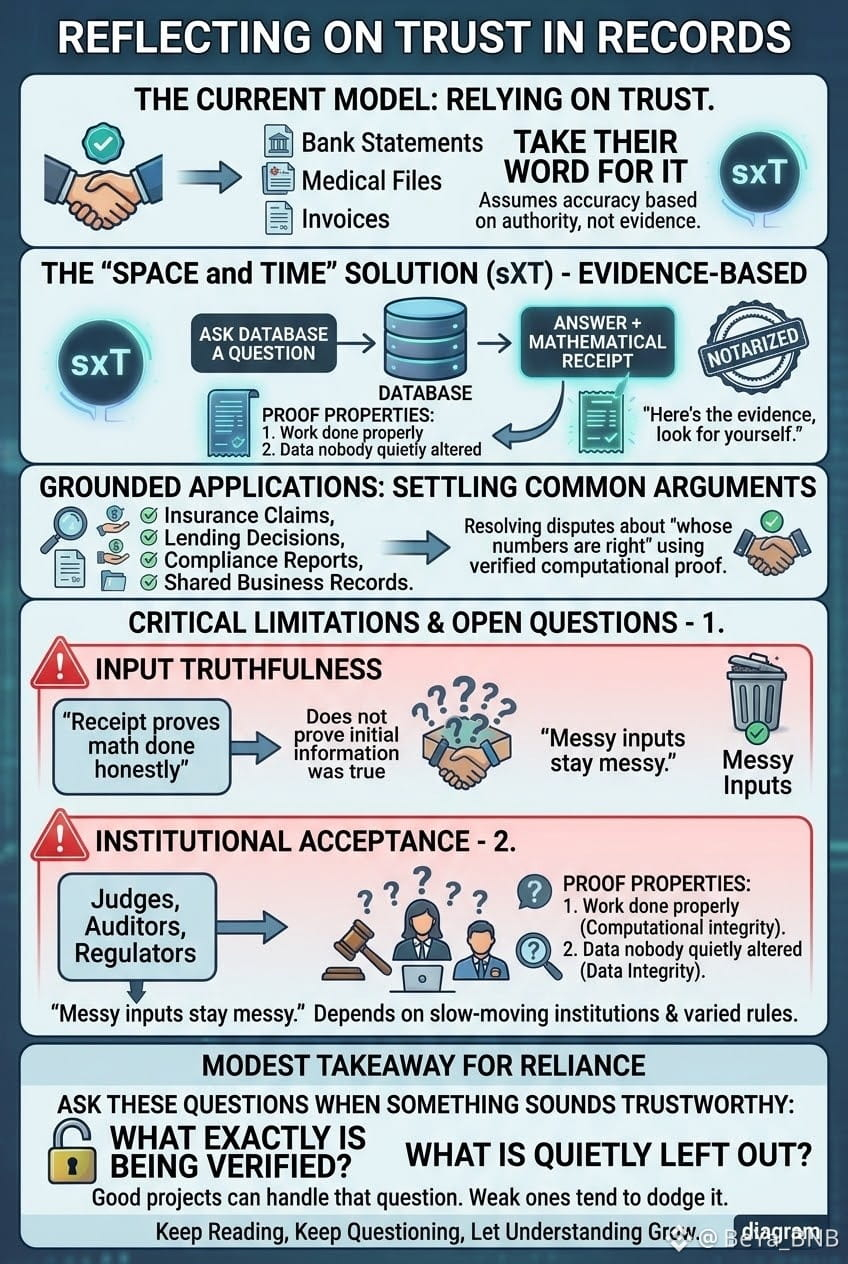
I was reading a contract last week when a thought stopped me: every record I rely on, whether bank statements or medical files or invoices, exists because someone told me it's accurate. I've never once checked.
That's what drew me to Space and Time. Their idea is that when you ask a database a question, the answer arrives with a mathematical receipt showing the work was done properly on data nobody quietly altered. Less "take our word for it," more "here's the evidence, look for yourself."
What makes it feel grounded to me is where the need already exists. Insurance claims, lending decisions, compliance reports, shared business records. People in those fields argue about whose numbers are right all the time. If a receipt settles even some of those arguments, it solves a problem that was there long before crypto.
But I'd be fooling myself if I stopped there. A receipt proves the math was done honestly. It says nothing about whether the information was true when it first went in. Messy inputs stay messy. And whether a judge, an auditor, or a regulator will accept this kind of proof is a separate matter, one that depends on slow-moving institutions and rules that vary from place to place.
So my takeaway is modest. When something sounds trustworthy, ask what exactly is being verified, and what is quietly left out. Good projects can handle that question. Weak ones tend to dodge it.
I don't have this all figured out, and I don't think anyone does. I'd rather keep reading, keep questioning, and let my understanding grow a little each week.
#sxt $SXT @SpaceandTime