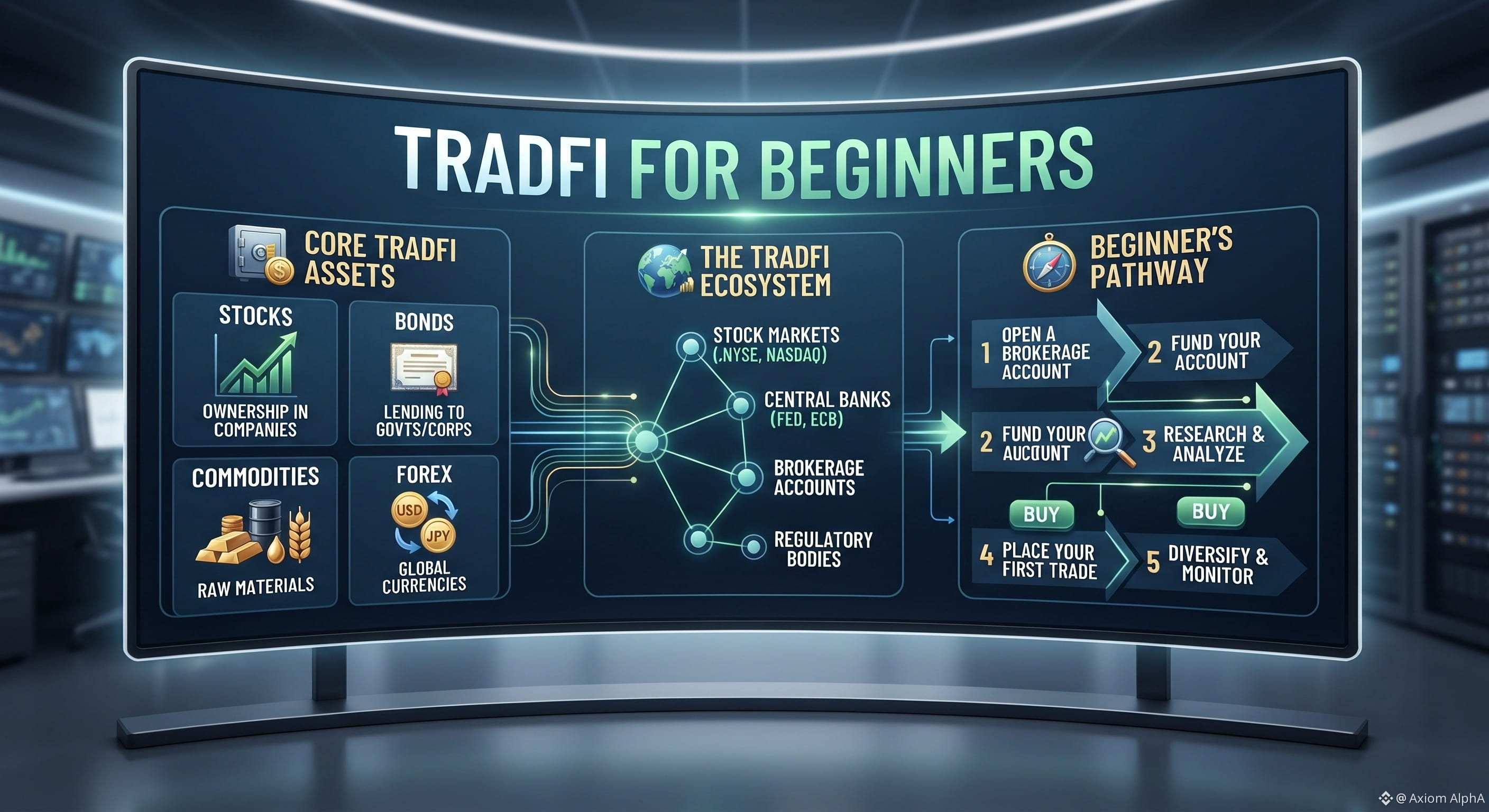
#tradfiforbeginners
Bridging Two Worlds: A Beginner’s Guide to Traditional Finance (TradFi) and Its On-Chain Evolution
For anyone stepping into the world of investing and trading, mastering the fundamentals can feel like learning a foreign language. Before diving into high-beta assets or crypto trading, understanding Traditional Finance (TradFi) is essential. TradFi encompasses the conventional global financial system built around established institutions like central banks, commercial and investment banks, stock exchanges, and regulatory bodies.
These institutions dictate how liquidity flows, how interest rates are set, and how massive amounts of capital move across global markets. However, the financial landscape has evolved dramatically. Today, TradFi and decentralized finance (DeFi) are no longer isolated silos; tokenized real-world assets (RWAs)—such as government treasury bills, corporate stocks, and commodities—are increasingly moving onto blockchain rails. For beginners, understanding how traditional markets operate alongside digital assets provides a critical edge in navigating modern multi-asset trading.
Chainlink ($LINK )
Why it matters: Chainlink serves as the industry-standard decentralized oracle network, feeding real-world TradFi data, stock prices, and net asset values (NAVs) onto the blockchain. It is a foundational infrastructure asset for tokenized real-world assets.
Avalanche ($AVAX )
Why it matters: Avalanche's customizable subnet architecture has made it a preferred network for institutional experiments and enterprise-grade asset tokenization, bridging traditional financial compliance with high-speed on-chain execution.
Polygon ($POL )
Why it matters: Focusing heavily on scalable zero-knowledge infrastructure, Polygon provides high-throughput execution layers that handle institutional transaction volume efficiently, making it a key hub for web3 financial applications.
#TraditionalFinance #cryptotrading #market