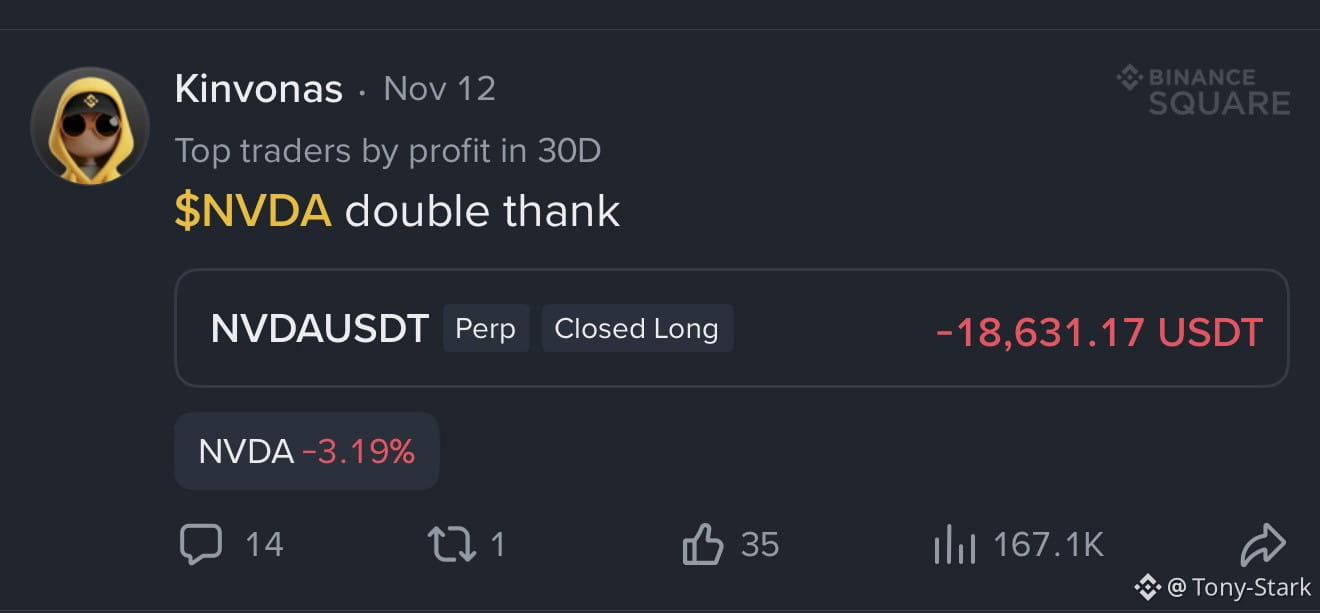
He thought he was fishing. In reality, he was the fish.
Look at this trade and learn the lesson.
Maybe his wallet is big, but the real question is: Why should we give even a single dollar to the market without understanding what we’re trading?
His biggest mistake was trading on hype rather than fundamentals. He assumed that if something went down today, it would simply recover tomorrow.
But markets don’t work that way.
When an infrastructure failure happens, recovery takes time. Sometimes it requires a fundamental change, a systemic upgrade, or a complete resolution of the underlying problem.
If NVDA faced selling pressure because of concerns surrounding its founders or leadership, why would you blindly go long before those concerns were resolved?
A price drop doesn’t automatically create a buying opportunity. Sometimes, it signals a problem that hasn’t even begun to unfold fully.
The lesson is simple:
* Don’t trade hype. Understand the fundamentals.
* Don’t confuse a temporary price drop with a genuine recovery opportunity.
* Don’t buy just because something looks cheap.
* Understand what caused the decline and what needs to happen before recovery becomes realistic.
Read the business, understand the infrastructure, and study the fundamentals before reading the chart.
A chart only tells you where the price has been. It doesn’t tell you why it moved, what is broken, or whether the future justifies a recovery.
Don’t become liquidity for someone else’s strategy.