🚀 B.AI API Experience Upgrade: Why Better Model Discovery Is Essential for Building Smarter AI Applications
The AI industry is entering a stage where developers no longer struggle with a lack of available models.
Instead, they face a different challenge: choosing the right model from an increasingly complex ecosystem of capabilities, pricing structures, and infrastructure options.
A developer building an AI application may need to compare reasoning performance, context capacity, API costs, and model availability before writing a single line of integration code.
As the number of available models increases, this decision-making process becomes more demanding.
B.AI's latest API management upgrade addresses an important but often overlooked part of AI development: reducing the friction between discovering a model and putting it into production.
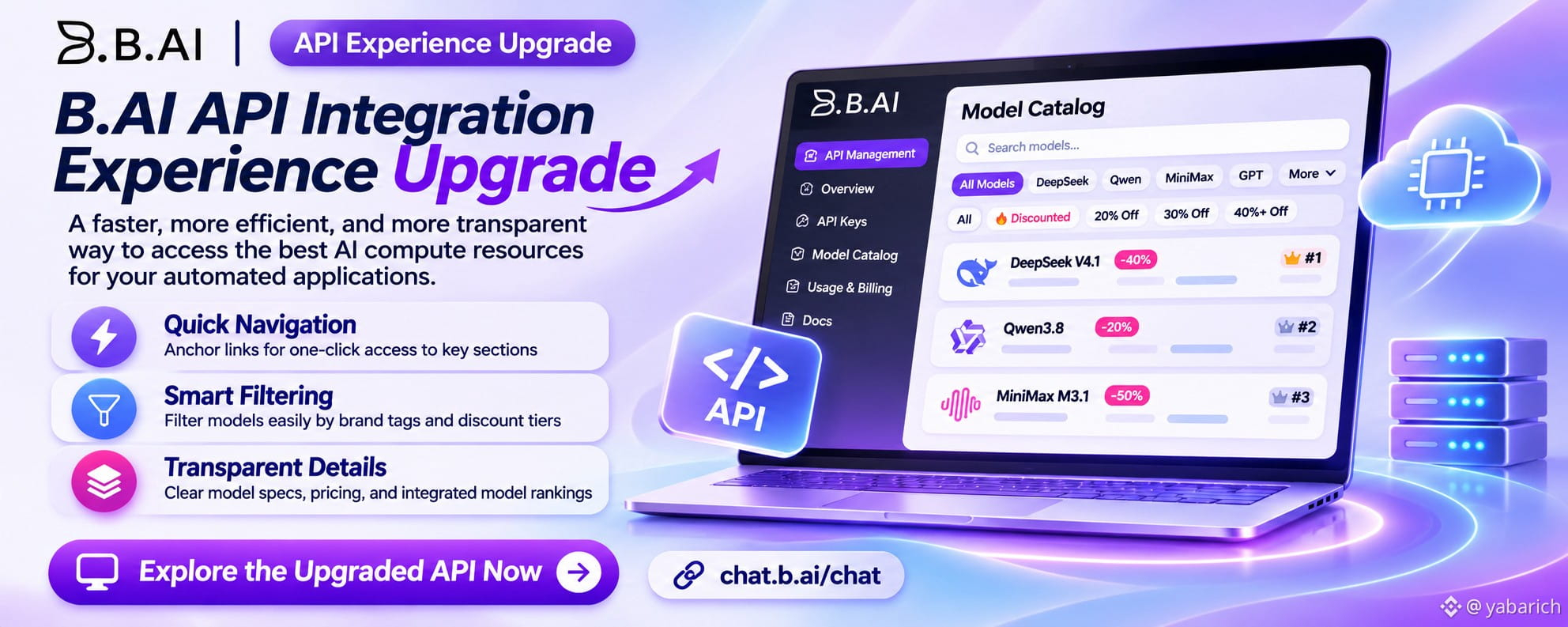
The upgraded interface introduces three improvements: Quick Navigation, Smart Filtering, and Transparent Model Details.
Their significance extends beyond interface convenience.
🔹 1. Quick Navigation: Reducing the Time Between Discovery and Integration
Developers frequently move between model documentation, API configurations, pricing information, and technical specifications.
When these resources are difficult to navigate, even simple integration decisions can require unnecessary time.
B.AI has introduced anchor links that allow users to jump directly to important sections of its API management page.
This reduces repetitive navigation and makes relevant information easier to locate.
For developers managing multiple models or experimenting with different configurations, faster access to technical information can improve workflow efficiency.
The underlying principle is straightforward:
The less time developers spend navigating infrastructure, the more time they can dedicate to building useful applications.
🔹 2. Smart Filtering: Turning Model Diversity Into Practical Choice
Having access to dozens of AI models is valuable, but model diversity alone does not guarantee a better developer experience.
Without effective discovery tools, a large model catalog can become difficult to evaluate.
B.AI's upgraded filtering system allows developers to organize available models by brand tags and discount tiers.
This makes it easier to narrow down options according to provider preferences and pricing requirements.
For example, a developer evaluating several models for an automated document-processing application may want to identify discounted options before conducting performance tests.
Another developer building a reasoning-intensive agent may prefer to compare models from specific providers.
Smart filtering helps users create a more manageable shortlist.
However, pricing should remain only one component of model selection.
A lower-cost model is not necessarily the most economical choice if it requires additional retries, longer outputs, or more complex workflows to complete the same task.
The best model is not always the cheapest per token. It is the one that delivers the required result at an acceptable total cost.
🔹 3. Transparent Model Details: Making AI Infrastructure Decisions More Informed
AI integration involves trade-offs.
Different models offer different context windows, supported capabilities, pricing structures, and performance characteristics.
Without clear information, developers may choose models based primarily on popularity or marketing claims.
B.AI's upgraded interface brings model specifications, pricing, and integrated rankings into a more accessible view.
This creates a stronger foundation for comparing available options before implementation.
Model rankings can provide useful signals about platform activity and relative popularity.
However, popularity should not be confused with technical superiority.
A model receiving substantial token consumption may be optimized for high-volume, low-cost workloads rather than complex reasoning.
Developers still need to evaluate performance using their own application requirements.
Transparent information makes better decisions possible, but meaningful benchmarking remains essential.
🔹 4. Why These Improvements Matter for AI Agent Development
The importance of model selection becomes even greater when applications evolve from simple chat interfaces into autonomous or semi-autonomous AI agents.
An AI agent may perform multiple operations within a single workflow:
It may analyze a request, retrieve information, invoke external tools, process intermediate results, and generate a final output.
Each operation can involve different computational requirements.
Using the most expensive model for every task may increase operating costs unnecessarily.
Using an unsuitable model may reduce reliability or require additional processing.
A platform that makes model discovery and pricing comparison easier can help developers design more efficient workflows.
B.AI's interface improvements do not automatically optimize model routing or guarantee better agent performance.
Instead, they reduce the information-access burden associated with selecting and integrating appropriate models.
This is an important distinction because effective automation depends on both capable models and well-designed infrastructure.
🔹 5. The Bigger Picture: B.AI Is Building a More Accessible Multi-Model Development Environment
B.AI provides access to more than 70 AI models alongside APIs, MCP capabilities, and Web3-related development tools.
As this ecosystem expands, the ability to organize and compare available resources becomes increasingly important.
A large model catalog creates opportunities for flexibility.
But an effective management interface helps translate that flexibility into practical developer value.
Quick Navigation improves access to information.
Smart Filtering simplifies model discovery.
Transparent Details support more informed comparisons.
Together, these improvements can reduce the operational complexity of working with multiple AI providers.
For independent developers, this may lower the effort required to experiment with different models.
For development teams, it can make model evaluation and integration planning more manageable.
For organizations building automated applications, clearer infrastructure information can support better cost-control and deployment decisions.
🔹 The Long-Term Perspective: AI Infrastructure Must Become Easier to Use as Models Become More Powerful
The future of AI development will not be determined solely by improvements in model intelligence.
It will also depend on how effectively developers can access, evaluate, integrate, and manage those capabilities.
As AI applications become more sophisticated, infrastructure usability will become an increasingly important competitive factor.
B.AI's API management upgrade reflects this shift.
Rather than focusing exclusively on adding new models, the platform is improving how developers interact with the resources already available.
The real value of a multi-model AI platform is not simply the number of models it provides, but how efficiently developers can turn those models into reliable, cost-effective applications.
Better discovery supports better decisions.
Better information supports more efficient integration.
And reduced infrastructure complexity allows developers to focus on what ultimately matters: creating AI products that solve real problems.
The next generation of AI development will reward platforms that make powerful technology easier to discover, compare, and use.
B.AI's latest upgrade is another practical step in that direction.
🔗 Explore the upgraded API experience: https://chat.b.ai/chat
#BAI #TRONEcoStar