The real strength of a decentralized compute network is not just its ability to provide computational resources. It is the economic system that makes participants accountable, rewards meaningful contributions, and protects the integrity of the entire network.
This is where BTT's role in BTT InferGrid becomes particularly interesting.
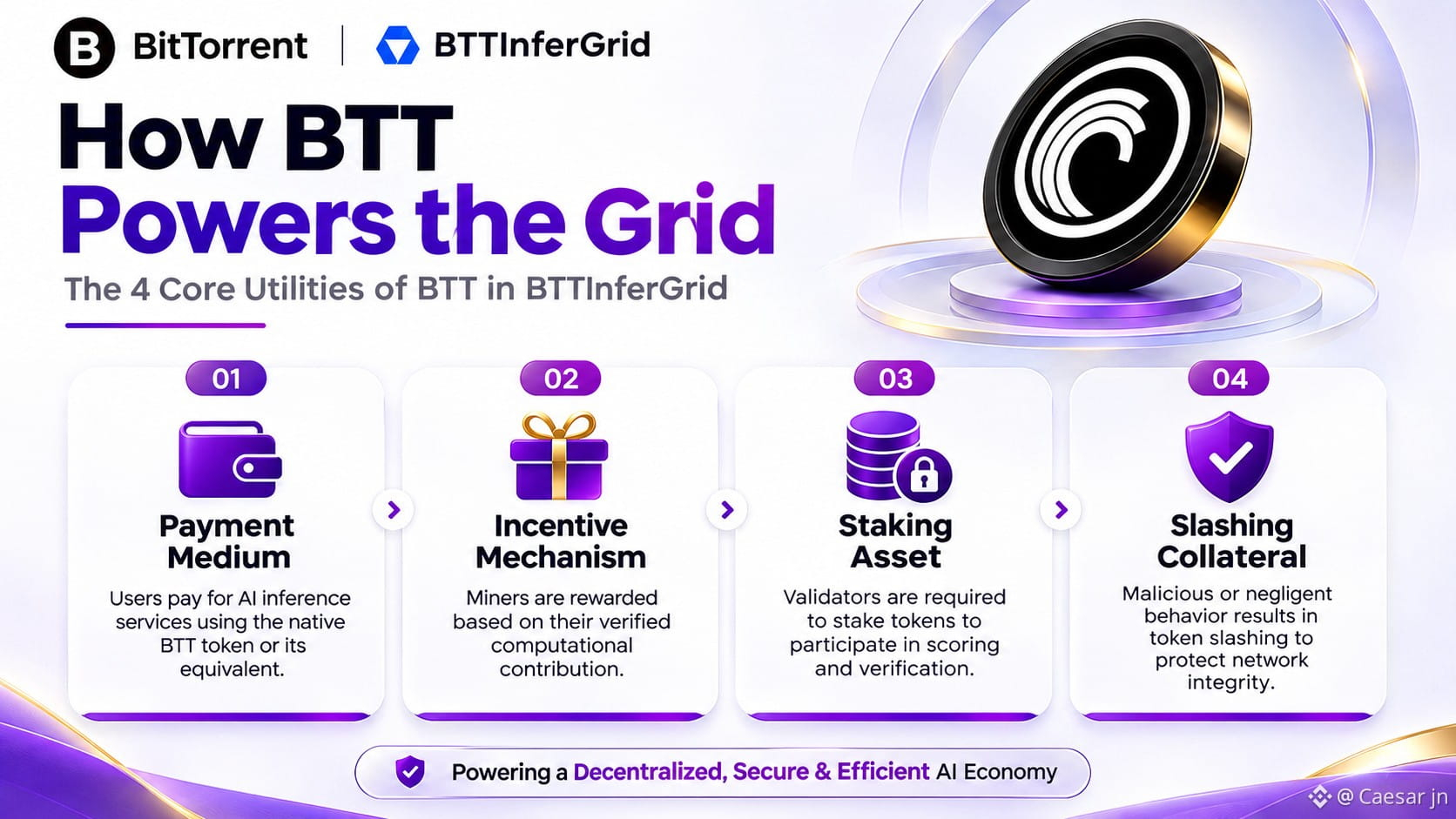
BTT is designed to serve four important functions within the ecosystem:
1. Payment Medium: BTT provides a mechanism for users to pay for AI inference services, connecting token utility directly to actual network usage.
2. Incentive Mechanism: Miners receive rewards for verified computational contributions, creating an economic reason to supply useful resources to the network.
3. Staking Asset: Validators commit tokens to participate in network scoring and verification, introducing economic responsibility into the validation process.
4. Slashing Collateral: Participants who engage in malicious or negligent behaviour risk losing their staked tokens, helping discourage misconduct and protect network integrity.
The bigger picture is that these functions are interconnected.
Payments create demand. Incentives encourage participation. Staking establishes economic commitment, while slashing introduces consequences for unacceptable behaviour.
Together, they help establish a framework where network participation is connected to measurable contributions and accountability.
This is an important principle for decentralized AI infrastructure.
A compute network cannot build lasting trust on computational capacity alone. It also needs mechanisms that align incentives, discourage dishonest behaviour, and make reliability economically meaningful.
The future of decentralized computing will depend not only on how much computing power a network can provide, but also on how effectively it can coordinate, reward, and secure that power.
That is the broader significance of BTT's utility within BTT InferGrid.
@BitTorrent_Official @Justin Sun孙宇晨
#TRONEcoStar