#sxt $SXT
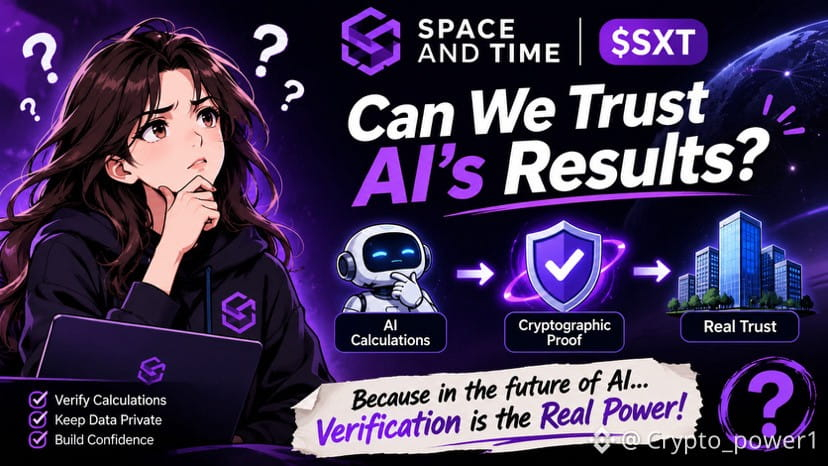
I keep coming back to one important question as AI becomes more powerful: Who verifies the intelligence behind its decisions?
Imagine an AI agent analyzing millions of dollars in financial data and recommending a major business decision. The calculations look perfect, the report sounds convincing, but how do we know the results are actually correct?
This is where things get interesting with @SpaceandTime ($SXT).
Its Proof of SQL technology introduces a way to cryptographically verify database calculations without exposing the organization’s confidential data. In simple terms, businesses can check whether calculations are correct while keeping their underlying information private.
I see an interesting opportunity here for AI agents, automated reporting, and enterprise decision-making.
But I wouldn’t call verification the complete solution just yet.
There is another side to this problem: What if the original data is wrong?
A cryptographic proof can establish that a calculation was performed correctly against specific data, but it cannot guarantee that the data itself is accurate, complete, or trustworthy.
That’s why I believe the future of AI needs more than intelligence. It needs accountability across the entire data pipeline.
$SXT is exploring an important piece of that puzzle. Now, the real test is whether this technology can deliver meaningful value in real-world applications.
Interesting technology, but adoption will be the real proof. @SpaceandTime #SXT