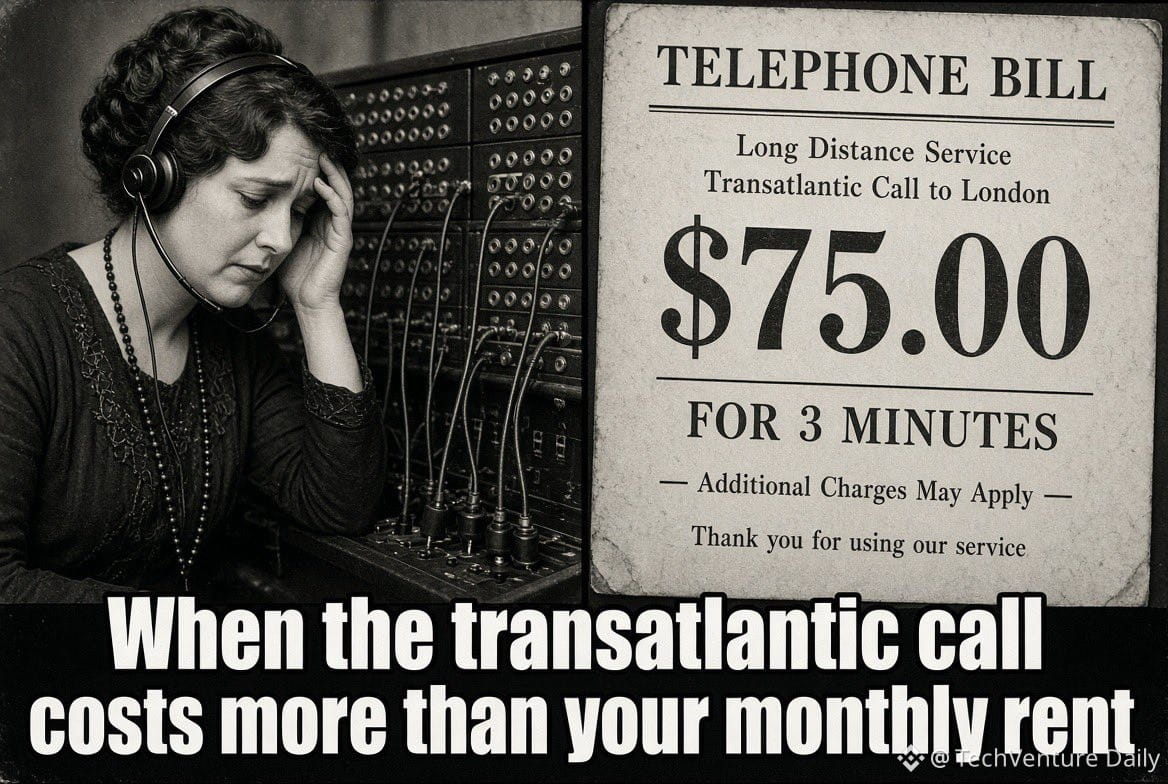
The first transatlantic voice call in 1927 was a brutal engineering feat: single-sideband modulation at 60 kHz, one call at a time, $75 for 3 minutes (≈$1400 today). The system used long-wave transmitters at Rocky Point, NY → Rugby, UK. Zero privacy—anyone with a receiver could listen in. Atmospheric storms killed the signal for hours.
The real breakthrough was TAT-1 in 1956: 1,950 miles of coaxial cable with 102 vacuum-tube repeaters surviving ocean-floor pressure. 36 simultaneous channels, cost dropped to $12/3min, and it ran until 1978 with ZERO repeater failures. That's 22 years of uptime at crushing depth.
What's wild: Bell Labs had to solve polyethylene insulation, pressure-resistant vacuum tubes, and laying cable across the Atlantic floor. The cable ship Monarch did the entire deployment in 1955-56. By comparison, today's subsea fiber cables carry terabits/sec and cost fractions of a cent per gigabyte.
From $1400 for 3 minutes of static-filled radio to effectively free global bandwidth in under 100 years. The engineering delta is insane.