

While all spot Bitcoin ETFs give long-term investors price exposure to Bitcoin without managing private keys or wallet security, their underlying market liquidity, custody architecture, and operational cost structures differ substantially.
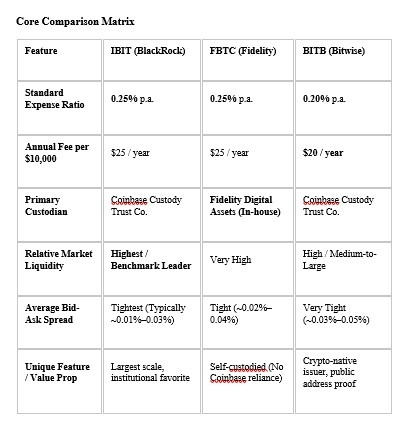
The main structural features and risk parameters across the top three spot Bitcoin ETFs—iShares Bitcoin Trust (IBIT), Fidelity Wise Origin Bitcoin Fund (FBTC), and Bitwise Bitcoin ETF (BITB)—compare as follows:
Key Area Breakdown
1. Expense Ratios & Total Cost of Ownership
BITB (0.20%): Bitwise offers a clear cost advantage, undercutting the major Wall Street asset managers by 5 basis points. Over multi-year or multi-decade holding periods, this lower expense ratio reduces overall drag on compounding returns.
IBIT & FBTC (0.25%): Both BlackRock and Fidelity match each other at a standard 0.25% net expense ratio. While slightly more expensive than BITB, for short-term or tactical traders, the higher liquidity of IBIT and FBTC can offset this fee difference through tighter bid-ask spreads during market order execution.
2. Liquidity & Trading Dynamics
IBIT (Market Leader): With the largest AUM and highest daily volume among all spot Bitcoin ETFs, IBIT commands the deepest liquidity pool. This minimizes execution slippage for high-volume traders or large block orders, making it the preferred vehicle for institutional desks.
FBTC (Strong Second): Features deep secondary market liquidity and robust Authorized Participant (AP) networks. It easily handles retail and mid-sized institutional order flows with minimal price impact.
BITB (Sufficient for Retail): While smaller in total volume compared to IBIT, BITB maintains active market-making support that ensures narrow spreads for standard retail allocation sizes.
3. Custodial Security & Infrastructure Architecture
FBTC (In-House / Vertically Integrated): Fidelity is unique among top issuers because it self-custodies its Bitcoin via Fidelity Digital Assets. This removes third-party concentration risk, ensuring Fidelity does not rely on Coinbase for cold storage.
IBIT & BITB (Third-Party Custody via Coinbase): Both BlackRock and Bitwise utilize Coinbase Custody Trust Company as their primary institutional vault manager. While Coinbase is the industry standard for institutional cold-storage security and multi-signature key architecture, it introduces counterparty concentration risk since a significant portion of US ETF assets reside under one entity.
Final Verdict: Which One Fits Which Goal?
Choose IBIT if you are an institutional buyer, high-frequency trader, or prioritize maximum liquidity, the tightest bid-ask spreads, and the backing of BlackRock.
Choose FBTC if you prefer single-firm vertical integration, want to avoid third-party custodian concentration risk with Coinbase, or manage your portfolio directly within Fidelity.
Choose BITB if you are a cost-conscious long-term buy-and-hold investor seeking the lowest ongoing expense ratio from an established crypto-native firm.