
#jobsreportraiseshikeodds 🌍 #PositiveMindsGlobalResults
Binance Square | INVEST • LEARN • GROW • TOGETHER
Stay positive. Stay informed. Stay secure! 💛🌍
📅 November 8, 2026
A stronger-than-expected American labor market is putting renewed pressure on the Federal Reserve, challenging expectations for monetary easing and creating fresh uncertainty for Bitcoin, equities and global financial markets.
1. A Jobs Report That Changed the Conversation
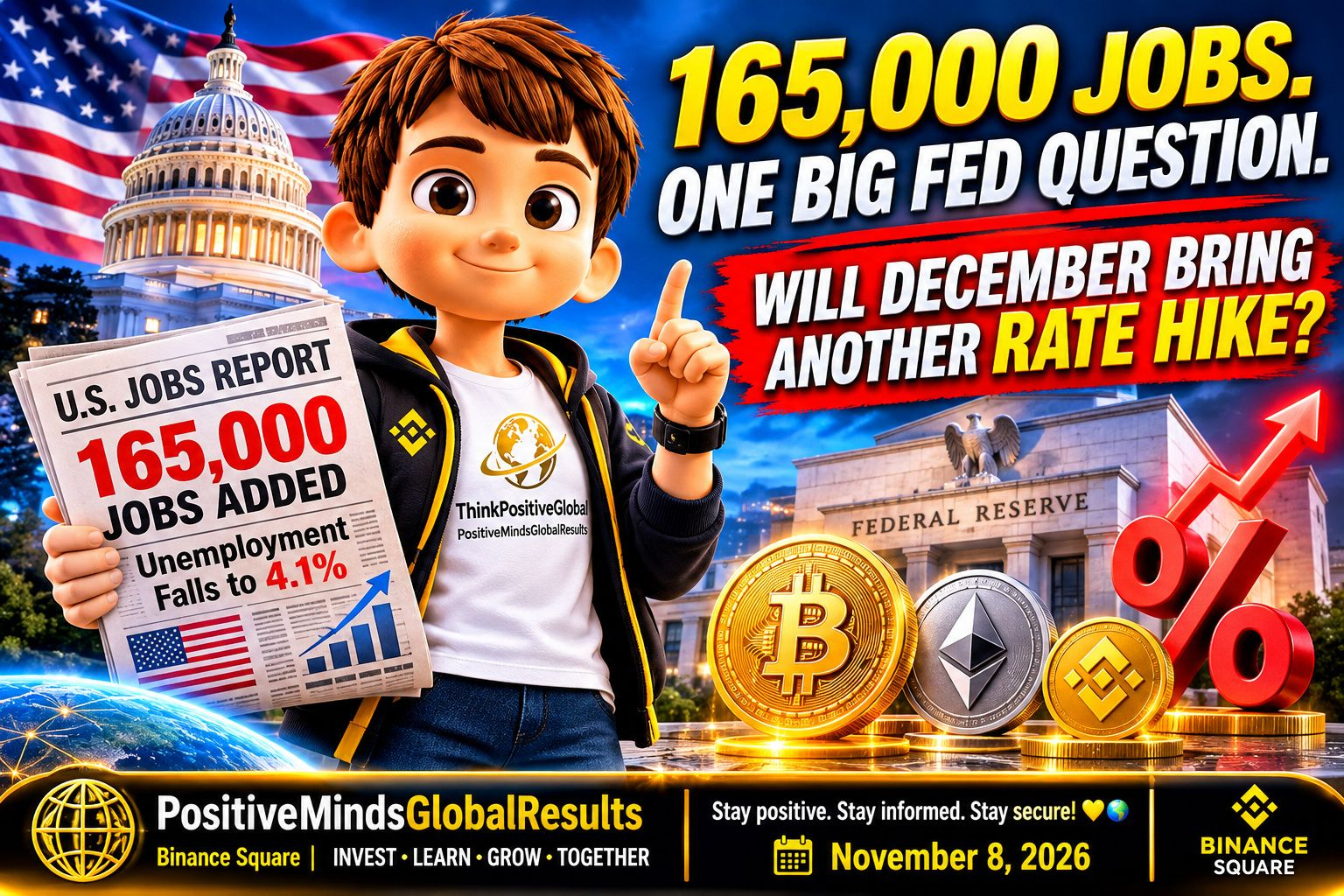
The US economy delivered a surprisingly strong employment report in October, adding 165,000 nonfarm payroll jobs, more than double the approximately 65,000 expected by economists.
The unemployment rate also declined from 4.2% to 4.1%, signaling that the labor market remains more resilient than many investors anticipated.
September' employment growth was revised upward from 29,000 to 60,000, while August' figure was also revised higher, adding further evidence that hiring momentum had been underestimated.
This is more than an encouraging economic headline. It changes the conversation surrounding the Federal Reserve's next policy decision.
2. The Federal Reserve Faces a Difficult Policy Choice
The Federal Reserve has a difficult balancing act: controlling inflation without unnecessarily damaging employment and economic growth.
A stronger labor market gives policymakers greater flexibility to maintain restrictive monetary conditions. If employment remains resilient while inflation stays above the Fed's 2% objective, policymakers may see fewer reasons to delay additional tightening.
Following the October employment report, market expectations shifted further towards another 25-basis-point rate increase at the December meeting.
Before the release, CME FedWatch indicated a 72.8% probability of a December increase. Following the report, market-implied expectations moved higher, with estimates varying across trading platforms and reporting times.
However, market probabilities are not official Fed decisions.
A December hike is increasingly plausible, but it is not guaranteed.
3. The Inflation Problem Behind the Strong Jobs Numbers
There is an important detail investors should not overlook.
Average hourly earnings increased 0.4% in October and 3.1% over the previous 12 months. Meanwhile, consumer inflation had reached 3.7% through September.
This creates an uncomfortable economic situation: employment is expanding, but workers are still facing pressure on their purchasing power.
For the Federal Reserve, the challenge is not simply whether Americans have jobs. It is whether inflation can return to target without weakening the broader economy.
Strong employment does not automatically mean inflation will accelerate. However, persistent demand and rising economic activity could make the fight against inflation more complicated.
4. Why the December Decision Matters More Than Ever
The timing of upcoming economic releases is particularly important.
The November US employment report is scheduled for December 4, just days before the Federal Reserve's December 8–9 policy meeting.
That leaves policymakers with another important employment indicator before making their final decision.
Investors will also be watching inflation figures, wage growth, consumer spending and Treasury yields.
If inflation remains stubborn and employment continues to outperform expectations, the argument for another rate increase becomes stronger.
Conversely, meaningful inflation moderation or signs of weakening economic activity could give policymakers reasons to pause.
5. The Financial Market Connection: Strong Economy, Complicated Market Reaction
Ordinarily, stronger employment is positive news for the economy. However, financial markets do not always interpret good economic news as good investment news.
The reason is monetary policy.
If investors anticipate higher interest rates, US Treasury yields and the dollar can come under upward pressure. Higher yields can make interest-bearing assets more attractive relative to riskier investments.
This can increase the opportunity cost of holding assets that do not generate traditional income.
The result could be additional volatility across equities, commodities and cryptocurrencies.
6. Bitcoin and the Crypto Market: Where Does the Risk Come From?
Bitcoin's reaction to the Federal Reserve's policy direction deserves particular attention.
A more hawkish Fed could create several challenges for digital assets:
Bitcoin (BTC): Higher Treasury yields and a stronger dollar could weaken demand for risk-sensitive assets and increase selling pressure.
Ethereum (ETH): A tighter liquidity environment could weigh on speculative investment and broader digital-asset demand.
BNB: Market-wide risk aversion could increase volatility, although its price will also depend on Binance-related developments and BNB ecosystem activity.
Altcoins: Smaller digital assets may face greater pressure if investors reduce exposure to higher-risk investments.
However, a rate increase does not automatically mean a crypto-market crash.
Bitcoin and other digital assets are also influenced by ETF flows, institutional demand, derivatives positioning, liquidity conditions, regulatory developments and investor sentiment.
The relationship between interest rates and crypto prices is important, but it is not always immediate or predictable.
7. Three Possible Scenarios for December
Scenario A — Another Rate Increase
If inflation remains elevated and employment continues to demonstrate resilience, the Fed could deliver another 25-basis-point increase.
Potential consequences: stronger dollar pressure, elevated Treasury yields and a more challenging environment for speculative assets.
Scenario B — The Fed Holds Rates Steady
If inflation begins to cool or financial conditions tighten sufficiently, policymakers could decide that additional increases are unnecessary.
Potential consequences: relief for equities and cryptocurrencies, although the market would still need confirmation that inflation is moving sustainably lower.
Scenario C — Economic Data Sends Mixed Signals
Employment could remain relatively strong while inflation gradually moderates.
This would create a more complicated policy debate, potentially producing sharp market reactions as investors repeatedly adjust their expectations.
8. The Bigger Picture: The Fed Is Watching More Than Jobs
The October report demonstrates that the American economy has not weakened as quickly as some investors expected.
But one employment report cannot determine the direction of monetary policy.
The Fed must evaluate the entire economic picture, including inflation, wage growth, labor-force participation, consumer demand and financial conditions.
The next major market catalyst is therefore not simply another jobs headline. It is whether the incoming economic data confirms that inflation remains persistent despite a resilient labor market.
FINAL TAKEAWAY: GOOD ECONOMIC NEWS, BUT A NEW CHALLENGE FOR INVESTORS
America's 165,000 new jobs have strengthened the argument for tighter monetary policy and pushed December rate-hike expectations higher.
For traditional financial markets, this creates a fresh interest-rate challenge. For cryptocurrency investors, it introduces another important variable into an already sensitive market environment.
The central question is no longer simply whether the US economy is strong. It is whether the Federal Reserve can bring inflation under control without sacrificing that strength.
December could become a defining moment for monetary policy and global risk sentiment.
Watch the inflation data, Treasury yields, the US dollar and institutional crypto flows. The next major market direction may emerge from the interaction of all four.
PositiveMindsGlobalResults | Positivity Without Borders | Invest, Learn, Grow, Together
Disclaimer: This article is for educational and informational purposes only. Market scenarios are not guaranteed outcomes and should not be considered financial advice. Always conduct your own research (DYOR) before making investment decisions.
#FederalReserve #USJobsReport #Bitcoin #bnb #CryptoMarket #Inflation #InterestRates #GlobalMarkets #PositiveMindsGlobalResults