
The Bank of England is widely expected to raise interest rates on Thursday, with soaring energy costs doing most of the persuading. The vote itself looks like the easy part. What the Bank says afterward may matter more, since policymakers could use the occasion to cool investors' bets that several more increases are coming next year.
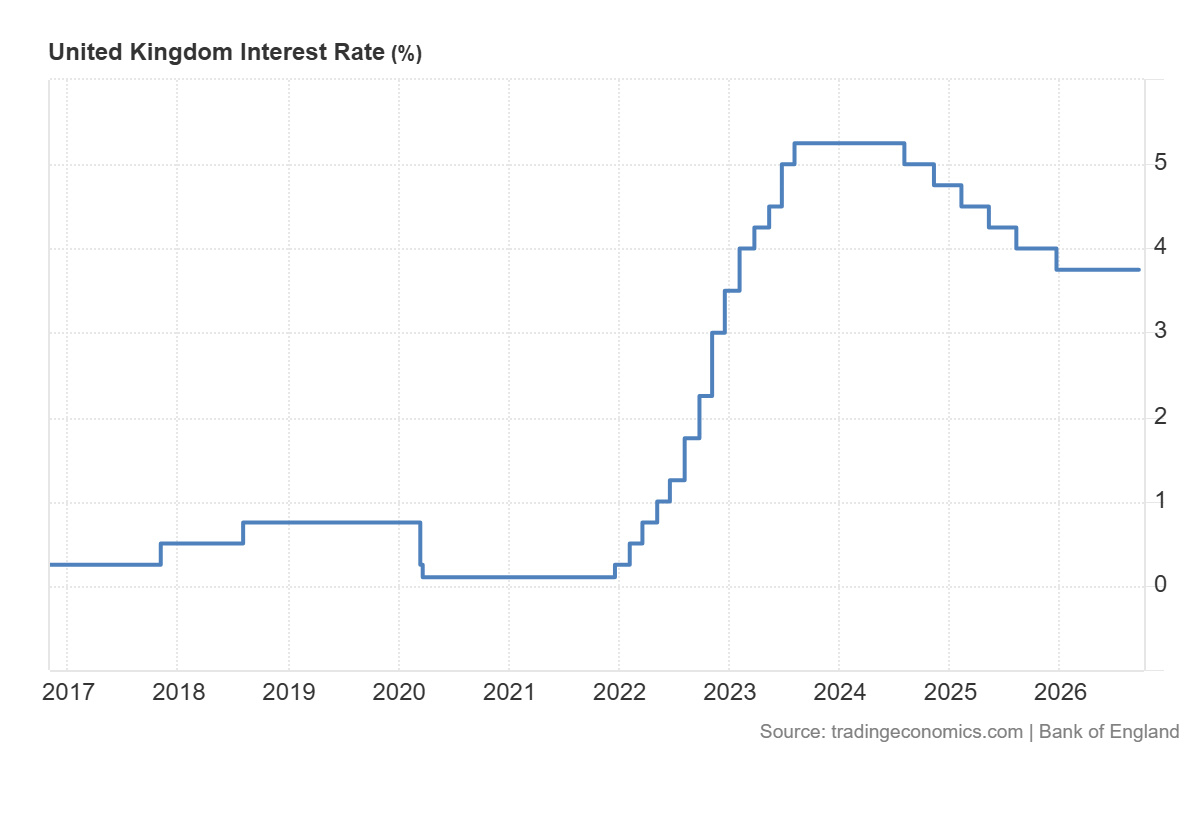
Analysts broadly expect the Monetary Policy Committee to lift Bank Rate from 3.75 percent to 4 percent. A Reuters poll of economists points the same way, and it would be the Bank's first increase since August 2023, when inflation was still running at more than triple its 2 percent target.
That poll also sketches the likely vote: 7-2, with external members Alan Taylor and Swati Dhingra the most probable holdouts for keeping rates steady. Deutsche Bank sees it tighter. Its call is a 6-3 majority for tightening, based on growing concern about how energy costs and growth will behave over the months ahead.
A second survey lands in much the same place. All of the economists in Bloomberg's Oct. 29-30 poll expect a move to 4 percent, which would end an 11-month stretch at 3.75 percent. Nearly 60 percent of respondents see a 7-2 vote for the hike against two against, while another 24 percent expect a 6-3 split.
Either result would be a sharp reversal from September, when only three members of the panel voted to raise rates.
History explains some of the urgency. The last time energy costs spiked, the Bank was criticized for misjudging how long inflation would hang around, and it is keen not to be caught out twice, with global energy prices high and no lasting end to the Iran war in sight.
In that earlier episode, it was among the first major central banks to raise rates. This time the U.S. Federal Reserve and the European Central Bank have gone first.
Prices Have Already Outrun the Bank's Forecast
The inflation numbers explain the caution. In September the Bank warned that inflation would climb above 4 percent early next year, and it said the jump in energy prices since its July forecasts looked a lot like its "adverse" scenario, the one in which inflation becomes entrenched. Since then, the data have come in hotter than the Bank expected.
Consumer prices rose 3.5 percent in the year to September, up from 3.1 percent in August and above the 3.0 percent the Bank had projected back in July. CPIH, the version that includes owner-occupiers' housing costs, climbed to 3.6 percent from 3.3 percent. Both gauges rose 0.4 percent on the month. A year earlier, CPI barely moved, and CPIH gained 0.1 percent.
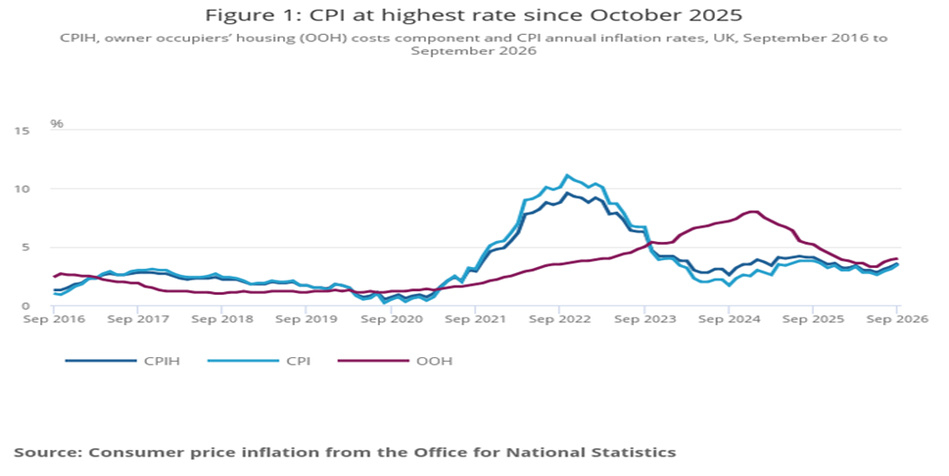
Economists expect the Bank to raise its inflation forecasts for this year and next when it publishes new projections on Thursday.
Dennis Shen, a lecturer at the International School of Management in Berlin, thinks the hike is "the beginning of a cycle, even if a short one," rather than a single adjustment. With inflation possibly topping 4 percent early next year, roughly double the Bank's target, he sees little room for complacency.
Hiring Turns Up Just as Rates Are About to Rise
The labor market has handed the hawks something to point at. Unemployment fell to 4.7 percent in the three months to August. Forecasters had expected it to sit at 4.9 percent for a fifth straight reading, and it's now the lowest rate since the three months to July 2025.
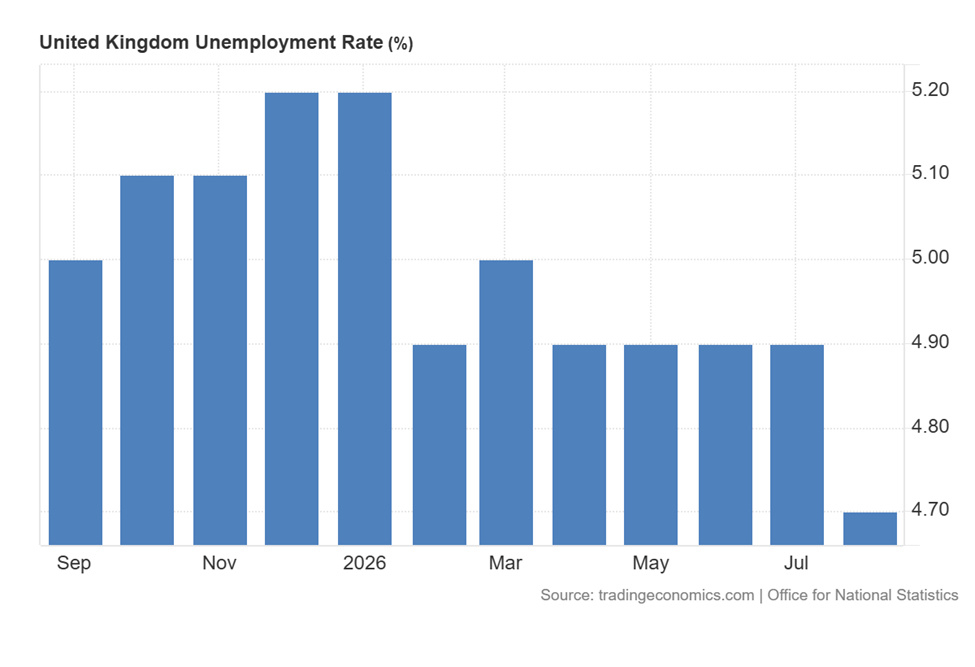
Under the headline, the number of unemployed people dropped by 47,000 from the previous quarter to 1.712 million, with declines among those out of work for up to six months and for six to 12 months. Compared with a year ago, the count is down 26,000. Employment grew by 102,000 on the quarter and 356,000 on the year to 34.577 million, and the employment rate edged up to 75.3 percent.
Surveys are telling a similar story. Rob Wood, chief UK economist at Pantheon Macroeconomics, called the biggest development in S&P's October PMI data the composite employment index rising above 50 for the first time since the 2024 budget. The jobs balance moved to 50.5 from 48.9 in September, which he reads as consistent with payroll growth of about 9,000 for the month.
Wood says that steady recovery strengthens the case for a November hike, which he regards as a near certainty, followed by another in February. Pantheon expects a third in May or earlier, though weak consumer signals make that one a close call.
An Economy Growing Unevenly, Led by Services
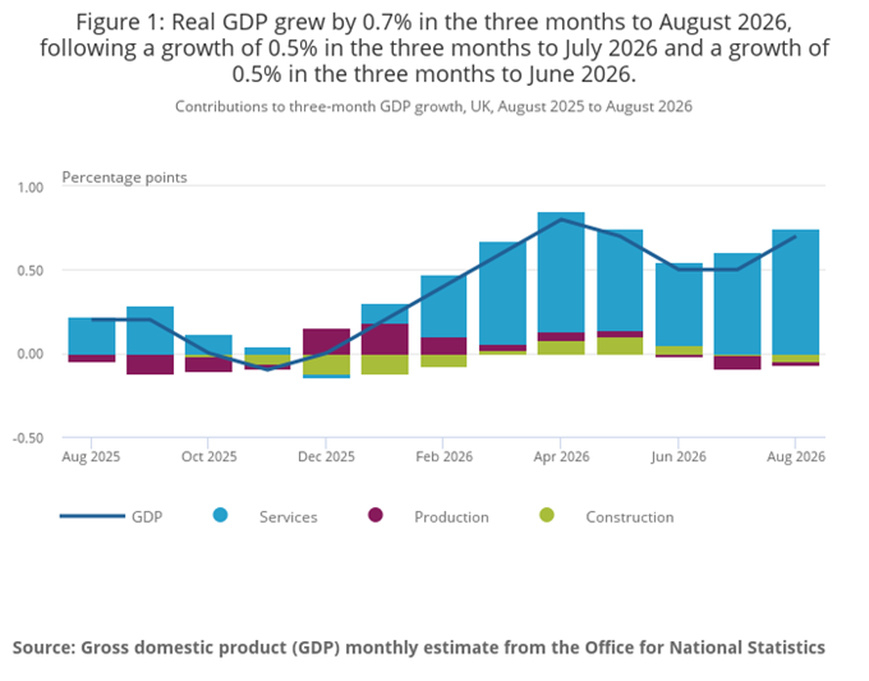
The output figures add a wrinkle to that picture. Growth is still lopsided, with a manufacturing-led rebound in production offset by weakness in other sectors. August itself was quiet. GDP rose just 0.1 percent on the month, slowing from 0.4 percent in July. Production rebounded 0.8 percent, services stagnated, and construction fell 0.2 percent.
The three-month view looks better. Output grew 0.7 percent over the three months to August, up from 0.5 percent in the three months to July (itself revised up from 0.4 percent). Services carried it with a 0.9 percent gain, while production slipped 0.2 percent and construction dropped 1.0 percent.
How Much Evidence Is Enough?
All of this lands on a committee that can't agree on how to read it. BoE officials have sounded more hawkish in recent weeks, and Bloomberg Economics tracks the shift with BOESPEAK, a natural language processing model that scores what committee members say in public. It shows hawkish sentiment at its highest in almost three years.
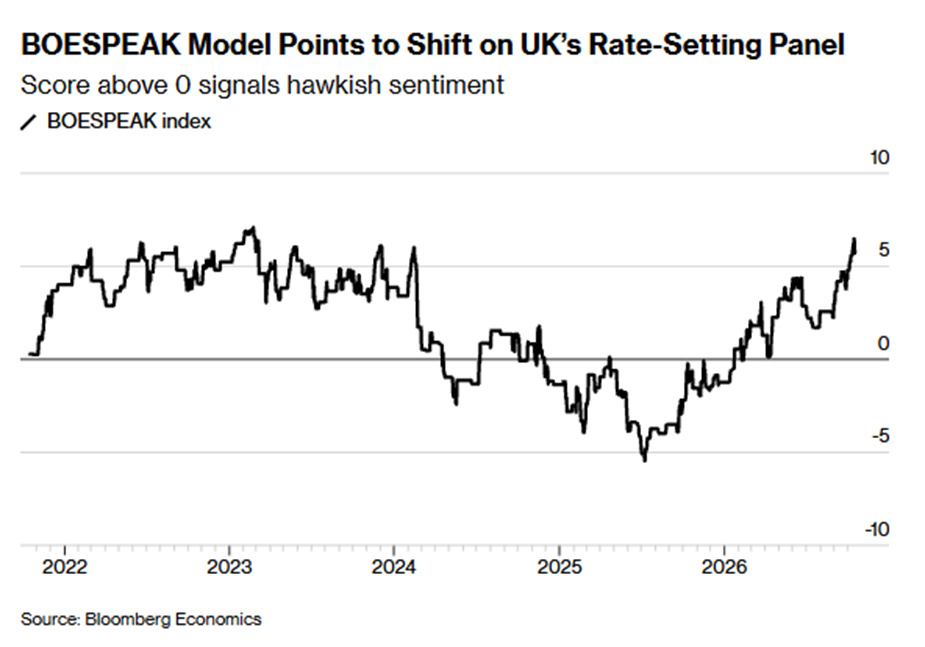
Two arguments sit behind that shift, and the committee hasn't settled either. How much evidence of second-round effects is enough to act on? And does a drawn-out Iran war make some of them inevitable? (Second-round effects are what happens when higher inflation feeds into wage and price setting.)
Governor Andrew Bailey has said the Bank can't wait for conclusive proof of those effects, or it will act too late. Last month he also said the businesses he has spoken to seem to be absorbing higher costs more than they did in 2022.
The committee's hawks have been sharper. Chief Economist Huw Pill and external members Catherine Mann and Megan Greene have all criticized how the Bank has handled the current episode.
Mann has a theory about those market bets. In her telling, they carry a risk premium that the Bank itself inflated by adopting a "wait-and-see" stance after war broke out in the Middle East, instead of signaling clearly that it would keep inflation in check. She says policy isn't tight enough, that the Bank can't count on risk premia to do the work of monetary policy, and that Bank Rate needs to go up.
Greene sees the biggest danger in leaving policy too loose. She has warned that the easing in wage growth has stalled, that second-round effects could surface early next year, and that the Bank would then need to act proactively. After a run of supply shocks, she says, UK policy remains relatively accommodative.
Pill points to resilient demand and upcoming wage settlements as inflation risks, although he's skeptical of the four rate increases the market has priced in.
Two of the Bank's deputy governors are edging toward the hawks, with conditions attached. Dave Ramsden says inflation risks have tilted further to the upside, with energy, weather and AI-related supply chains on his watch list, and that a rate increase may be needed if the pressure persists. Clare Lombardelli has warned that the Bank could raise rates if higher oil prices produce persistent inflation, since a prolonged energy shock can seep into wages, inflation expectations and price-setting.
The doves have their own case. Deputy Governor Sarah Breeden has suggested that businesses could absorb the energy shock by cutting costs instead of passing it on to consumers. Taylor and Dhingra have both cautioned against tightening too early.
Dhingra says Britain isn't living through the broad-based inflation spiral of 2022, that price pressures are narrower this time, and that the labor market is weakening. She expects the war's inflation impact to come into focus by winter.
So the Bank looks set to raise rates with a majority that agrees on the move but not on the reason. One camp calls it insurance against effects that haven't shown up yet. The other wonders what exactly is being insured. Winter should settle the argument, and by then there may be a second increase to defend.