
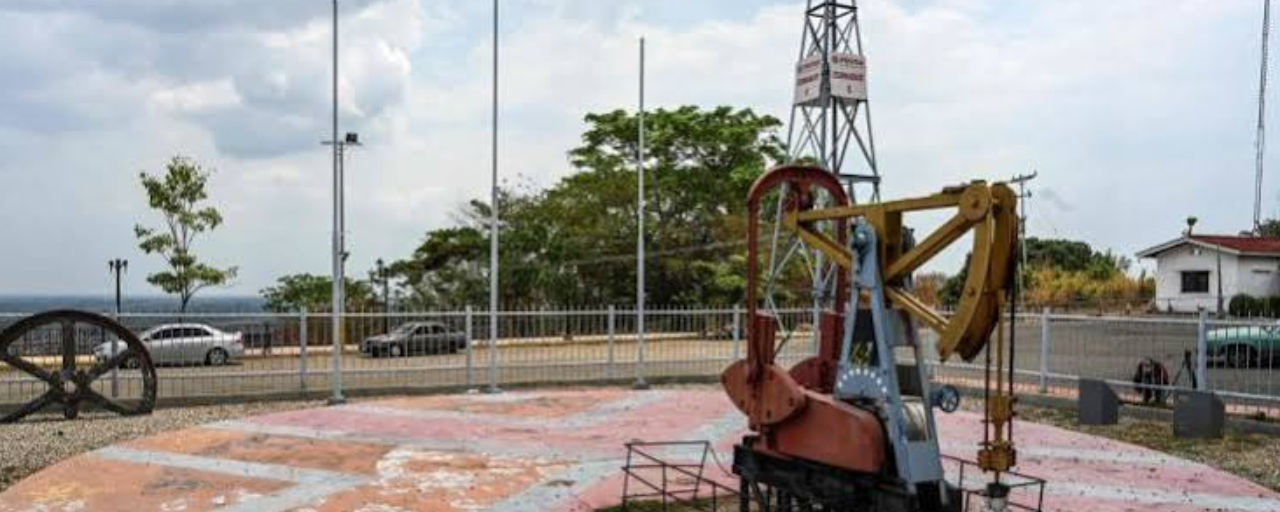

Venezuela today, October 24, 2026, is no longer in free fall. The economy remains oil-dependent, inflationary, and deeply unequal, but after years of contraction and emergency, there is finally a credible reason to speak about reconstruction rather than mere survival.
If we see current investment in the country as a champagne-glass tower, the logic is top-down and oil-led: new hydrocarbon income and investment first repair the fiscal position and financial system, then cascade through contractors, utilities, construction, equipment suppliers, commerce, and finally reach household incomes. The champagne should not remain at the top; the test of the next two years is whether it fills every glass below.
Venezuela’s 2026 starting point supports that sequencing. January’s hydrocarbons reform opened greater direct private participation and improved contractual, fiscal, and legal terms, while Chevron announced plans to invest more than US$7 billion over five years through its Venezuelan joint ventures, aiming to more than double its own output to about 600,000 barrels per day.
This is a conditional base case, not a guarantee. It assumes workable oil prices, stable licenses and contracts, credible execution by PDVSA, improving infrastructure, and a broadly predictable tax and labor framework. Chevron itself identifies policy, sanctions, market, and regulatory changes as material risks.
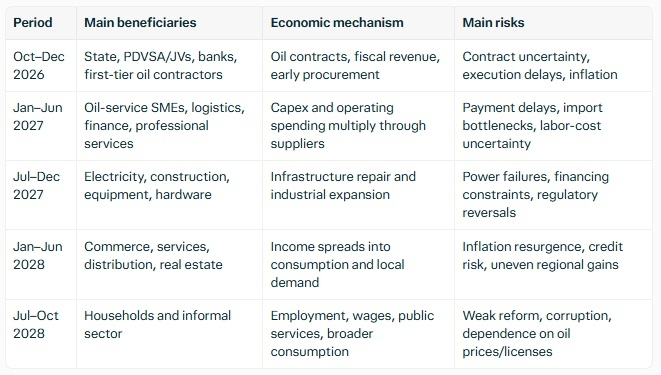
Stage 0 — October to December 2026: “Filling the top glass”
Who benefits first: Venezuelan state accounts, PDVSA and joint ventures, banks financing operators, and the first wave of oil-service companies.
Oil and gas companies convert new agreements into procurement, maintenance, drilling, workover, logistics, security, transport, and engineering contracts. Chevron’s joint ventures had already increased production 15% year-to-date by September 2026, and new agreements added acreage and investment commitments.
The state begins to receive more predictable inflows through royalties, taxes, dividends, and export-related revenue. The 2026 Hydrocarbons Law reform created Production Participation Contracts, allowing private operators greater operational and financial responsibility, while simplifying some fiscal arrangements.
SENIAT’s modernization matters here: digitalization, interoperability with SUDEBAN and SAREN, removal of some physical-document requirements, and no-expiry RIF reduce friction for formal companies, importers, and contractors.
Labor conditions remain restrictive: job-security protections run through December 2026, and employers still face parafiscal obligations including SSO, FAOV, INCES, and a pension contribution equal to 9% of salaries and bonuses.
Visible signal: More bank deposits and credit activity among oil-service firms; higher government spending capacity; early hiring in technical trades; better payment regularity from large operators.
Stage 1 — January to June 2027: Contractors and finance expand
Who benefits next: Oilfield-service SMEs, transport firms, camps and catering, maintenance companies, customs brokers, insurers, legal/accounting firms, and regional banks.
Contracts move from planning to execution. Equipment orders, spare parts, drilling inputs, valves, pipes, chemicals, generators, trucks, and specialized services rise. Chevron’s program alone is designed to expand production over five years, which requires a sustained local supply chain.
Banks begin to see stronger collateral, deposits, and repayment capacity among contractors. Credit may remain cautious, but trade finance, working-capital lines, and equipment leasing should improve before broad consumer lending.
SENIAT’s electronic-invoicing and customs digitalization can lower compliance costs for SMEs, especially if the announced mobile e-invoicing app reduces the need for costly fiscal printers.
Labor reform becomes a major variable. Authorities had announced a review of working hours, vacations, pensions, and social-security sustainability, while business groups were pushing for labor flexibility and fiscal incentives before the end of 2026.
Visible signal: More formal hiring in Zulia, Monagas, Anzoátegui, and Carabobo; improved payments from oil clients; rising imports of industrial inputs; first signs of hotel, transport, and food-service recovery near oil hubs.
Stage 2 — July to December 2027: Electricity, construction, and equipment
Who benefits next: Power-sector companies, construction firms, cement and steel suppliers, hardware stores, equipment importers, industrial maintenance firms, and real-estate services.
Higher oil activity exposes bottlenecks in electricity, ports, roads, water, and housing. That creates public and private demand for generation, transmission, transformers, cables, construction materials, and engineering services. Legislative work on the Electricity Law was already on the 2026 reform agenda.
Construction follows with a lag: first industrial and logistics projects, then worker housing, offices, warehouses, and commercial refurbishment. The government’s review of state assets and discussion of housing reforms could eventually release land and properties into more productive use.
The equipment and hardware sector sees a clear upturn because contractors and SMEs buy tools, safety gear, electrical materials, pumps, compressors, generators, and vehicles before consumers materially increase discretionary purchases.
If labor reform clarifies contracting rules, overtime, severance exposure, and outsourcing, firms can plan payrolls with less uncertainty. But if reform preserves rigid protections without offsetting productivity measures, companies may prefer temporary, outsourced, or capital-intensive solutions.
Visible signal: More construction permits, higher imports of electrical and building materials, rising industrial electricity demand, and stronger sales at hardware and equipment distributors.
Stage 3 — January to June 2028: Commerce and services broaden
Who benefits next: Wholesale distributors, retailers, restaurants, pharmacies, schools, health services, telecoms, tourism, and local professional services.
By now, wages and procurement income have spread beyond the oil corridor. Oil workers, contractors, construction employees, and public-sector vendors spend more on food, clothing, appliances, transport, education, health, and leisure.
Commerce becomes more formal because SENIAT’s simplified invoicing and digital procedures lower the relative cost of operating formally; the announced mobile invoicing tool is particularly relevant for small merchants.
Banks broaden credit from corporate and trade finance toward mortgages, auto loans, credit cards, and SME working capital—though only if inflation and payment behavior remain controlled.
The champagne tower is now several layers deep: the state’s oil revenue has become salaries, supplier payments, tax receipts, bank deposits, and retail sales.
Visible signal: Higher foot traffic in commercial areas, more imports of consumer goods, stronger demand for housing rentals, and growth in service employment rather than only technical oil employment.
Stage 4 — July to October 2028: Household-level recovery
Who benefits last: Ordinary households, especially those connected directly or indirectly to formal employment.
By late 2028, the effect reaches people through more jobs, higher real incomes, better access to dollars or formal banking, improved public services, and greater availability of goods.
The improvement will be uneven. Oil-producing states, major cities, logistics corridors, and formal SMEs should feel it first; rural areas and informal workers will lag unless public transfers, agriculture, and local infrastructure also improve.
Labor and pension reform will determine how inclusive the final stage is. A reform that raises formal wages without exploding labor costs could broaden consumption; one that sharply raises non-wage costs could slow hiring and push activity back into informality.
The most important test is whether the state uses the additional oil revenue to reduce bottlenecks—electricity, ports, roads, water, health, and education—rather than merely expanding current spending.
Visible signal: More formal jobs, higher retail sales outside oil zones, greater bank penetration, improved availability of imported goods, and a gradual recovery in real wages.
What SENIAT and labor reform can change
SENIAT can accelerate the cascade if it continues reducing paperwork, digitizing customs and invoicing, and making compliance affordable for SMEs. The 2026 measures—software-homologation elimination, RIF simplification, reduced physical documentation, and planned mobile e-invoicing—point in that direction.
Labor reform can either amplify or restrain the final stages. Venezuela’s current framework is highly protective, with job-security rules through December 2026 and significant employer contributions; announced reforms address working hours, vacations, pensions, and social-security financing. A balanced outcome would formalize more employment, make hiring predictable, and finance pensions without making SME labor costs prohibitive.
In short: October 2026 to late 2027 should look like an industrial and fiscal recovery; 2028 should be when it becomes visible in commerce, credit, services, and household welfare. The process is real, but its speed depends less on the champagne tower’s shape than on whether each “glass” actually receives the flow: contracts paid on time, electricity available, banks lending, taxes predictable, and labor rules investable.