


South Korean retail investors lost a net 6.313 trillion won on single-stock leveraged and inverse ETPs between the products’ May 27 debut and August 14. The figures come from Financial Supervisory Service data submitted to lawmaker Park Sung-hoon and reported on October 21. The products track twice the daily move of Samsung Electronics or SK Hynix.
A 6.313 trillion won loss across 546,000 accounts
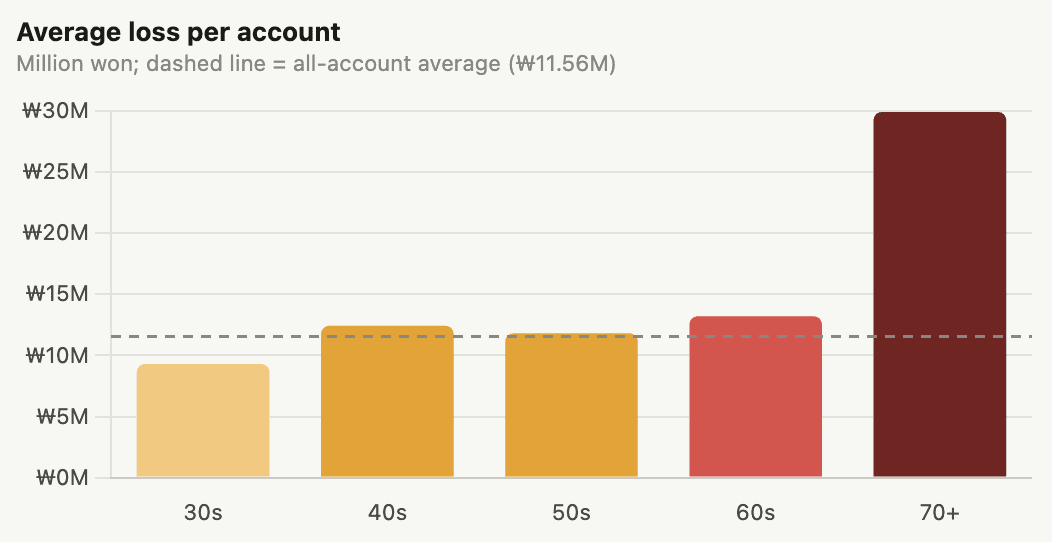
The FSS combined trading data from 10 large brokerages, covering every individual account that traded the products at least once in the period. That was 546,000 accounts, with an average loss of about 11.56 million won each.
Realized losses from completed trades totalled 2.3242 trillion won. Unrealized losses on positions still held were 3.9888 trillion won, or 63.2% of the total. Those paper losses were marked on August 14 and do not reflect price moves since.
Investors in their 40s lost the most in total
Age group | Accounts | Total loss (won) | Average per account (won) |
|---|---|---|---|
30s | 117,300 | 1.0912 trillion | 9.30 million* |
40s | 165,200 | 2.0530 trillion | 12.43 million* |
50s | 158,000 | 1.8655 trillion | 11.81 million* |
60s | 61,000 | 805.9 billion | 13.21 million |
70 and over | 9,800 | 293.4 billion | 29.94 million |
All accounts | 546,000 | 6.313 trillion | 11.56 million |
*Calculated from reported totals and account counts.
Investors in their 40s and 50s together accounted for 3.9185 trillion won, or 62.1% of all losses.
Over-70s lost 2.6 times the average per account
The oldest group traded through the fewest accounts but lost the most per account: 29.94 million won, about 2.6 times the all-account average. The figures are per account, not per investor. One person can hold accounts at more than one brokerage.
Realized losses accelerated in August
Between end-July and August 14, realized losses rose by 360.4 billion won while unrealized losses fell by 50.7 billion won. Total losses grew by 309.7 billion won to 6.313 trillion won. The shift is consistent with investors selling losing positions, but price moves and new trades also affect the figures. The FSS data cannot show why investors sold or whether any positions were forcibly liquidated.
Political fallout at the parliamentary audit
The products have been a flashpoint in this month’s National Assembly audit. Financial Services Commission Chairman Lee Eog-weon apologised on October 8 for investor losses and market disruption, while denying claims the products were introduced on the presidential office’s orders. Because the FSS tally covers only 10 brokerages and stops on August 14, actual retail losses may be larger.