

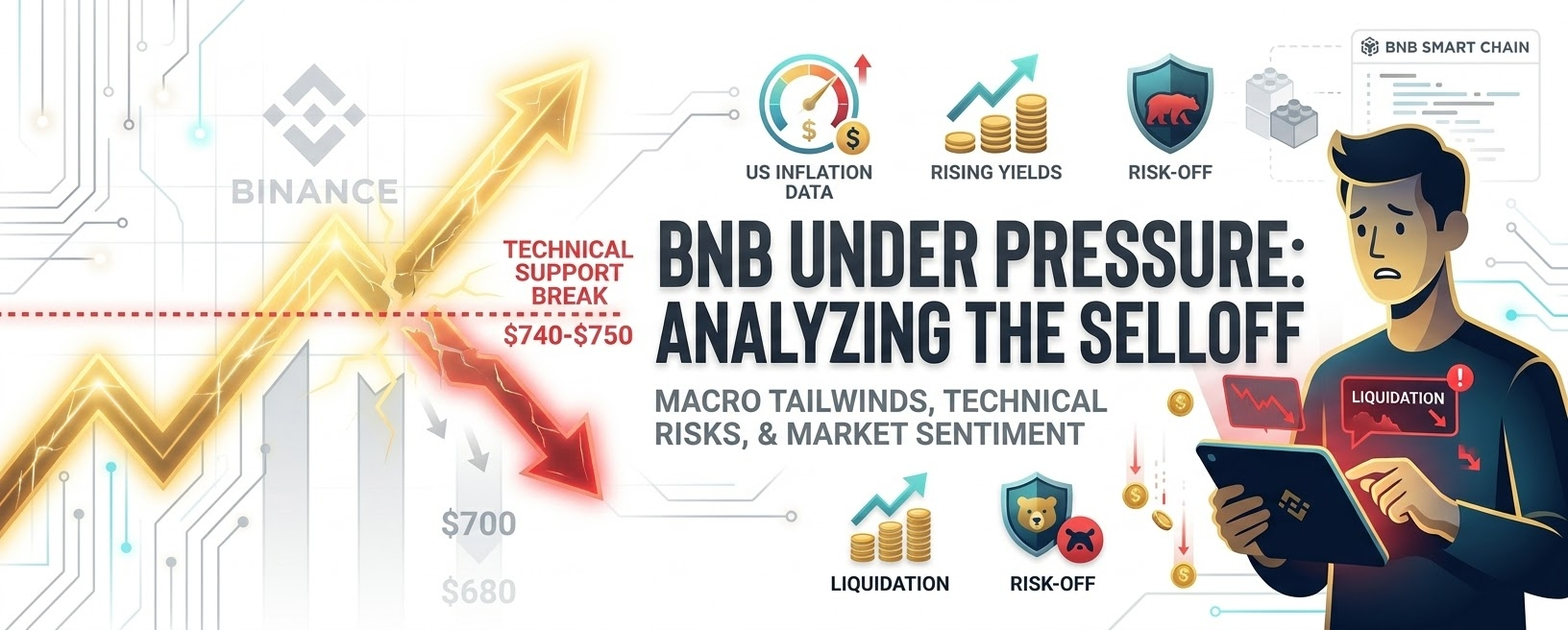


I’m reading the current weakness in BNB as a combination of macro pressure, technical deterioration, and reduced speculative positioning rather than a single isolated catalyst.
The broader crypto market is dealing with a more defensive environment after stronger-than-expected U.S. inflation data changed expectations around the Federal Reserve’s next moves. Higher Treasury yields and a firmer dollar generally make liquidity conditions less supportive for risk assets, and crypto tends to feel that shift quickly.
For BNB, that macro pressure is being amplified by its own market structure.
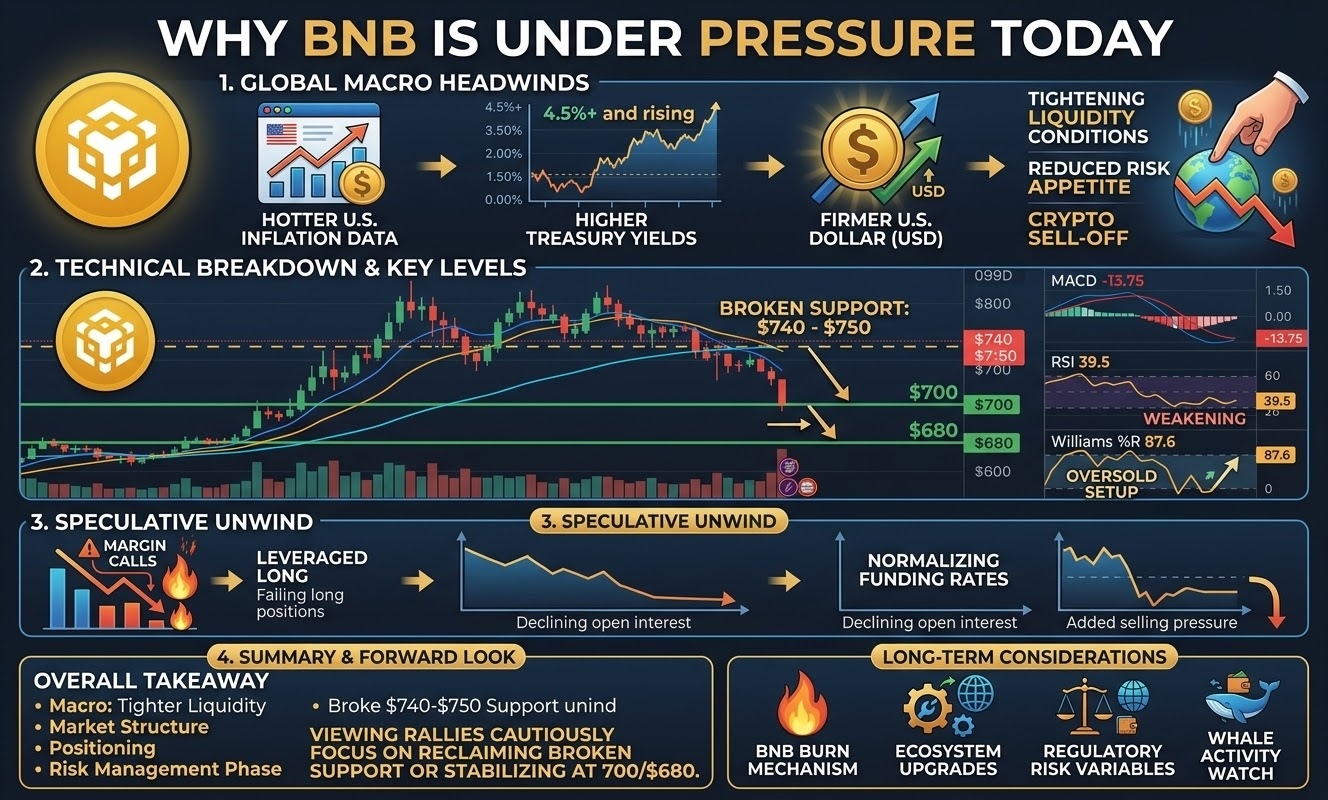
Macro Conditions Are Working Against Risk Assets
The inflation picture has pushed traders to reassess how quickly monetary policy could become less restrictive. When expectations for rate cuts weaken, yields can rise and the dollar can strengthen.
That combination matters because it increases the opportunity cost of holding volatile assets.
I’m therefore not surprised to see pressure spreading across digital assets. Weakness in technology equities and outflows from major spot crypto products add another layer to the risk-off environment.
BNB is being affected by that broader liquidity contraction rather than trading in isolation.
Technical Support Has Started to Break
The more immediate concern is the loss of important short-term levels.
BNB has moved below the $740-$750 area, which had been an important technical zone. Once support fails, automated stop-loss orders and leveraged positions can accelerate the move.
The next areas I’m watching are around $700 and $680.
The distinction is important. A move toward those levels would not automatically mean the longer-term structure has failed, but it would indicate that sellers have gained considerably more control over the short-term market.
Derivatives Are Adding to the Selling Pressure
The derivatives market appears to be contributing to the weakness.
As BNB moved lower, leveraged long positions were forced to reduce exposure. At the same time, perpetual funding rates have normalized and speculative open interest has contracted.
That tells me some of the previous positioning is being unwound.
This can create a feedback loop: price falls, leveraged traders close positions, liquidations add additional selling, and weaker technical levels then attract more defensive positioning.
It is one reason crypto corrections can move much faster than the underlying fundamentals.
BNB's Ecosystem Still Has Longer-Term Factors
The short-term price action shouldn’t completely obscure the broader BNB ecosystem.
Binance has been streamlining products and services while focusing resources around its core exchange infrastructure and BNB Smart Chain development. The network’s continued technical upgrades remain relevant to the long-term utility discussion.
The BNB burn mechanism is another structural factor investors continue to monitor because it affects the token’s supply over time.
But I would separate those longer-term considerations from today’s trading conditions. A favorable supply mechanism doesn’t prevent a token from falling when liquidity is tightening and traders are reducing risk.
Markets have an irritating habit of caring about timing.
Regulatory and Compliance Risk Remain Variables
There is also an ongoing regulatory dimension around Binance’s global operations and compliance framework.
During stable market conditions, these concerns may receive less attention. During a selloff, however, investors tend to become more sensitive to anything that could increase uncertainty around an exchange-linked ecosystem.
That doesn't necessarily explain the entire move in BNB, but it can contribute to volatility when broader sentiment is already weak.
Whale Activity Adds Another Layer
Large-wallet behavior is also worth monitoring.
Transfers from sizeable holders toward exchange deposit addresses can increase potential spot supply, particularly when price has already struggled around resistance.
I wouldn’t automatically interpret every large transfer as a sale. Wallet movements have multiple possible explanations. But when those transfers appear alongside weakening technical structure and declining risk appetite, they become another signal worth keeping on the radar.
Technical Momentum Is Weak, but Not Without a Possible Bounce
The current indicators paint a mixed picture.
The MACD around -13.746 reflects negative momentum, while the RSI near 39.45 shows that selling pressure has pushed BNB toward weaker territory without yet reaching deeply oversold conditions.
The Williams %R reading around 87.62 points toward an oversold setup under the convention used in the analysis.
That combination leaves room for a short-term relief bounce, but I would want to see price reclaim broken support before treating such a bounce as a meaningful reversal.
My Takeaway
For me, BNB’s current decline is best understood as a three-layer problem.
Macro: hotter inflation, higher yields and tighter liquidity are reducing appetite for risk.
Market structure: the loss of the $740-$750 zone has weakened the short-term chart and exposed $700 and $680 as the next areas to watch.
Positioning: declining open interest and long liquidations suggest speculative exposure is being removed rather than aggressively rebuilt.
The longer-term BNB ecosystem story and its supply mechanics remain relevant, but they don't override short-term liquidity conditions.
Right now, I’m watching whether BNB can stabilize around the next support zones and eventually reclaim the broken $740-$750 area. Until that happens, I’d treat rallies cautiously and view the market as being in a risk-management phase rather than assuming the decline is already finished.
$BNB $AGT $BTC #BrentHits$110ForFirstTimeSinceMay #BitcoinRecoversTo$82K #BitcoinShortTermHoldersReach4.08MBTC #BNB_Market_Update
