

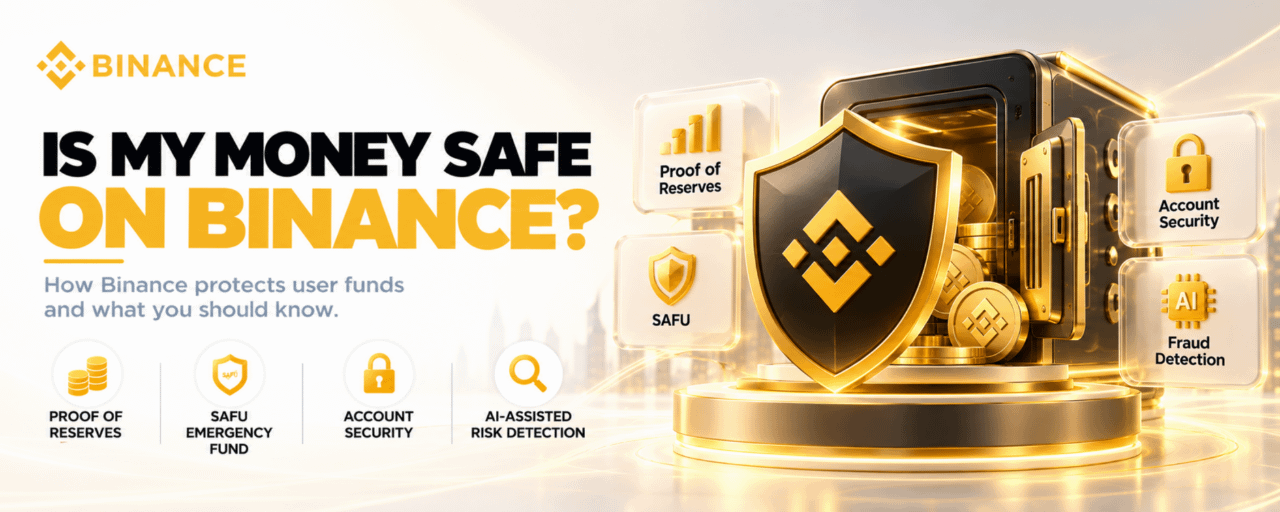

Binance uses multiple layers of protection to help safeguard user funds, including Proof of Reserves (PoR), the Secure Asset Fund for Users (SAFU), account-security tools, and systems designed to detect fraud and suspicious transactions. However, no crypto exchange can guarantee that your money is completely risk-free.
Understanding how these safeguards work—and what they do not cover—can help you make more informed decisions about storing and managing your crypto assets.
How Does Binance Protect Customer Funds?
Binance uses several security measures designed to address different risks, from account takeovers and phishing to platform-level security incidents.
These measures include:
Proof of Reserves: Provides a way for users to verify that their account balances were included in the relevant reserve calculation.
SAFU: An emergency reserve fund intended to help protect users in extreme situations.
Account-security controls: Features such as two-factor authentication, passkeys, anti-phishing codes, and withdrawal address allowlisting.
AI-assisted risk detection: Systems designed to identify suspicious transactions, phishing attempts, and potential scams.
No single measure addresses every possible risk. Users should understand how each protection works and take steps to secure their own accounts.
What Is Binance's Proof of Reserves and How Does It Work?
Proof of Reserves (PoR) is a transparency mechanism that allows users to verify whether their account balances were included in Binance's reserve verification process.
Binance uses Merkle Trees and zk-SNARKs to support cryptographic verification while protecting individual account information.
A Merkle Tree organizes account information into a structure that can be verified using cryptographic hashes. zk-SNARKs help verify properties of the reserve calculation without publicly exposing individual account details.
Users can review the available reports and verification resources here:
https://www.binance.com/en/proof-of-reserves
Binance also provides instructions for checking account inclusion in its PoR process:
https://www.binance.com/en/support/faq/detail/815b25f0cb054bdd9d35eccc408fe981
What are the limitations? PoR reflects a particular verification snapshot and the assets covered by the process. It should not be treated as a complete independent assessment of every liability, operational risk, or possible future loss. It also does not guarantee that an account cannot be compromised.
What Is Binance's SAFU Fund and How Does It Protect Users?
The Secure Asset Fund for Users (SAFU) is an emergency reserve established by Binance in 2018 to help protect users in extreme situations, such as certain security breaches or platform-level incidents.
According to Binance, SAFU held crypto assets valued at approximately US$1 billion as of February 2026. The fund's value can fluctuate with market conditions.
Learn more in Binance's official SAFU FAQ:
https://www.binance.com/en/support/faq/detail/028799e730294ae4a9b382d60d350116
SAFU serves a different purpose from Proof of Reserves. PoR provides information that helps users verify the inclusion of their balances in a reserve calculation, while SAFU is an emergency reserve that Binance may use to compensate eligible users in qualifying incidents.
SAFU should not be interpreted as universal insurance. It does not guarantee reimbursement for every type of loss, including losses caused by market movements, user mistakes, scams, or every possible security incident.
How Does Binance Use AI and Security Technology to Protect User Assets?
Fraud tactics continue to evolve, including phishing, impersonation, and scams that exploit human behavior. Binance reports using AI-assisted risk systems to help identify suspicious activity and support real-time risk decisions.
In an October 7, 2026 security update, Binance reported that its systems helped protect more than 8 million users and prevent approximately US$4.6 billion in potential losses during the first half of 2026. These are company-reported estimates of potential losses prevented, not guarantees that future fraud will be stopped.
Read Binance's security update:
https://www.binance.com/en/blog/security/8785025149838654560
Users can also strengthen their accounts with several security controls:
Two-factor authentication (2FA): Adds another verification step.
Passkeys: Provide an alternative authentication method designed to reduce exposure to password theft and phishing.
Anti-phishing codes: Help users distinguish genuine Binance communications from impersonation attempts.
Withdrawal address allowlisting: Restricts withdrawals to approved addresses when enabled.
Device and login reviews: Help users identify unfamiliar account activity.
For more guidance, visit Binance's account-security guide:
https://www.binance.com/en/support/faq/detail/115002439332
These tools can reduce certain risks, but they cannot eliminate every attack. Users should never share passwords, authentication codes, or wallet recovery phrases with someone claiming to be customer support.
What Happens to My Assets if a Crypto Exchange Becomes Insolvent?
If a crypto exchange becomes insolvent, access to customer assets may be affected while the situation is assessed and resolved. The outcome depends on factors such as the applicable legal entity, custody arrangements, contractual terms, local law, and the treatment of customer assets during insolvency proceedings.
Proof of Reserves does not guarantee protection against insolvency, and SAFU is not a guarantee that all customer assets will be reimbursed in every scenario.
Users should understand the terms applicable to their account and the legal entity providing the service. They should also consider whether keeping all assets on a centralized exchange fits their needs.
Self-custody is another option, but it introduces its own responsibilities and risks. Losing a recovery phrase or making an irreversible transfer to the wrong address can result in permanent loss.
Frequently Asked Questions
Is my money safe on Binance?
Binance provides multiple safeguards, including Proof of Reserves, SAFU, account-security tools, and fraud-detection systems. These measures address different types of risk, but they do not make crypto assets completely risk-free or guarantee that every loss will be reimbursed.
What happens to my money if Binance shuts down?
The outcome would depend on the circumstances, the applicable legal entity, custody arrangements, contractual terms, and relevant legal proceedings. Users should not assume that PoR or SAFU guarantees immediate access to all assets or full reimbursement in every shutdown scenario.
What security measures does Binance use to prevent unauthorized transactions?
Binance provides security features such as 2FA, passkeys, anti-phishing codes, and withdrawal address allowlisting. Users should enable appropriate protections, review login activity, and verify withdrawal addresses and transaction details before confirming transfers.
Official security guide:
https://www.binance.com/en/support/faq/detail/115002439332
How is Binance's SAFU fund different from Proof of Reserves?
Proof of Reserves helps users verify that their account balances were included in a reserve calculation. SAFU is an emergency reserve that may be used to compensate eligible users in qualifying extreme incidents. They serve different purposes, and neither guarantees protection against every possible loss.
Does Binance reimburse users if funds are stolen in a hack?
Binance may use SAFU to compensate eligible users in qualifying security incidents. However, reimbursement is not automatic for every loss and depends on the circumstances and applicable eligibility conditions. Users should not assume that every scam, compromised account, unauthorized transfer, or market loss will be covered.
Final Takeaway
Binance uses multiple safeguards to address risks involving customer assets, account security, and suspicious activity. Proof of Reserves, SAFU, AI-assisted fraud detection, and account-security controls each serve a different role.
The important distinction is that security measures reduce certain risks; they do not eliminate all risks or guarantee reimbursement.
Before depositing funds, review the relevant product terms, understand the available protections and their limitations, and secure your account. Making an informed decision means understanding not only what a platform does to protect users, but also what those protections cannot promise.