

The data behind AI and Web3 keeps growing, but blockchains were never built to hold large files.
BUSINESS
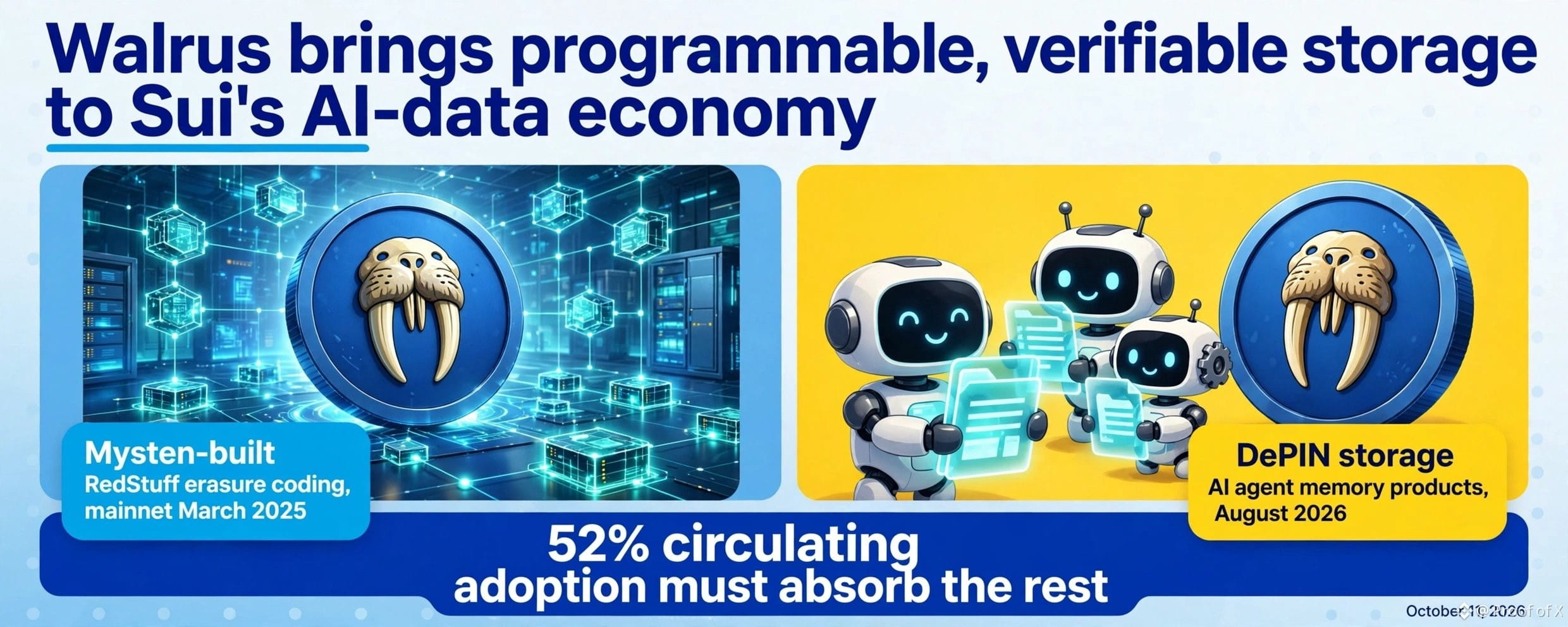
Walrus is a decentralized storage and data availability protocol built on Sui, originally developed by Mysten Labs, the team behind the Sui blockchain itself.
The network stores the large files that chains handle badly: video, AI datasets, application assets, and entire websites.
Users pay for storage in $WAL for fixed time periods, and those payments flow to storage nodes and their stakers, tying token demand to real storage consumption.
Mainnet went live on March 27, 2025, after the Walrus Foundation raised 140 million dollars in a private token sale led by Standard Crypto, with a16z crypto and Franklin Templeton Digital Assets participating.
By 2026 the network had reportedly surpassed 450 terabytes of stored data, with AI-focused products and partnerships building on top of it.
TECHNOLOGY
Walrus uses a novel two-dimensional erasure-coding scheme called RedStuff that splits each file into shards distributed across many storage nodes.
The network recovers data even when up to two thirds of the shards are missing, while requiring only about four to five times the original data in replication.
Security comes from delegated proof of stake: $WAL staking decides which nodes hold data shards each epoch, and misbehaving nodes can be slashed.
Stored blobs are native Sui objects, so smart contracts can buy, own, extend, and transfer storage directly onchain.
Developers get first-class tooling, including a command-line interface, JSON and HTTP APIs, and software development kits, with the protocol written in Sui's Move language.
SECTOR
Walrus sits in the decentralized storage corner of the DePIN sector, where raw capacity and programmability compete for developer attention.
The tailwind this year is AI: portable AI-agent memory products launched on Walrus in August 2026, and the Sui and Google Cloud collaboration on onchain AI agents creates enterprise demand for storage fees paid in $WAL.
Decentralized storage keeps growing as an alternative to centralized clouds, but the sector rewards protocols that convert real usage into sustained demand.
COMPETITION
$FIL and $AR are the entrenched names in decentralized storage, each with deeper ecosystems and longer operating histories than Walrus.
$FIL built the largest open storage marketplace in crypto while $AR carved out permanent archival storage, and Walrus differentiates through Sui-native programmability, storage that smart contracts can trade and manage, plus a focus on AI data workloads rather than pure capacity or archival use.
The trade-off is dependence: Walrus lives entirely inside the Sui ecosystem, so its trajectory follows Sui adoption.
TOKENOMICS
Per CoinGecko data verified this run, $WAL carries a market cap near 102 million dollars against a fully diluted valuation near 195 million dollars.
About 2.62 billion of the 5 billion maximum supply circulates, so roughly 52 percent is unlocked and the remaining 48 percent represents future supply overhang.
Value capture runs through storage payments, staking rewards for securing the network, and governance of protocol parameters.
No verifiable unlock schedule was found this run.
Not financial advice. DYOR.
$WAL