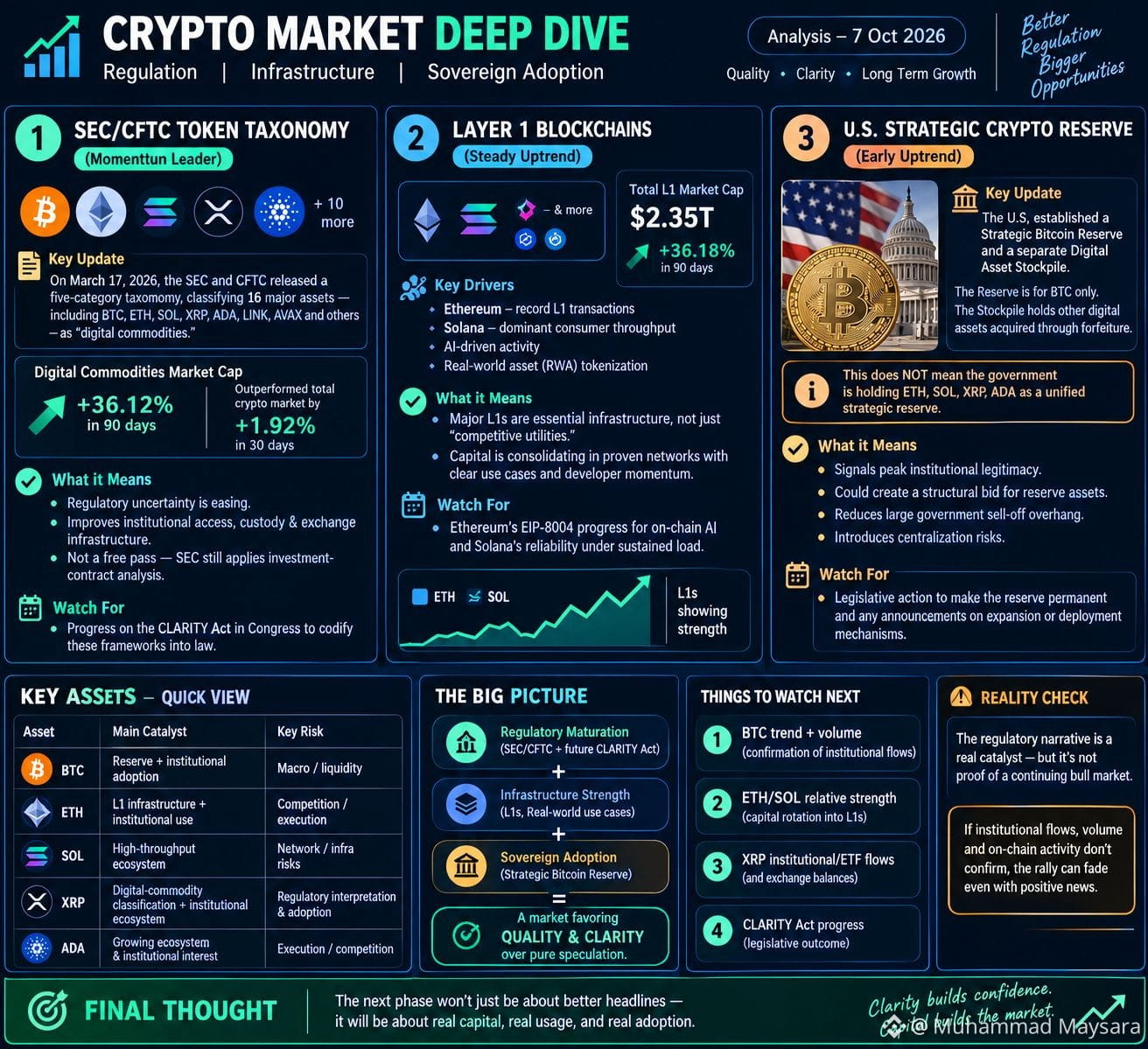
Your thesis is **directionally strong, but two important details need correction** before using it as a crypto-market conclusion.
### 🔎 Deep-Dive Market Read — 7 Oct 2026
**1. SEC/CFTC taxonomy — genuinely important**
The March 17, 2026 SEC/CFTC framework is real. It created five categories and explicitly listed **BTC, ETH, SOL, XRP, ADA, LINK, AVAX and others as “digital commodities.”** The official list contains **16 named digital commodities**, not 18. ([Commodity Futures Trading Commission](https://www.cftc.gov/LawRegulation/FederalRegister/finalrules/2026-05635.html?utm_source=chatgpt.com "2026-05635 | CFTC"))
The key nuance: being a digital commodity does **not** mean every transaction involving the token is automatically outside securities law. The SEC explicitly retained the investment-contract analysis. ([Commodity Futures Trading Commission](https://www.cftc.gov/LawRegulation/FederalRegister/finalrules/2026-05635.html?utm_source=chatgpt.com "2026-05635 | CFTC"))
**Market implication:** regulatory uncertainty has been reduced, which can improve the environment for institutional products, custody and exchange infrastructure—but it doesn't guarantee price appreciation.
---
**2. Layer-1 narrative — structurally constructive**
Your L1 argument makes sense: capital can rotate toward established networks when investors prefer infrastructure/use cases over speculative micro-caps.
Solana also had a useful resilience test in August 2026: an infrastructure-provider routing failure temporarily knocked nearly 29% of stake offline, yet blocks continued and transactions kept landing. ([Solana](https://solana.com/news/solana-building-trust-in-public?utm_source=chatgpt.com "Solana: Building, Proving and Earning Trust in Public | Solana Media"))
So the important question isn't simply *“Are L1s bullish?”* It's whether **capital continues flowing into ETH/SOL and other established networks while activity and liquidity expand.**
---
**3. U.S. Strategic Crypto Reserve — correction needed ⚠️**
This is the biggest issue in your original text
### 🔎 Deep-Dive Market Read — 7 Oct 2026
**1. SEC/CFTC taxonomy — genuinely important**
The March 17, 2026 SEC/CFTC framework is real. It created five categories and explicitly listed **BTC, ETH, SOL, XRP, ADA, LINK, AVAX and others as “digital commodities.”** The official list contains **16 named digital commodities**, not 18. ([Commodity Futures Trading Commission](https://www.cftc.gov/LawRegulation/FederalRegister/finalrules/2026-05635.html?utm_source=chatgpt.com "2026-05635 | CFTC"))
The key nuance: being a digital commodity does **not** mean every transaction involving the token is automatically outside securities law. The SEC explicitly retained the investment-contract analysis. ([Commodity Futures Trading Commission](https://www.cftc.gov/LawRegulation/FederalRegister/finalrules/2026-05635.html?utm_source=chatgpt.com "2026-05635 | CFTC"))
**Market implication:** regulatory uncertainty has been reduced, which can improve the environment for institutional products, custody and exchange infrastructure—but it doesn't guarantee price appreciation.
---
**2. Layer-1 narrative — structurally constructive**
Your L1 argument makes sense: capital can rotate toward established networks when investors prefer infrastructure/use cases over speculative micro-caps.
Solana also had a useful resilience test in August 2026: an infrastructure-provider routing failure temporarily knocked nearly 29% of stake offline, yet blocks continued and transactions kept landing. ([Solana](https://solana.com/news/solana-building-trust-in-public?utm_source=chatgpt.com "Solana: Building, Proving and Earning Trust in Public | Solana Media"))
So the important question isn't simply *“Are L1s bullish?”* It's whether **capital continues flowing into ETH/SOL and other established networks while activity and liquidity expand.**
---
**3. U.S. Strategic Crypto Reserve — correction needed ⚠️**
This is the biggest issue in your original text