
Back on Sep 23 I shared a breadth framework on X but never posted it here, so let me put both parts together.
At the time, altcoin breadth was starting to improve. More coins were outperforming Bitcoin and the market looked less dependent on a tiny group of winners.
That was encouraging, but breadth expanding during a strong BTC rebound isn't new. We've seen it several times over the last 5–6 years. What usually failed was keeping that participation alive once Bitcoin stopped doing all the work.
So the real test was what happens while BTC consolidates. I wanted to see two things.
The number of altcoins beating Bitcoin should stay high.
And if you remove the strongest leaders, the rest of the market shouldn't fall straight back into negative territory.
If breadth collapses as soon as BTC loses momentum, it was probably just a strong relief move rather than a real change in market structure.
Here's where things stand now.
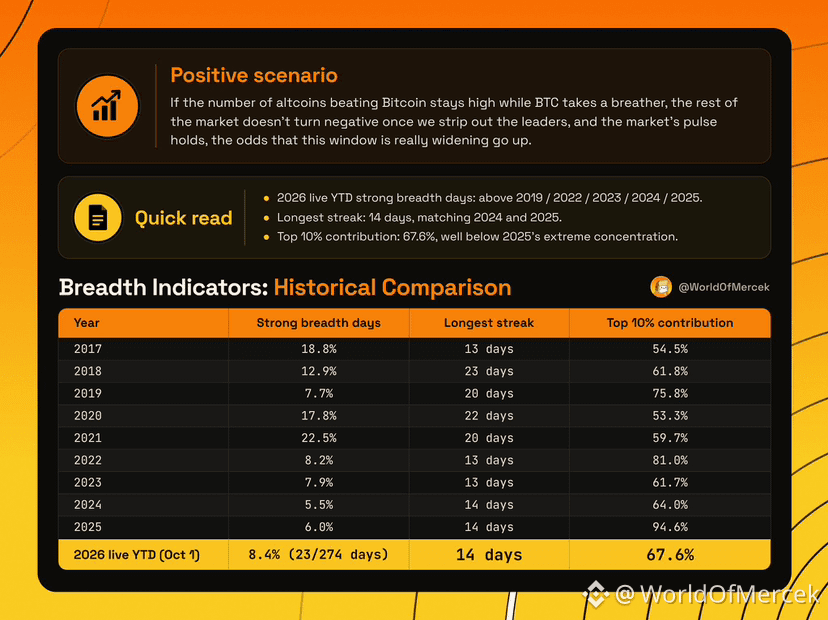
So far in 2026, 8.4% of days have shown strong breadth. That's the highest since 2021, and above 2019, 2022, 2023, 2024 and 2025.
The longest streak is 14 days, the same as 2024 and 2025.
The part I care about most is concentration. The top 10% of coins accounted for 67.6% of the total contribution. Last year that was 94.6%, which means the move was much more dependent on a handful of names. It's not exactly the second condition, but it points the same way: this move is leaning less on its leaders.
We're still well below the breadth we saw in 2017, 2018, 2020 and 2021, so I'm not calling this an altseason.
But for now, the picture is leaning toward the positive branch of that scenario tree.
At the time, altcoin breadth was starting to improve. More coins were outperforming Bitcoin and the market looked less dependent on a tiny group of winners.
That was encouraging, but breadth expanding during a strong BTC rebound isn't new. We've seen it several times over the last 5–6 years. What usually failed was keeping that participation alive once Bitcoin stopped doing all the work.
So the real test was what happens while BTC consolidates. I wanted to see two things.
The number of altcoins beating Bitcoin should stay high.
And if you remove the strongest leaders, the rest of the market shouldn't fall straight back into negative territory.
If breadth collapses as soon as BTC loses momentum, it was probably just a strong relief move rather than a real change in market structure.
Here's where things stand now.
So far in 2026, 8.4% of days have shown strong breadth. That's the highest since 2021, and above 2019, 2022, 2023, 2024 and 2025.
The longest streak is 14 days, the same as 2024 and 2025.
The part I care about most is concentration. The top 10% of coins accounted for 67.6% of the total contribution. Last year that was 94.6%, which means the move was much more dependent on a handful of names. It's not exactly the second condition, but it points the same way: this move is leaning less on its leaders.
We're still well below the breadth we saw in 2017, 2018, 2020 and 2021, so I'm not calling this an altseason.
But for now, the picture is leaning toward the positive branch of that scenario tree.