
#cftcupdatesguidanceontokenizedassets
CFTC Clarifies How Tokenized Assets Fit Into Existing Rules
The U.S. Commodity Futures Trading Commission is giving the tokenization market a clearer look at how blockchain-based assets can fit within existing regulatory frameworks.
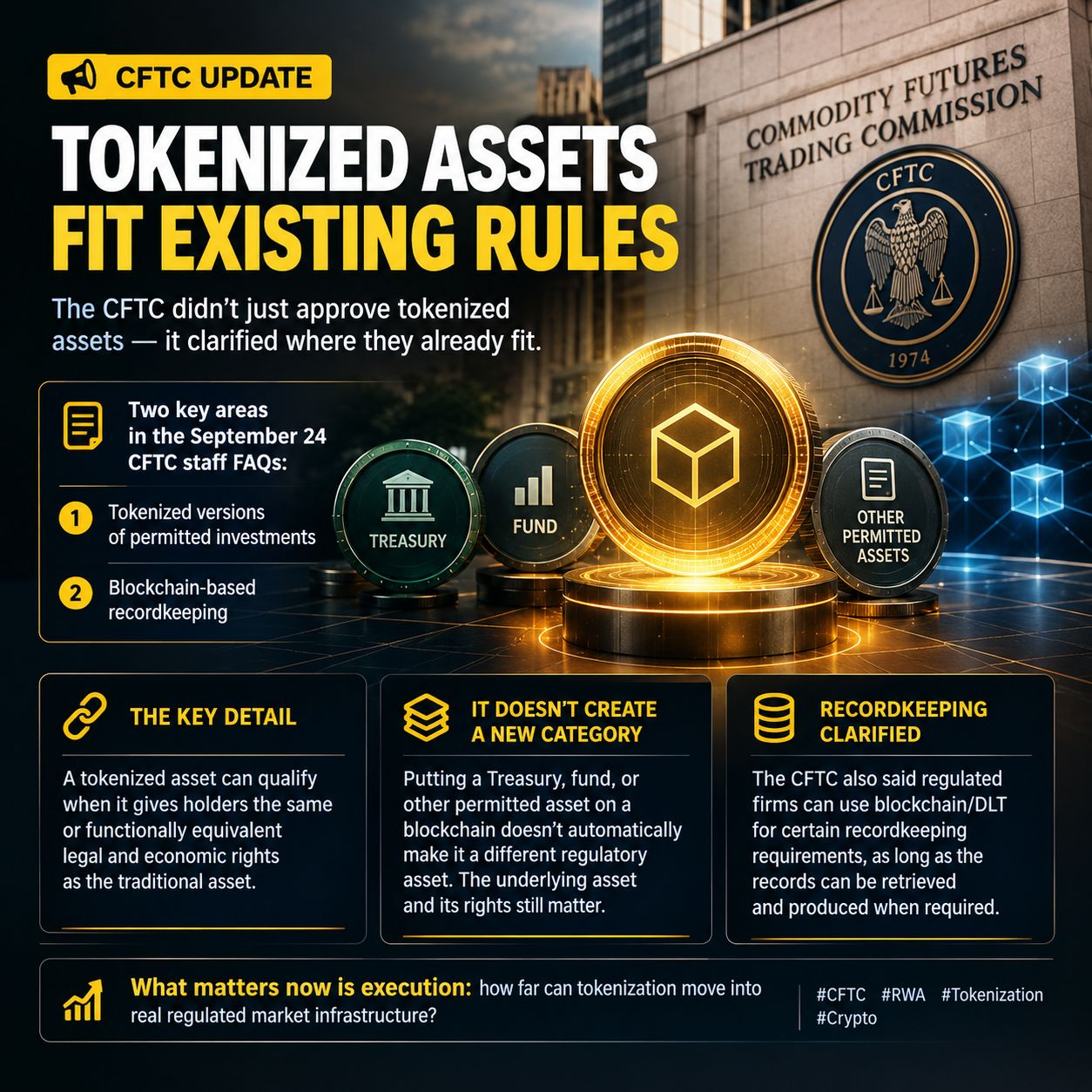
On September 24, CFTC staff updated its crypto FAQs to address two areas that are becoming increasingly relevant as traditional financial markets move onto blockchain infrastructure: tokenized versions of permitted investments and blockchain-based recordkeeping.
One of the key points is that tokenizing an asset does not necessarily mean creating an entirely new regulatory category.
Under the clarification, a tokenized version of a permitted investment can qualify when the token provides holders with the same or functionally equivalent legal and economic rights as the underlying traditional asset.
That distinction is important for the broader real-world asset (RWA) sector.
A Treasury, fund interest, or another permitted investment can potentially be represented through a blockchain-based token without the token itself automatically becoming a fundamentally different product from the underlying asset. The legal and economic rights attached to the token remain central to how it is treated.
In other words, the blockchain is not necessarily what determines the regulatory status. What the token represents and what rights it provides can matter more.
Blockchain as infrastructure
The CFTC's update also addresses the use of blockchain or distributed ledger technology for certain recordkeeping requirements.
Qualifying regulated firms may be able to use DLT-based systems for applicable records, provided they can meet the relevant requirements, including the ability to retrieve and produce records when required.
That could be meaningful for financial institutions exploring blockchain not just as a settlement layer, but as part of their broader market infrastructure.
Instead of treating blockchain as a separate financial system, the emerging approach increasingly looks at where the technology can operate within existing regulatory and operational frameworks.
Why this matters for tokenization
Tokenization has often been discussed as a bridge between traditional finance and blockchain markets.
The appeal is straightforward: traditional assets could potentially gain blockchain-based features such as programmable transfers, automated settlement, and more transparent ownership records.
But regulatory treatment remains one of the major pieces of the puzzle.
The CFTC clarification doesn't mean every tokenized asset is automatically approved or treated the same way. The underlying asset, the rights attached to the token, the structure of the product, and the applicable regulatory requirements still matter.
That makes the distinction between tokenization and regulatory approval particularly important.
A blockchain representation of an existing asset is not, by itself, a guarantee that the product can be freely offered, traded, or used across regulated markets.
The bigger question is adoption
For the RWA sector, the more interesting question may now be how these principles translate into actual market infrastructure.
If regulated firms can increasingly use blockchain for asset representation, settlement, and recordkeeping while maintaining existing legal and compliance requirements, tokenization could move further from experimentation toward practical financial-market applications.
But execution will matter.
The technology needs to work alongside custody, compliance, reporting, liquidity, and existing market rules. The legal rights represented by the token also need to remain clear.
So while the CFTC update adds useful regulatory clarity, it is better viewed as part of the broader process of integrating blockchain into regulated markets rather than as a blanket green light for tokenized assets.
What matters now is whether regulated institutions can turn that clarity into real-world infrastructure and products.
#CFTC #RWA #Tokenization #Crypto #Blockchain