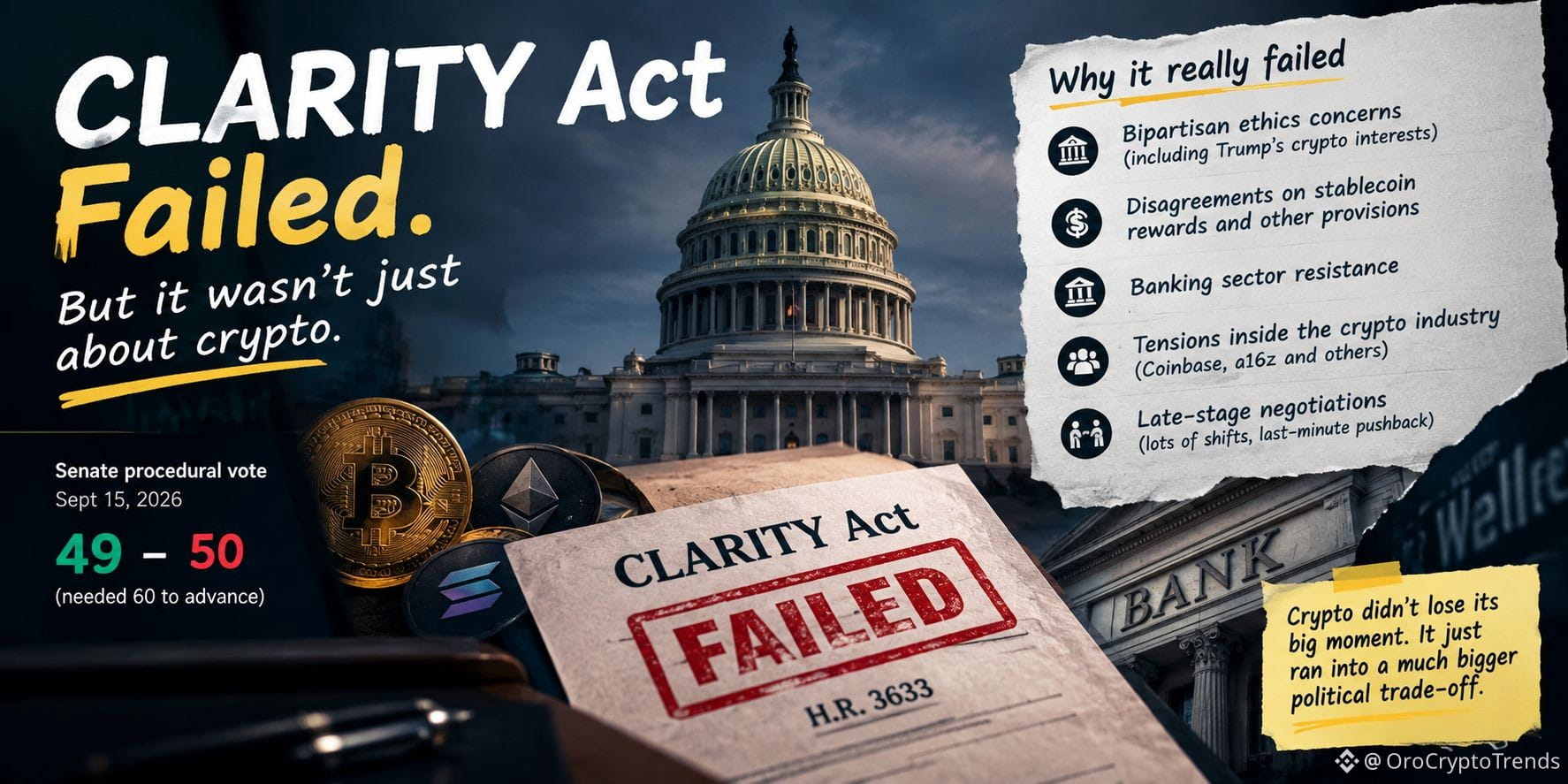

The CLARITY Act didn’t just “fail.”
The weird part is how many different fights got packed into one bill.
The Senate’s September 15 procedural vote ended 49–50, short of the 60 votes needed to move H.R. 3633 forward. Four Republicans voted no, while Democrats opposed it as well.
And this is where I think the simple “crypto lost” narrative gets lazy.
There were ethics concerns around Trump’s crypto interests. There was resistance around stablecoin rewards and other provisions. There were banking-sector concerns. And, according to reporting from the WSJ and Punchbowl News, there was also serious friction inside the crypto industry itself. Coinbase CEO Brian Armstrong became one of the most visible figures in that dispute, although Armstrong has argued that his earlier opposition was about flaws in the draft rather than killing the bill.
Wait — maybe the bigger issue isn’t who “killed” CLARITY.
It’s that crypto still hasn’t solved the political trade-off between giving the industry clearer rules and deciding who gets protected, who gets regulated, and which financial interests absorb the cost.
The bill can still theoretically return, but the immediate legislative path is clearly much harder now.
Still trying to figure out what this actually changes.
#Write2Earn
The weird part is how many different fights got packed into one bill.
The Senate’s September 15 procedural vote ended 49–50, short of the 60 votes needed to move H.R. 3633 forward. Four Republicans voted no, while Democrats opposed it as well.
And this is where I think the simple “crypto lost” narrative gets lazy.
There were ethics concerns around Trump’s crypto interests. There was resistance around stablecoin rewards and other provisions. There were banking-sector concerns. And, according to reporting from the WSJ and Punchbowl News, there was also serious friction inside the crypto industry itself. Coinbase CEO Brian Armstrong became one of the most visible figures in that dispute, although Armstrong has argued that his earlier opposition was about flaws in the draft rather than killing the bill.
Wait — maybe the bigger issue isn’t who “killed” CLARITY.
It’s that crypto still hasn’t solved the political trade-off between giving the industry clearer rules and deciding who gets protected, who gets regulated, and which financial interests absorb the cost.
The bill can still theoretically return, but the immediate legislative path is clearly much harder now.
Still trying to figure out what this actually changes.
#Write2Earn