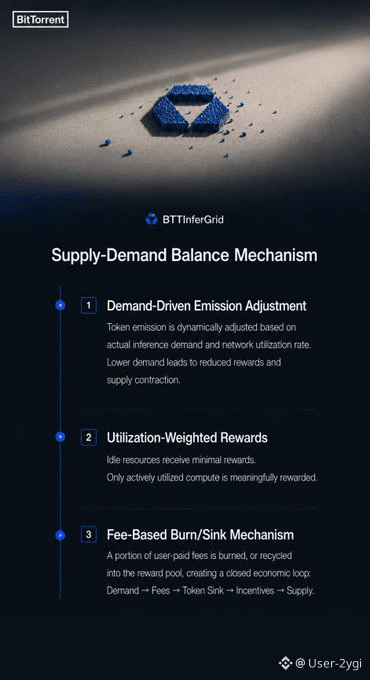
⚖️ THE OVERSUPPLY TRAP IN DePIN: HOW BTTINFERGRID ENFORCES DEMAND-CALIBRATED COMPUTE ECONOMICS
1. Structural Comparison: Fixed Subsidy vs. Dynamic Equilibrium
TRADITIONAL DePIN (Fixed Inflationary Emissions): [Idle Hardware] ──> [Fixed Token Emissions] ──> [No Real Demand] ──> [Token Sell Pressure] ──> [Node Capitulation] BTTINFERGRID (Dynamic Supply-Demand Balance Mechanism): [Real Developer Task] ──> [Cryptographic Verification] ──> [Task-Linked Payout] ──> [Real Fee Revenue / Token Burn]
2. Core Pillars of the Dynamic Balance Mechanism
Inference-Linked Compensation:
Instead of distributing flat inflation, the network quantifies actual tensor operations. Compute providers receive rewards proportional to completed, verified inference requests from developers integrating open-source models (such as Llama, DeepSeek, or Qwen).
Dynamic Supply Throttling & Scheduling:
When inference request volume drops, baseline network reward rates adjust dynamically to signal excess supply. This prevents token dilution while routing incoming tasks exclusively to high-reputation, low-latency nodes.
Decentralized Storage Symbiosis with BTFS:
Model weights are distributed and cached across host drives using Reed-Solomon $(k + m)$ erasure coding on the BitTorrent File System (BTFS). This eliminates expensive cloud egress costs, ensuring that edge nodes only fetch and retain active model layers currently demanded by the market.
Revenue Pipeline to Buyback-and-Burn:
Protocol fees settled in $BTT directly offset circulating supply. Ecosystem revenue is channeled through automated buybacks and sent to burn addresses, directly connecting real-world developer demand with token scarcity.
3. Macro Settlement & Infrastructure Anchors
🛡️ BitTorrent Chain (BTTC) Settlement: All micro-escrows, execution disputes, and task payments settle deterministically on BTTC (Chain ID: 199) with deterministic sub-cent gas fees ($<\$0.01$ per TX).
@BitTorrent_Official @Justin Sun孙宇晨 #TRONEcoStar
1. Structural Comparison: Fixed Subsidy vs. Dynamic Equilibrium
TRADITIONAL DePIN (Fixed Inflationary Emissions): [Idle Hardware] ──> [Fixed Token Emissions] ──> [No Real Demand] ──> [Token Sell Pressure] ──> [Node Capitulation] BTTINFERGRID (Dynamic Supply-Demand Balance Mechanism): [Real Developer Task] ──> [Cryptographic Verification] ──> [Task-Linked Payout] ──> [Real Fee Revenue / Token Burn]
2. Core Pillars of the Dynamic Balance Mechanism
Inference-Linked Compensation:
Instead of distributing flat inflation, the network quantifies actual tensor operations. Compute providers receive rewards proportional to completed, verified inference requests from developers integrating open-source models (such as Llama, DeepSeek, or Qwen).
Dynamic Supply Throttling & Scheduling:
When inference request volume drops, baseline network reward rates adjust dynamically to signal excess supply. This prevents token dilution while routing incoming tasks exclusively to high-reputation, low-latency nodes.
Decentralized Storage Symbiosis with BTFS:
Model weights are distributed and cached across host drives using Reed-Solomon $(k + m)$ erasure coding on the BitTorrent File System (BTFS). This eliminates expensive cloud egress costs, ensuring that edge nodes only fetch and retain active model layers currently demanded by the market.
Revenue Pipeline to Buyback-and-Burn:
Protocol fees settled in $BTT directly offset circulating supply. Ecosystem revenue is channeled through automated buybacks and sent to burn addresses, directly connecting real-world developer demand with token scarcity.
3. Macro Settlement & Infrastructure Anchors
🛡️ BitTorrent Chain (BTTC) Settlement: All micro-escrows, execution disputes, and task payments settle deterministically on BTTC (Chain ID: 199) with deterministic sub-cent gas fees ($<\$0.01$ per TX).
@BitTorrent_Official @Justin Sun孙宇晨 #TRONEcoStar