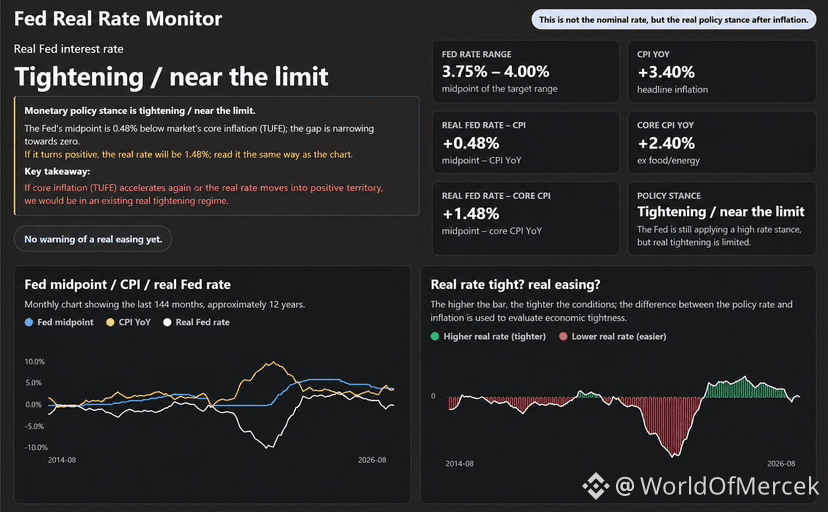

The Fed ended up doing the tightening itself.
That’s interesting because there was another way this could have played out.
Earlier this year, the policy rate was sitting still while inflation was moving higher. The result was easy to miss if you only watched the headline rate: monetary policy was becoming less restrictive in real terms.
I wrote about it in May because that dynamic couldn’t run forever.
The adjustment could come from either side.
Inflation pressure could ease enough to restore some of the Fed’s real restraint, or the Fed could eventually raise rates to do it directly.
Four months later, we’ve had some of both.
Inflation has pulled back from its recent highs, and yesterday the Fed raised the target range by 25 bps to 3.75–4.00%. The FOMC itself still describes inflation as elevated.
The real-rate compression I was watching earlier this year has now largely reversed.
But there’s a policy angle here that I think gets overlooked.
Trump has repeatedly wanted lower interest rates, but the conditions that make lower rates possible aren’t entirely outside the administration’s influence.
The White House can’t set the Fed funds rate. But trade policy, fiscal choices, energy conditions and geopolitical developments can affect the inflation environment the Fed has to navigate. Fed officials themselves have discussed tariffs and geopolitical/energy shocks as contributors to recent inflation, while also noting that some of those effects may now be fading.
So there are two very different ways to get toward lower rates.
Ask the Fed to tolerate more inflation.
Or help create an environment where inflation falls enough that the Fed actually has room to ease.
The second route requires less work from monetary policy.
For now, though, the adjustment came partly through the Fed.
The real easing I was worried about in May has largely disappeared.
And that’s a much more meaningful change than simply saying rates went up 25 bps.
That’s interesting because there was another way this could have played out.
Earlier this year, the policy rate was sitting still while inflation was moving higher. The result was easy to miss if you only watched the headline rate: monetary policy was becoming less restrictive in real terms.
I wrote about it in May because that dynamic couldn’t run forever.
The adjustment could come from either side.
Inflation pressure could ease enough to restore some of the Fed’s real restraint, or the Fed could eventually raise rates to do it directly.
Four months later, we’ve had some of both.
Inflation has pulled back from its recent highs, and yesterday the Fed raised the target range by 25 bps to 3.75–4.00%. The FOMC itself still describes inflation as elevated.
The real-rate compression I was watching earlier this year has now largely reversed.
But there’s a policy angle here that I think gets overlooked.
Trump has repeatedly wanted lower interest rates, but the conditions that make lower rates possible aren’t entirely outside the administration’s influence.
The White House can’t set the Fed funds rate. But trade policy, fiscal choices, energy conditions and geopolitical developments can affect the inflation environment the Fed has to navigate. Fed officials themselves have discussed tariffs and geopolitical/energy shocks as contributors to recent inflation, while also noting that some of those effects may now be fading.
So there are two very different ways to get toward lower rates.
Ask the Fed to tolerate more inflation.
Or help create an environment where inflation falls enough that the Fed actually has room to ease.
The second route requires less work from monetary policy.
For now, though, the adjustment came partly through the Fed.
The real easing I was worried about in May has largely disappeared.
And that’s a much more meaningful change than simply saying rates went up 25 bps.