🔥 UNI (Uniswap) — Latest Professional Market Analysis
$UNI is more than just a governance token now — Uniswap is expanding across trading, liquidity, hooks, cross-chain execution and DeFi infrastructure.
🚀 What UNI/Uniswap has
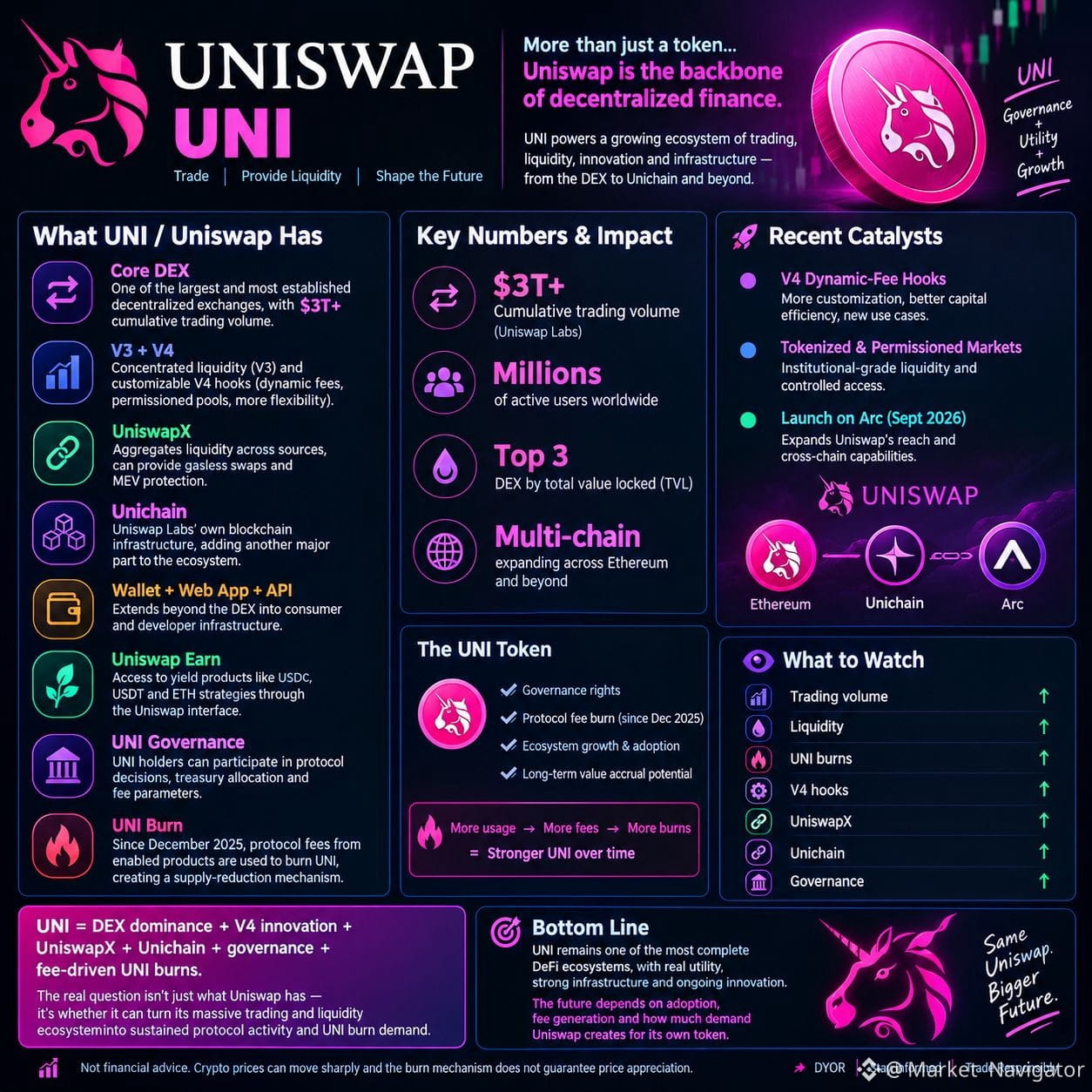
Core DEX: One of the largest and most established decentralized exchanges, with $3T+ cumulative trading volume according to Uniswap Labs.
V3 + V4: Concentrated liquidity plus customizable V4 hooks, including dynamic-fee and permissioned-pool designs.
UniswapX: Aggregates liquidity across sources and can provide gasless swaps and MEV protection.
Unichain: Uniswap Labs' own blockchain infrastructure adds another major part to the ecosystem.
Wallet + Web App + API: The ecosystem extends beyond the DEX into consumer and developer infrastructure.
Uniswap Earn: Users can access yield products such as USDC, USDT and ETH strategies through the Uniswap interface.
UNI governance: UNI holders can participate in protocol decisions, treasury allocation and fee parameters.
UNI burn: Since December 2025, protocol fees collected from enabled products are used in a mechanism that burns UNI, creating a supply-reduction mechanism.
⚡ Current catalyst
Uniswap has recently gone deeper into V4 dynamic-fee hooks and tokenized/permissioned markets, while also launching on Arc in September 2026.
⚠️ What to watch
UNI still depends heavily on Uniswap adoption, trading activity, governance decisions and actual fee generation. The burn mechanism does not mean UNI holders automatically receive protocol revenue; the value-accrual mechanism works through UNI being burned.
🎯 Bottom line
UNI = DEX dominance + V4 innovation + UniswapX + Unichain + governance + fee-driven UNI burns.
The interesting part for the market is whether Uniswap can continue converting its enormous trading/liquidity ecosystem into sustained protocol activity and UNI burn demand.
#UNI #crypto #tradingsignals #Altcoins #BTC
$UNI is more than just a governance token now — Uniswap is expanding across trading, liquidity, hooks, cross-chain execution and DeFi infrastructure.
🚀 What UNI/Uniswap has
Core DEX: One of the largest and most established decentralized exchanges, with $3T+ cumulative trading volume according to Uniswap Labs.
V3 + V4: Concentrated liquidity plus customizable V4 hooks, including dynamic-fee and permissioned-pool designs.
UniswapX: Aggregates liquidity across sources and can provide gasless swaps and MEV protection.
Unichain: Uniswap Labs' own blockchain infrastructure adds another major part to the ecosystem.
Wallet + Web App + API: The ecosystem extends beyond the DEX into consumer and developer infrastructure.
Uniswap Earn: Users can access yield products such as USDC, USDT and ETH strategies through the Uniswap interface.
UNI governance: UNI holders can participate in protocol decisions, treasury allocation and fee parameters.
UNI burn: Since December 2025, protocol fees collected from enabled products are used in a mechanism that burns UNI, creating a supply-reduction mechanism.
⚡ Current catalyst
Uniswap has recently gone deeper into V4 dynamic-fee hooks and tokenized/permissioned markets, while also launching on Arc in September 2026.
⚠️ What to watch
UNI still depends heavily on Uniswap adoption, trading activity, governance decisions and actual fee generation. The burn mechanism does not mean UNI holders automatically receive protocol revenue; the value-accrual mechanism works through UNI being burned.
🎯 Bottom line
UNI = DEX dominance + V4 innovation + UniswapX + Unichain + governance + fee-driven UNI burns.
The interesting part for the market is whether Uniswap can continue converting its enormous trading/liquidity ecosystem into sustained protocol activity and UNI burn demand.
#UNI #crypto #tradingsignals #Altcoins #BTC