
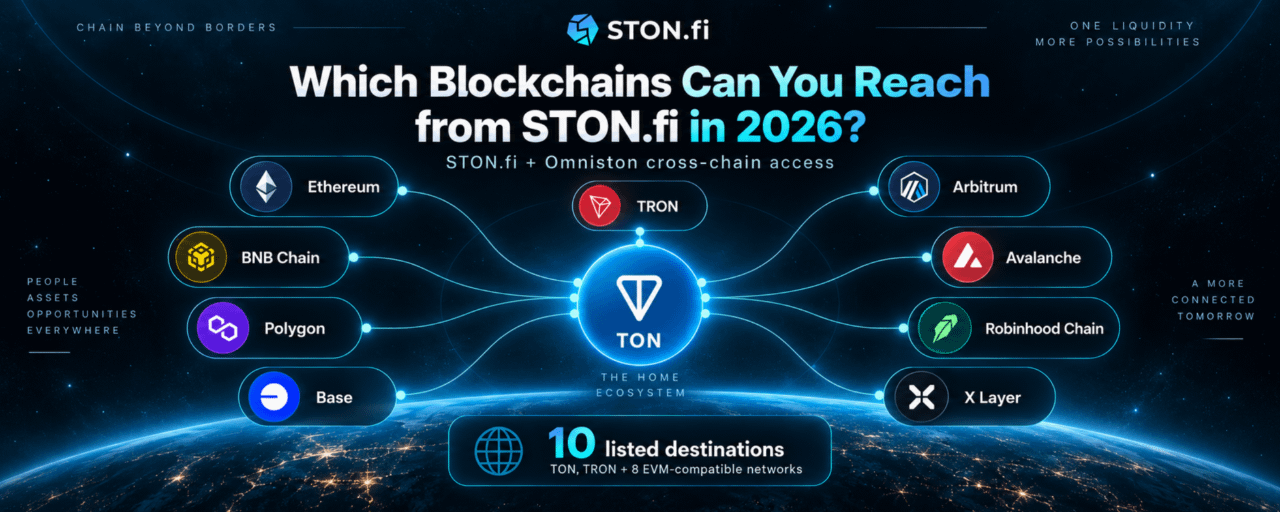
TON remains the home of STON.fi, but its cross-chain interface now reaches TRON and a growing group of EVM networks.
In 2026, STON.fi is no longer limited to swapping assets inside TON. Its cross-chain layer, Omniston, lets you move between TON, TRON, and multiple EVM-compatible networks from the same interface. As of September 15, 2026, the current STON.fi cross-chain page names TON, TRON, Ethereum, BNB Chain, Polygon, Base, Arbitrum, Avalanche, X Layer, and Robinhood Chain.
There is one important distinction, though. Reaching a blockchain through STON.fi does not necessarily mean the STON.fi AMM itself has been deployed there. Pools, farming, and the core STON.fi DeFi environment remain centered on TON. Cross-chain access uses Omniston to coordinate swaps between separate networks.
That difference is the key to understanding what "multi-chain STON.fi" actually means in 2026.
The current STON.fi network map
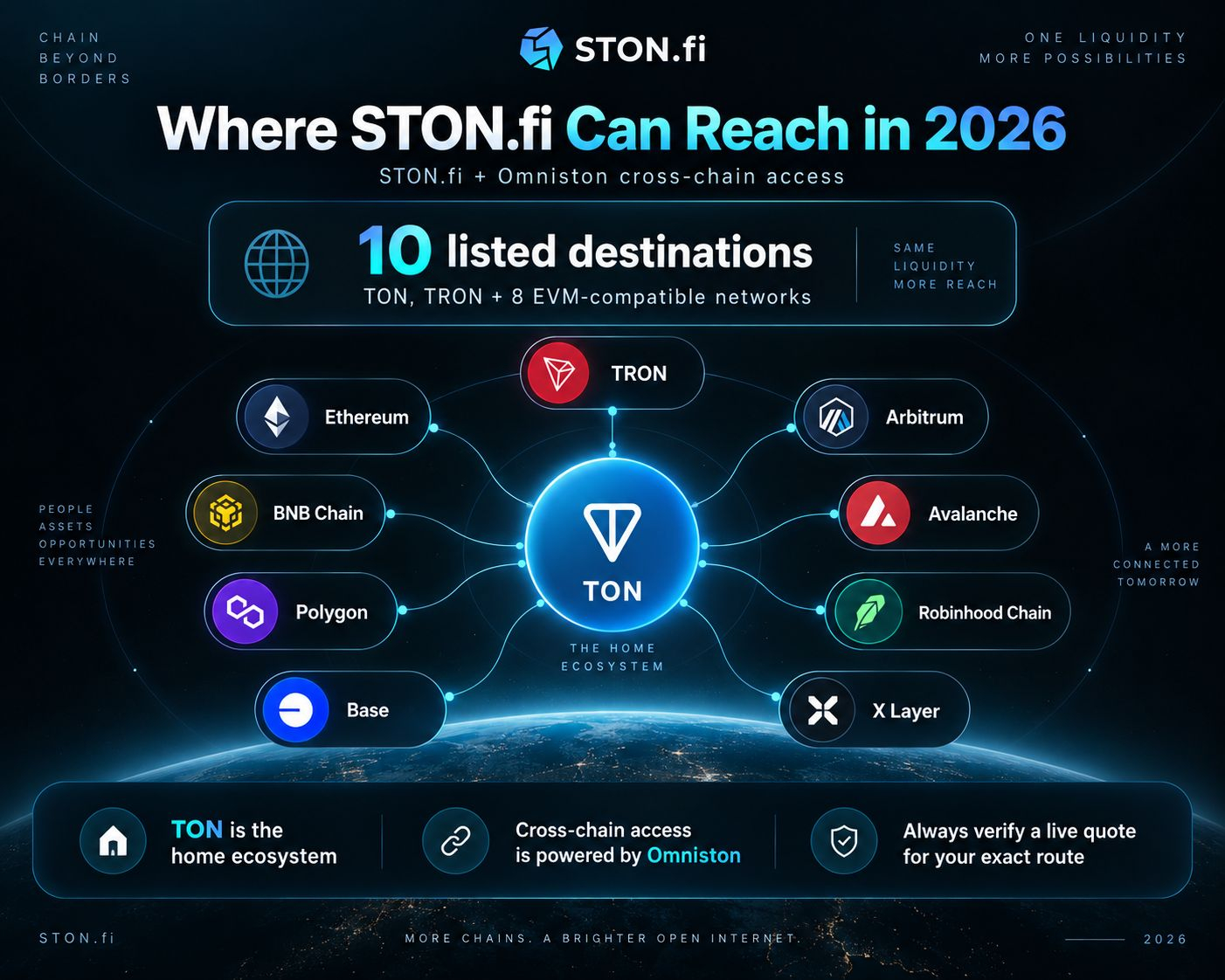
The simplest way to look at STON.fi today is to separate its home chain from the networks its cross-chain execution layer can reach.
STON.fi's public cross-chain page currently presents all ten as destinations and even includes a campaign task for completing swaps across "all 10 destinations."
The Omniston product page, however, currently labels TON, TRON, Ethereum, Base, BNB Chain, Polygon, Arbitrum, Avalanche, and Robinhood as "Live on," leaving X Layer out of that particular list.
That difference matters. The consumer-facing cross-chain page appears to be ahead of the main Omniston integration page for X Layer. If X Layer is your target, the safest practical test is simple: open the STON.fi dApp, select your intended assets and networks, and confirm that Omniston returns an executable quote before planning around the route.
Reaching another chain is not the same as deploying STON.fi there
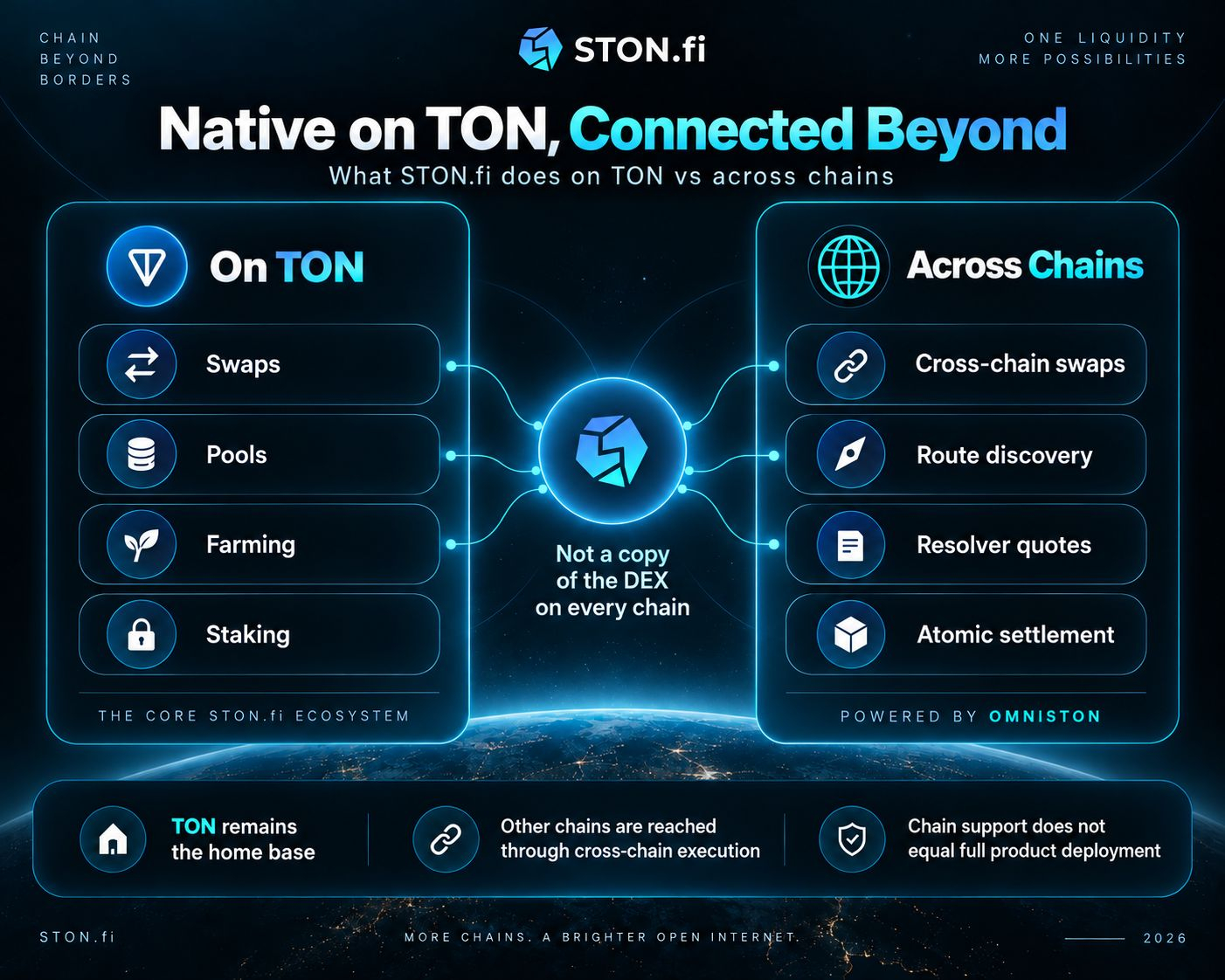
A common assumption about multi-chain DeFi is that a protocol must launch a complete copy of itself on every blockchain it supports.
That is not what STON.fi is doing.
STON.fi remains fundamentally based on TON. Its native automated market maker, liquidity pools, farming products, and TON-side token ecosystem operate there. The main STON.fi website explicitly distinguishes cross-chain swaps from these products, stating that swaps can move between TON, TRON, and EVM networks while pools, farming, and staking run on TON.
Omniston adds a separate execution layer on top.
Instead of requiring a STON.fi liquidity pool to exist on every destination blockchain, Omniston sends a request for quote to resolvers. A resolver willing to fill the order supplies destination-side liquidity. Funds on the two chains are then coordinated through linked Hashed Timelock Contracts, or HTLCs.
The flow is roughly:
You choose a source chain, input asset, destination chain, and output asset.
Omniston sends an RFQ to available resolvers.
Resolvers compete by returning executable quotes.
The winning route locks the relevant funds through linked HTLC contracts.
The swap settles across both chains, or the contract logic refunds the parties if settlement cannot complete.
STON.fi describes Omniston as a bridge-free execution layer in which the cross-chain swap settles atomically or each party receives a refund.
This architecture is why STON.fi can expand its network reach without turning every supported blockchain into another full STON.fi DEX deployment.
What the major destinations give you
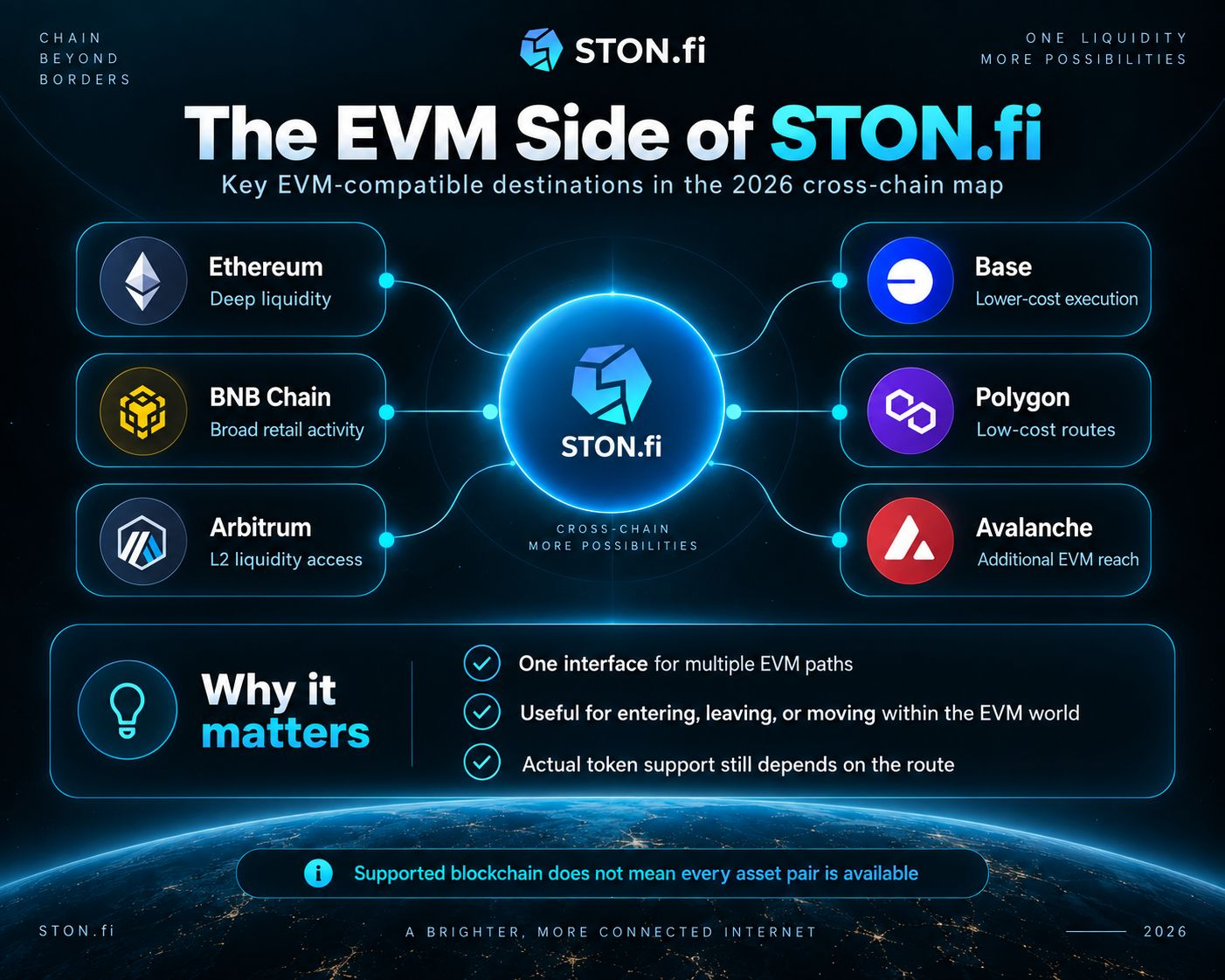
The chain list becomes more useful when you stop treating every destination as interchangeable.
TON is still the center
TON is where STON.fi offers the broadest product experience.
If your funds and the asset you want are already on TON, you do not need a cross-chain route at all. You can use TON-side liquidity directly, including the large number of Jettons that exist specifically within the TON ecosystem.
Cross-chain execution becomes relevant when either your starting capital is elsewhere or the asset you want sits on another blockchain.
Ethereum connects STON.fi to the main EVM liquidity environment
Ethereum was one of the first EVM networks activated for STON.fi cross-chain swaps.
When TON-to-EVM swaps went live in June 2026, STON.fi initially supported TON, Ethereum, Base, BNB Chain, and Polygon in different chain-to-chain combinations. Launch assets included USDT and USDC on Ethereum.
Ethereum therefore gives a TON user a direct route toward assets and liquidity in the largest established EVM ecosystem without first depositing to a centralized exchange.
The trade-off is network cost. STON.fi cannot eliminate Ethereum gas conditions simply because the route begins inside the STON.fi interface.
Base, BNB Chain, and Polygon broaden the EVM choice
These networks were also part of STON.fi's early EVM rollout.
Base gives users an Ethereum-compatible environment where transaction costs are generally much lighter than on Ethereum mainnet. BNB Chain adds access to another major EVM ecosystem with large stablecoin and retail trading activity. Polygon provides another low-cost destination for supported assets.
STON.fi also supports EVM-to-EVM routing. You do not necessarily need TON to be one side of the transaction.
For example, STON.fi documents a flow in which a user connects an EVM wallet, selects one EVM network as the source and another as the destination, reviews the quote, and lets Omniston coordinate settlement underneath.
That makes the interface relevant not only for someone leaving or entering TON, but also for a trader whose real goal is to reposition between supported EVM chains.
Arbitrum and Avalanche extend the map further
The 2026 network set has expanded beyond the original Ethereum, Base, BNB Chain, and Polygon group.
Arbitrum and Avalanche now appear in the official STON.fi cross-chain network list. The Robinhood Chain guide also confirms supported stablecoin availability including USDT0 and USDC on Arbitrum and USDT and USDC on Avalanche.
For users, the significance is straightforward: more destination networks create more possible paths between isolated pools of capital without requiring a separate bridge interface for each move.
Asset coverage still matters, however. Supporting a blockchain does not mean every token on that chain can automatically be swapped through Omniston.
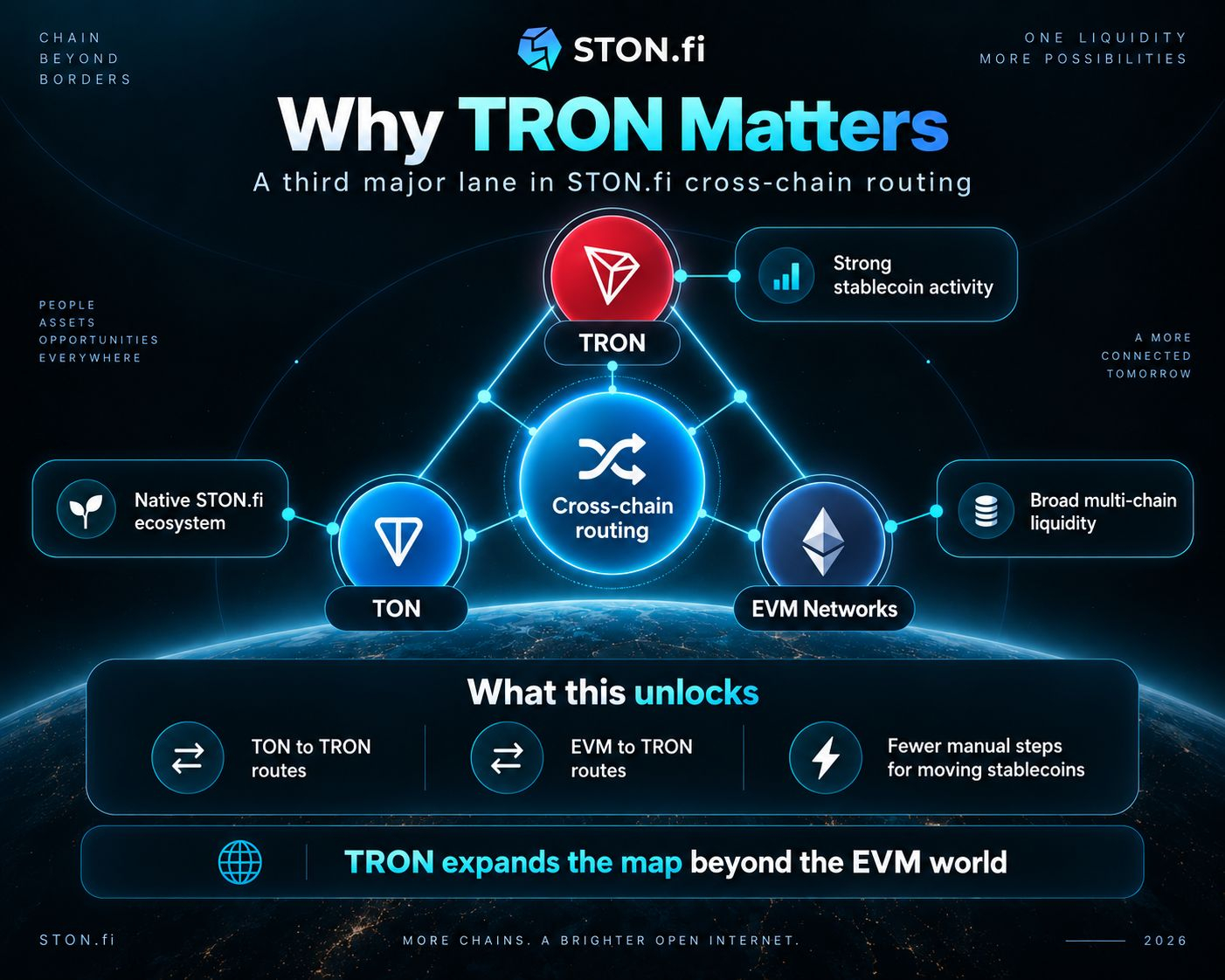
TRON changes the picture beyond EVM
TRON is especially important because it shows that STON.fi's cross-chain ambitions are not limited to EVM-compatible networks.
TRON has a major stablecoin economy, particularly around USDT. Adding it gives users a path between three distinct environments:
TON
EVM-compatible networks
TRON
STON.fi's current homepage describes routes such as TON to EVM, TON to TRON, and EVM to TRON as part of one cross-chain workflow.
That is a more meaningful form of multi-chain access than simply adding another Ethereum-compatible Layer 2. An EVM wallet cannot natively behave like a TRON wallet, just as a TON wallet does not automatically become an Ethereum wallet. STON.fi therefore surfaces separate TON, EVM, and TRON wallet connections in its cross-chain experience.
For someone who holds USDT on TRON but wants to move into the TON ecosystem, this removes several manual steps that would otherwise involve an exchange or a separate bridge and swap sequence.
Robinhood Chain shows how new networks can be added
Robinhood Chain became available through STON.fi cross-chain swaps in August 2026.
STON.fi currently positions USDG as the destination asset for Robinhood Chain. Its own guide says users can access USDG there from TON, TRON, and supported EVM networks through the same cross-chain interface.
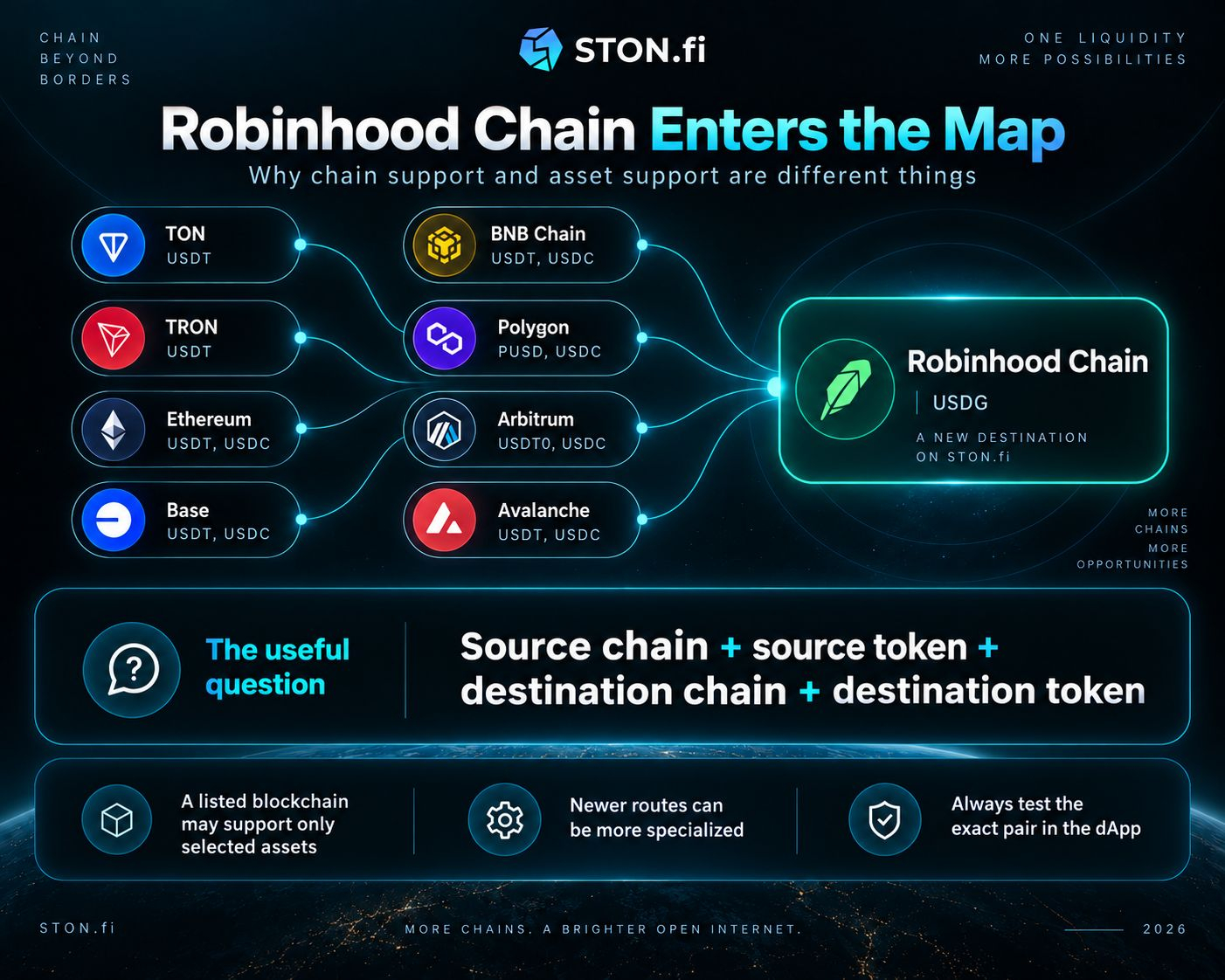
The supported stablecoin set described in that guide gives a useful snapshot of how chain support works in reality:
USDT on TON
USDT on TRON
USDG on Robinhood Chain
USDT and USDC on Ethereum, BNB Chain, Base, and Avalanche
USDT0 and USDC on Arbitrum
PUSD and USDC on Polygon
This is why asking only "Which chains are supported?" is not enough.
A blockchain may be connected while the actual executable market is limited to a much smaller set of assets. The useful question is always the combination of source chain + source token + destination chain + destination token.
What you should verify before choosing a route
Cross-chain support changes quickly. A network name on a supported-chain list is only the first check.
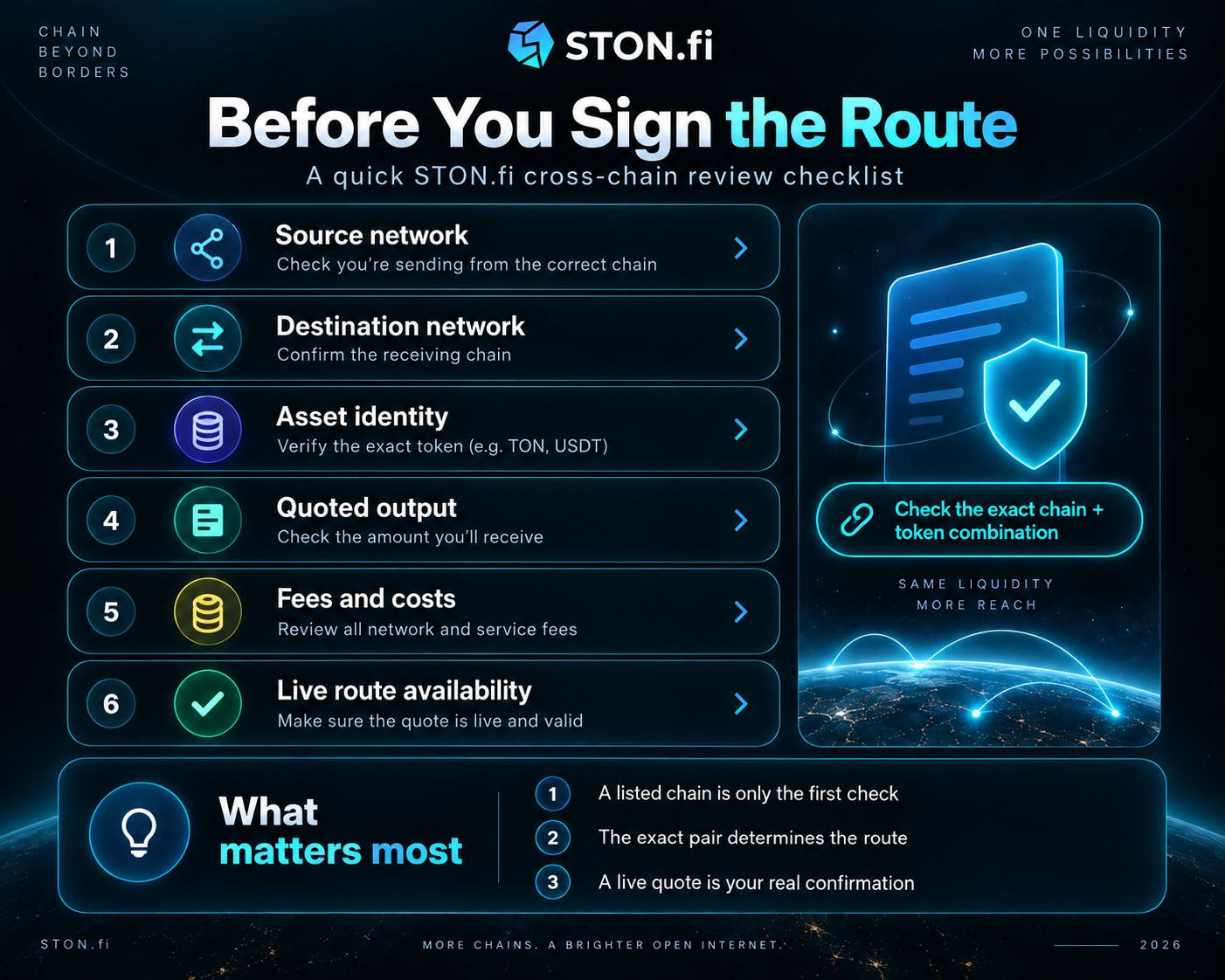
Before signing, verify:
Source network: Make sure the wallet is connected to the chain where the asset actually exists.
Destination network: Check that you selected the intended version of the chain, especially when working across several EVM networks.
Asset identity: USDT on TON, TRON, Ethereum, and BNB Chain are separate on-chain assets even when they track the same dollar value.
Quoted output: Review how much of the destination asset you are expected to receive.
Fees: Network conditions and the route itself can affect the final economics.
Price impact: A supported route may still be unattractive if available liquidity is weak.
Transaction limits: New routes can launch with temporary size limits.
Actual quote availability: A listed chain does not guarantee that a resolver will quote every possible asset pair at every moment.
The final item is particularly important for newer additions such as X Layer. STON.fi's latest public cross-chain page includes X Layer, while the Omniston developer page currently does not include it in its "Live on" line.
A live executable quote is therefore more useful than assuming every theoretical combination in a network list must be available.
Following one STON.fi cross-chain swap
Consider a simple scenario: you hold USDT on TON but want USDC on Base.
You connect the appropriate wallet or wallets and choose TON as the source network. Then you select USDT as the input, Base as the destination, and USDC as the output.
Omniston requests quotes from resolvers. If an acceptable route is available, STON.fi shows you the expected destination amount and relevant transaction details before confirmation.
Underneath the interface, the source and destination sides are coordinated through linked HTLCs rather than a traditional lock-and-mint bridge that issues a wrapped representation of the source asset. TON documentation describes the traditional bridge model as locking an asset on one chain and minting an equivalent wrapped token on another. Omniston instead coordinates a swap into the asset available on the destination side.
Once settlement succeeds, your goal is not to hold a representation of TON-side USDT on Base. You asked for USDC on Base, and that destination asset is what the route is designed to deliver.
That distinction explains the real value of the growing blockchain list. STON.fi is not merely transporting one token representation across ten networks. It is trying to turn separate pools of liquidity into executable asset-to-asset routes.
Practical takeaway: when you want to know whether STON.fi can reach a particular blockchain, first check the current network list, then test your exact token pair in the dApp. Network support tells you where Omniston can operate. A live quote tells you whether the particular route you actually need is available now.
Frequently Asked Questions
Which blockchains does STON.fi support in 2026?
STON.fi's current cross-chain page lists TON, TRON, Ethereum, BNB Chain, Polygon, Base, Arbitrum, Avalanche, X Layer, and Robinhood Chain. The separate Omniston product page currently lists the same group except X Layer in its "Live on" section, so X Layer availability should be checked directly in the dApp before relying on a specific route.
Is STON.fi deployed as a DEX on all of those blockchains?
No. STON.fi's native DeFi environment remains centered on TON. Its pools, farming, staking, and TON-native AMM activity are different from Omniston cross-chain execution. The other networks can be reached through cross-chain swaps without requiring a complete STON.fi AMM deployment on each chain.
Can I swap from one EVM chain directly to another?
Yes, supported EVM-to-EVM routes can be handled through STON.fi. For example, the protocol has documented flows between Ethereum, BNB Chain, Base, and Polygon. You select the source network and destination network in the same interface, while Omniston handles RFQ routing and cross-chain settlement underneath.
Can I use STON.fi to reach Solana?
Solana is not included in the current official STON.fi cross-chain list reviewed for this article. The supported set can expand over time, so future availability should be checked against the current STON.fi or Omniston interface rather than assuming the 2026 list is permanent.
Does support for a blockchain mean every token on it is supported?
No. Chain support and asset support are separate. A network can be connected while Omniston offers only selected assets or pairs there. Robinhood Chain, for example, currently uses USDG in the STON.fi cross-chain flow. Always test the exact source asset and destination asset you want rather than relying on the network name alone.
Do I have to start or finish on TON?
No. STON.fi now supports cross-chain workflows that do not require TON to be one side of the route. Official material describes EVM-to-EVM swaps and the main STON.fi site also presents EVM-to-TRON routing. TON remains the protocol's home ecosystem, but Omniston's execution layer reaches beyond TON-only flows.
How do I check whether my exact STON.fi cross-chain route works?
Open the STON.fi dApp, connect the wallet required for your source and destination networks, select the exact source token and destination token, and request a quote. Check the output, fees, price impact, networks, asset identities, and any transaction limit before signing. A valid current quote is the clearest confirmation that your specific route is executable.
Sources and Further Reading
STON.fi Cross-chain - One Swap. Across Chains. Current consumer-facing list of cross-chain destinations and explanation of the atomic swap flow
Omniston by STON.fi - Cross-Chain Swap API & SDK. Current Omniston architecture, RFQ and HTLC execution model, and "Live on" network list
STON.fi main website. Overview of the distinction between cross-chain swapping and TON-native pools, farming, and staking
STON.fi goes cross-chain: TON x EVM swaps are live. June 2026 announcement covering the first live TON and EVM network set and launch asset support
EVM-to-EVM swaps without leaving STON.fi: a guide for multi-chain traders. Explanation of cross-chain routing between supported EVM networks through Omniston
What is Robinhood Chain, and how to swap into it on STON.fi. August 2026 update covering Robinhood Chain, USDG, and supported stablecoins across current networks
Cross-chain swaps is not a feature - it's the new default for DeFi. STON.fi explanation of resolver-based HTLC execution and the difference between bridge and atomic-swap architectures
TON Docs - Bridges. TON's explanation of cross-chain bridges, isolated blockchain networks, and lock-and-mint asset transfers