
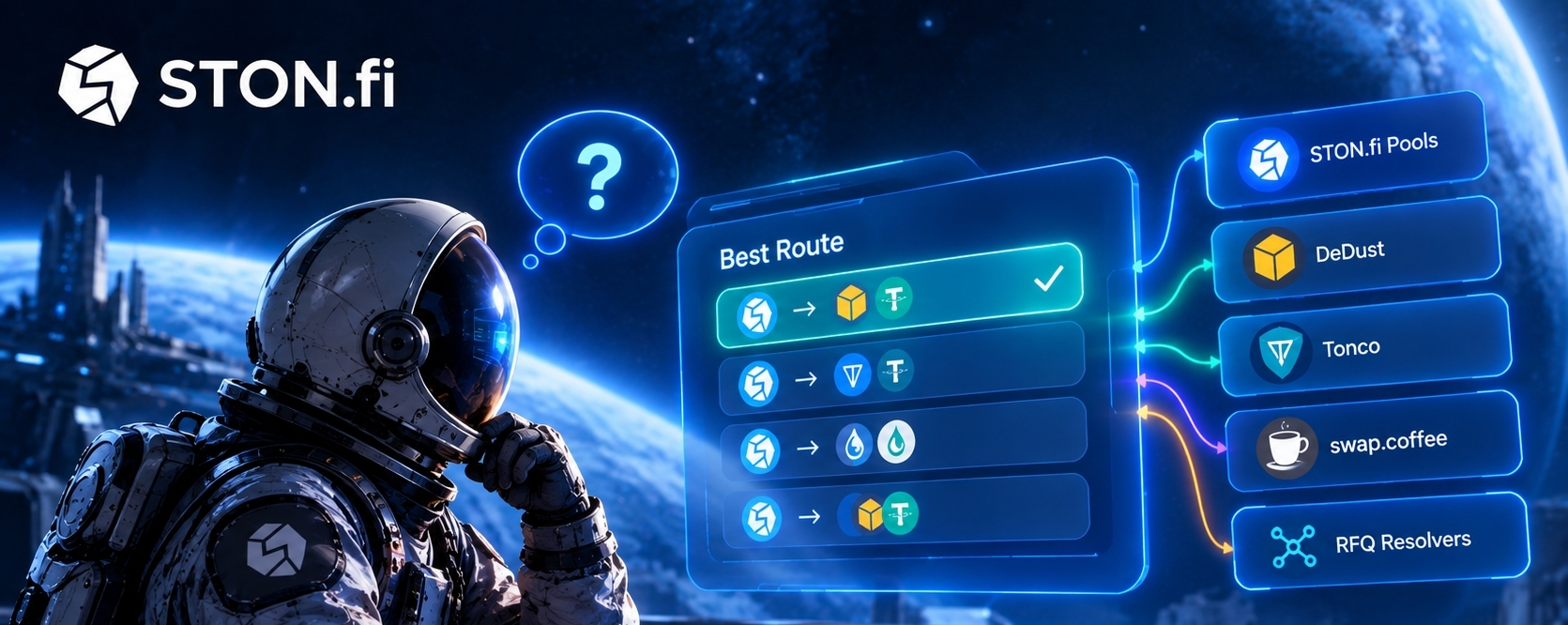

What Is Omniston and How It Improves STON.fi Swaps
Decentralized exchanges have made token swapping simple, but there is still a major challenge behind the scenes: liquidity is fragmented.
The best price for a swap may not always exist in one liquidity pool or even on one decentralized exchange. One source could have deeper liquidity, another could offer a better price, while a resolver may provide a competitive quote for the same trade.
This is where Omniston becomes important.
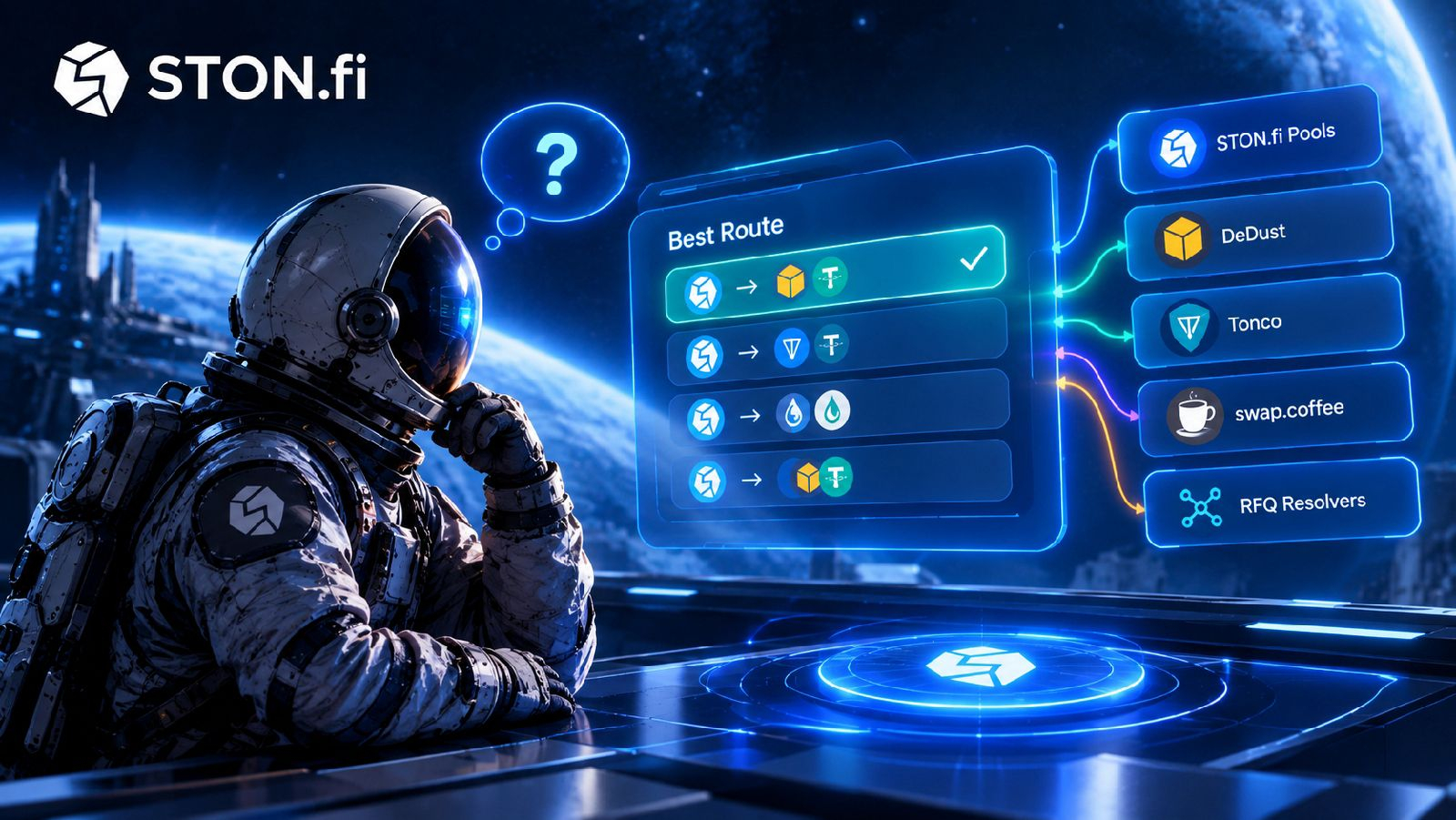
Omniston is the liquidity aggregation and execution layer behind STON.fi swaps. Instead of restricting a swap to a single pool, it can request competing quotes, compare available routes across connected liquidity sources and select the strongest valid execution for the trade.
The result is a smarter swap experience where users can access more of the available liquidity without manually searching across multiple platforms.
What Is Omniston?
At its core, Omniston is designed to solve the problem of fragmented liquidity.
Imagine you want to exchange Token A for Token B.
Without an aggregation layer, you might have to check different pools or decentralized exchanges yourself to determine where the best route is. That takes time, and by the time you find a better option, market conditions may have already changed.
Omniston brings these possibilities together.
It can connect STON.fi swaps to multiple liquidity sources and execution providers, allowing them to compete for the same trade. Instead of asking only one pool, the system can evaluate multiple available options and determine which route provides the strongest valid execution.
In simple terms:
Omniston acts like a smart traffic controller for liquidity.
It does not create new liquidity by itself. Instead, it helps make more existing liquidity reachable through the familiar STON.fi swapping experience.
What Omniston Does on STON.fi
Omniston introduces several important capabilities to the STON.fi swap experience.
1. It turns fragmented liquidity into one comparable market
Liquidity can exist across different AMM pools, decentralized exchanges, and RFQ-based resolvers.
Rather than forcing users to investigate each source independently, Omniston brings available options into the same routing process.
This gives the system a wider view of the market when looking for an execution path.
2. AMM DEXs and RFQ resolvers can compete
Omniston is not limited to traditional AMM liquidity.
AMM DEXs can provide routes through their liquidity pools, while RFQ resolvers can return quotes for the same trade.
This creates competition around the swap instead of assuming that one liquidity source will always provide the best execution.
3. It supports cross-DEX routing
The best route is not necessarily a direct swap.
For example, instead of moving directly from:
Token A → Token B
the optimal path could be:
Token A → TON → Token B
By considering multiple sources and intermediate assets, Omniston can identify routes that may provide better execution than a single direct pool.
4. STON.fi uses Omniston smart routing by default
This means smart routing is integrated into the normal STON.fi swap experience rather than requiring users to manually compare different liquidity sources themselves.
The complexity stays behind the interface while the user still follows the familiar process:
Choose tokens → review the quote → confirm the swap.
How Omniston Finds a Route
Omniston's routing process can be understood as a simple sequence.
Step 1: You define your swap
The process begins when you select the assets you want to exchange and specify the amount.
For example:
Sell: Token A
Receive: Token B
The system now knows what needs to be executed.
Step 2: Connected sources return routes or quotes
Omniston communicates with connected liquidity sources and resolvers.
These sources can provide different possibilities for completing the same swap.
One source may offer a direct pool.
Another may provide a multi hop route.
A resolver may return a competitive RFQ quote.
Step 3: Omniston compares the available options
The returned routes and quotes are evaluated against each other.
The objective is to identify the strongest valid execution available to the system for that request.
This is where aggregation becomes valuable: instead of evaluating only one option, Omniston can compare multiple possibilities.
Step 4: The selected route is executed
Once you accept the quote, the selected path is built into the wallet transaction.
From the user's perspective, the experience remains straightforward.
You do not have to manually execute several swaps across multiple DEXs just because the optimal route involves more than one source.
The routing complexity happens behind the scenes.
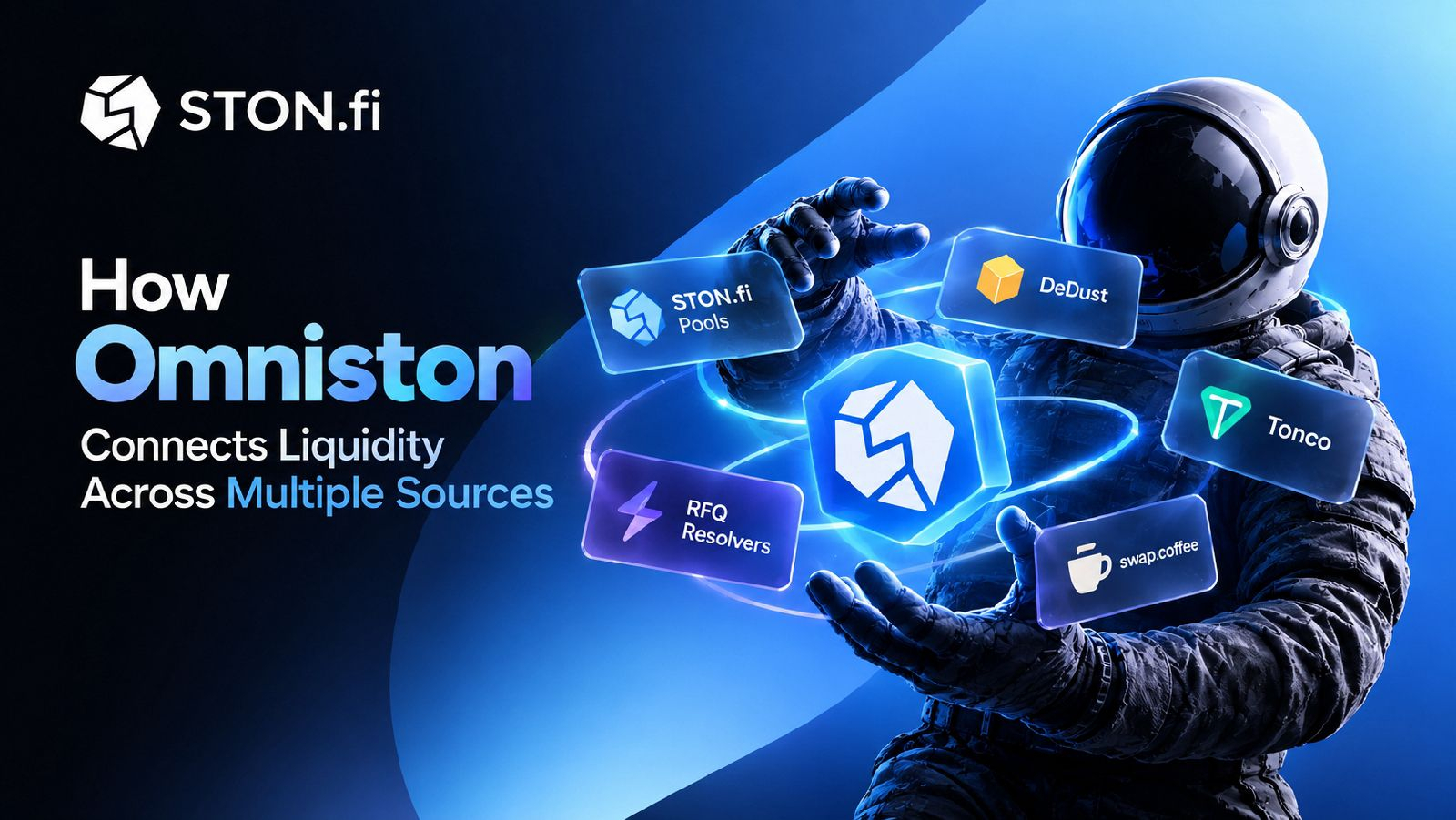
Why Aggregation Matters for STON.fi Users
A single DEX can have limitations.
It may not have the deepest liquidity for a particular token pair. Another platform might have a better route, while a resolver may be able to provide a more competitive quote.
Without aggregation, discovering these alternatives can be difficult.
Omniston addresses this by making more existing liquidity reachable through one interface.
This does not mean Omniston creates liquidity.
Instead, it improves access to liquidity that already exists.
Think about it this way:
A map does not create roads. It helps you identify which roads can take you to your destination.
Similarly, Omniston does not create the underlying pools or resolver liquidity. It helps connect the trade to available routes and determine which valid option is strongest.
More Liquidity Can Mean Better Execution
For traders, one of the most important considerations is the impact a swap has on the market.
Large trades can move the price inside a liquidity pool, producing greater price impact.
When more liquidity sources are available for consideration, a trade may have access to deeper liquidity or a route that distributes execution more efficiently.
This can potentially lead to:
Lower price impact
More competitive execution
Better access to liquidity
Improved routing for larger trades
However, aggregation should not be interpreted as a guarantee.
Market conditions are constantly changing and the strongest available route can change from one moment to another.
A Better Quote Can Replace an Earlier Quote
Another important characteristic of an aggregated routing system is that liquidity conditions are not static.
Prices can move.
Pool balances can change.
Resolvers can update their quotes.
New liquidity can become available.
Because of this, an earlier quote may no longer represent the strongest available option while a swap request remains active.
Omniston can compare available offers and use a better valid quote when one becomes available.
This helps the routing process remain responsive to changing market conditions.
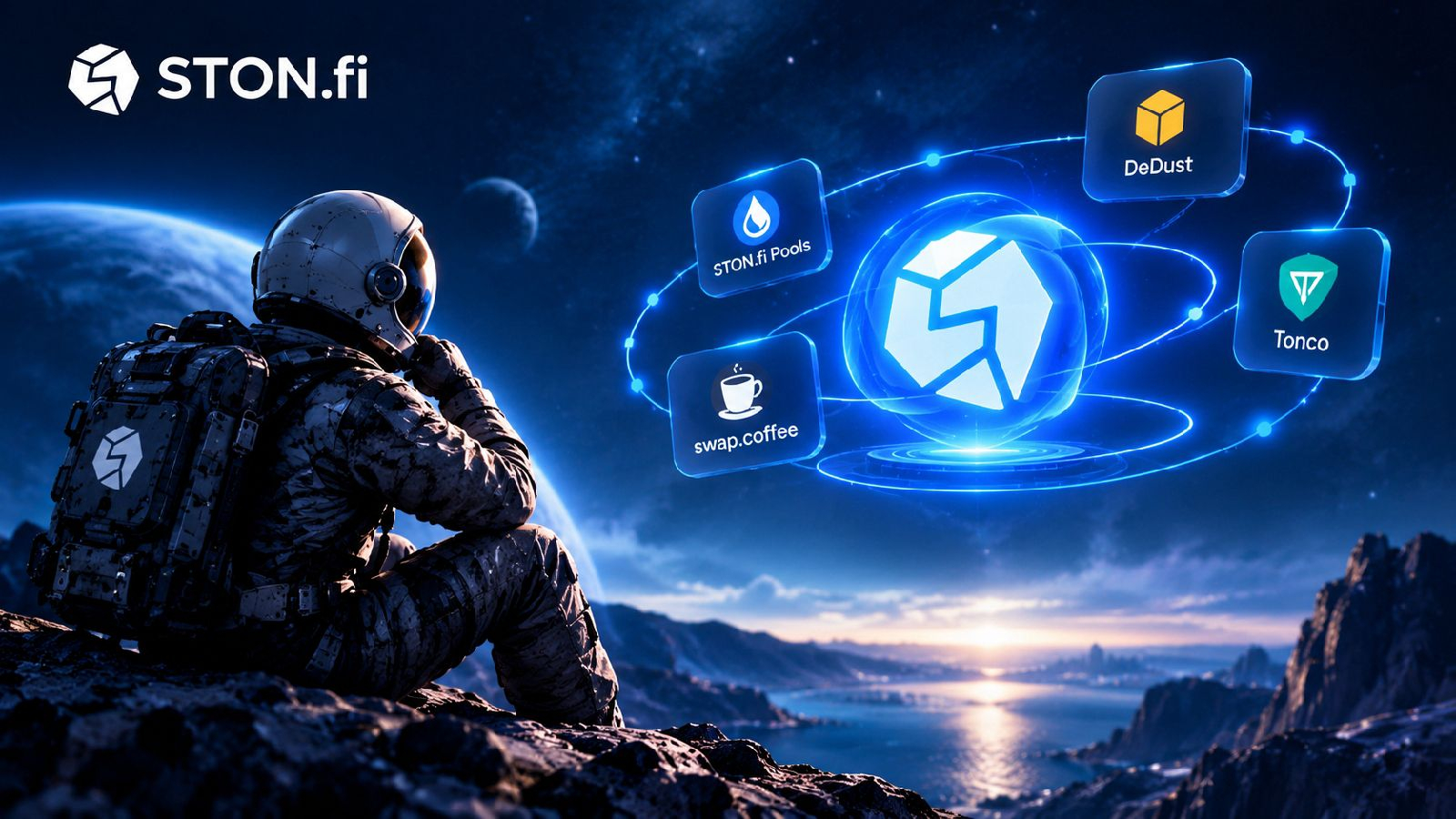
Where Omniston Can Source Liquidity
A STON.fi swap can potentially use several connected liquidity sources.
These include:
STON.fi pools
DeDust
Tonco
swap.coffee
Resolver liquidity
The important point is that users do not need to manually visit every platform.
The aggregation layer brings the available possibilities into the STON.fi swap flow, allowing the user to review the resulting quote before confirming.
This creates a simpler user experience while giving the routing system a wider selection of possible execution paths.
AMM Pools vs RFQ Resolvers
To understand why Omniston can be powerful, it helps to understand the difference between these liquidity models.
AMM liquidity
An Automated Market Maker (AMM) uses liquidity pools to facilitate trades.
The price is determined by the pool's pricing mechanism and the assets available inside it.
Different AMM pools can have different levels of liquidity, resulting in different prices and levels of price impact.
RFQ liquidity
Request-for-Quote (RFQ) systems work differently.
Instead of relying solely on a public liquidity pool, a resolver can provide a specific quote for the requested trade.
This introduces another possible source of execution that can compete with AMM-based routes.
By allowing AMM DEXs and RFQ resolvers to participate in the same routing process, Omniston can compare fundamentally different execution sources for the user's trade.
Cross DEX Routing: More Than a Direct Swap
One of the most useful concepts behind aggregation is that the best route does not always have to be direct.
Suppose you want:
Token A → Token B
A direct pool may exist, but it could have limited liquidity.
A better route could instead be:
Token A → TON → Token B
The first portion could use one liquidity source, while the second portion could use another.
This is known as multi hop or cross DEX routing.
The advantage is that the routing engine can search beyond a single trading pair and consider a broader network of available paths.
For users, this can potentially improve execution without requiring them to manually perform each step.
The User Experience Remains Simple
One of the biggest advantages of an aggregation layer is that complicated routing does not necessarily have to mean a complicated user interface.
From the user's perspective, the experience can remain familiar:
1. Select the token you want to sell.
2. Select the token you want to receive.
3. Enter the amount.
4. Review the available quote and execution details.
5. Confirm the transaction in your wallet.
Behind these simple actions, Omniston can be evaluating multiple sources and possible routes.
This separation between complex infrastructure and simple user experience is one of the strongest arguments for aggregation.
The Benefits of Omniston
Omniston can improve the STON.fi swap experience in several ways.
More competition
When multiple liquidity sources can compete for the same trade, users are not relying on one isolated liquidity source.
Better route discovery
A route that would be difficult for a user to discover manually can be considered automatically.
Access to deeper liquidity
More connected sources can give the routing system access to a larger liquidity landscape.
Potentially lower price impact
For larger trades especially, access to additional liquidity can help identify routes with lower price impact.
Simpler user experience
Users do not need to manually move between different DEX interfaces to compare every possible option.
Smarter execution
The system can evaluate competing quotes and routes rather than simply sending the trade through one predetermined pool.
What Omniston Does Not Guarantee
Aggregation is powerful, but it is important to understand its limitations.
It does not guarantee the best price everywhere
Omniston evaluates the liquidity sources and resolvers connected to its routing system.
That does not mean it has access to every source of liquidity that exists across the entire market.
Therefore, aggregation is not a guarantee of the best possible price anywhere in the world.
Market conditions can change
Crypto markets move quickly.
The quote you see can change because liquidity, prices and market conditions change between quote generation and execution.
More routes do not automatically mean zero slippage
Additional liquidity sources can improve routing opportunities, but slippage can still occur.
The final result depends on the market and the specific trade.
Users still need to verify the transaction
Smart routing reduces the need for manual comparison, but users should still inspect what they are approving.
What You Should Check Before Confirming a Swap
Even with intelligent aggregation, users should never blindly approve a transaction.
Before confirming a STON.fi swap, pay attention to:
The token you are selling
Make sure you selected the correct asset and the correct token address where applicable.
The token you are receiving
Verify that the destination token is the one you actually intend to receive.
Expected output
Check how much you are expected to receive.
Minimum received
Review the minimum amount protected by your slippage settings.
Price impact
For larger trades, price impact can be especially important.
Route details
Understanding where your swap is being routed can provide additional context about the execution.
Wallet prompt
Always inspect the transaction shown by your wallet before signing.
The aggregation layer can make routing smarter, but the final responsibility for approving a transaction still sits with the user.
Omniston in One Simple Example
Imagine you want to swap 1,000 units of Token A for Token B.
A traditional single-pool approach might send your trade to one pool without checking whether another source can provide better execution.
With Omniston, multiple possibilities can be considered.
For example:
Route 1: Token A → STON.fi Pool → Token B
Route 2: Token A → DeDust → Token B
Route 3: Token A → Tonco → Token B
Route 4: Token A → TON → Token B
Route 5: Token A → RFQ Resolver → Token B
Omniston can compare the available valid offers and select the strongest route for the request.
The exact result depends on available liquidity, market conditions, fees, price impact and the state of the connected sources at that moment.
The important idea is that the user does not have to manually test every route.
Why Omniston Matters for the STON.fi Ecosystem
As decentralized finance grows, liquidity becomes increasingly fragmented.
Different platforms can specialize in different pools, trading pairs, pricing mechanisms and liquidity strategies.
That fragmentation creates opportunity, but it also creates complexity.
Aggregation provides a way to connect those pieces.
For STON.fi users, Omniston means the swap interface can become more than a gateway to one liquidity pool.
It can become an intelligent access point to a broader liquidity network.
Instead of asking:
“Which pool should I use?”
the experience can shift toward:
“Which available route provides the strongest execution for my trade?”
That is a meaningful difference.
The Bigger Picture
The long-term importance of systems like Omniston goes beyond simply finding a cheaper swap.
Aggregation is about making decentralized liquidity easier to access.
Users should not need to become experts in every DEX, pool, resolver and routing path just to make a basic token swap.
Infrastructure can handle much of that complexity in the background while the user retains visibility into the quote and transaction before signing.
That creates a balance between:
More liquidity
More competition
Smarter routing
Simpler execution and User control
Final Thoughts
Omniston adds an important layer to the STON.fi swapping experience by connecting fragmented liquidity and comparing available execution opportunities.
It can request competing quotes, evaluate routes across connected sources, support multi-hop and cross DEX paths and select a strong valid route for the swap.
The key value is not that Omniston magically creates liquidity.
Its value is that it helps make more existing liquidity accessible and comparable.
STON.fi users can therefore benefit from a routing system that looks beyond a single pool while maintaining a familiar swap experience.
Still, aggregation is not a guarantee of perfect execution. Users should continue checking the token, expected output, minimum received, slippage, route information and wallet transaction before signing.
Ultimately, Omniston moves the swapping experience toward a simple idea:
More connected liquidity. Smarter routes. Better opportunities for execution.
So, on your next STON.fi swap, what would you check first:
the final output or the route details?
Explore more on STON.FI