🔥 The Next Bitcoin Cycle Top Could Be Decided by ETF Flows Outside the U.S.
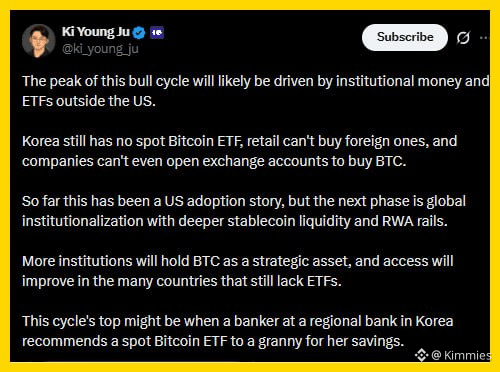
According to CryptoQuant CEO Ki Young Ju, the capital driving Bitcoin toward the next cycle peak may no longer come primarily from the United States.
Instead, the next major wave could come from global institutional adoption, particularly from countries that still do not have easily accessible spot Bitcoin ETFs.
South Korea is a prime example.
Local retail investors face restrictions when attempting to buy Bitcoin ETFs listed overseas, while Korean companies have also faced difficulties opening accounts with crypto exchanges to directly purchase BTC.
If these barriers are eventually removed, the combination of greater institutional access, deeper stablecoin liquidity, and a more developed RWA infrastructure could unlock a significant new source of capital outside the U.S.
And this could fundamentally change the next Bitcoin cycle.
For years, the market has focused heavily on U.S. spot ETFs as the main institutional gateway into Bitcoin.
But once more countries create regulated investment products and make access easier, the potential pool of institutional capital becomes much larger.
Ki Young Ju offered an interesting analogy for what a true cycle top might look like:
A local Korean bank employee recommending a Bitcoin ETF to an elderly woman as a simple savings product.
That would be the moment Bitcoin has moved far beyond crypto-native investors and into the mainstream financial system.
And perhaps that's the real signal to watch.
Not another whale buying BTC.
Not another ETF inflow headline.
But the moment ordinary bank customers around the world start treating Bitcoin exposure like a normal financial product.
If that happens, the next cycle top may be driven by money coming from places the market hasn't fully priced in yet.
$BTC $ETH $ZEC
According to CryptoQuant CEO Ki Young Ju, the capital driving Bitcoin toward the next cycle peak may no longer come primarily from the United States.
Instead, the next major wave could come from global institutional adoption, particularly from countries that still do not have easily accessible spot Bitcoin ETFs.
South Korea is a prime example.
Local retail investors face restrictions when attempting to buy Bitcoin ETFs listed overseas, while Korean companies have also faced difficulties opening accounts with crypto exchanges to directly purchase BTC.
If these barriers are eventually removed, the combination of greater institutional access, deeper stablecoin liquidity, and a more developed RWA infrastructure could unlock a significant new source of capital outside the U.S.
And this could fundamentally change the next Bitcoin cycle.
For years, the market has focused heavily on U.S. spot ETFs as the main institutional gateway into Bitcoin.
But once more countries create regulated investment products and make access easier, the potential pool of institutional capital becomes much larger.
Ki Young Ju offered an interesting analogy for what a true cycle top might look like:
A local Korean bank employee recommending a Bitcoin ETF to an elderly woman as a simple savings product.
That would be the moment Bitcoin has moved far beyond crypto-native investors and into the mainstream financial system.
And perhaps that's the real signal to watch.
Not another whale buying BTC.
Not another ETF inflow headline.
But the moment ordinary bank customers around the world start treating Bitcoin exposure like a normal financial product.
If that happens, the next cycle top may be driven by money coming from places the market hasn't fully priced in yet.
$BTC $ETH $ZEC