#dusk $DUSK
The name "Rusk" kept appearing in Dusk's documentation without a clear explanation of what it actually is. It's the reference node implementation — and understanding what a "node" covers in this context is worth being specific about.
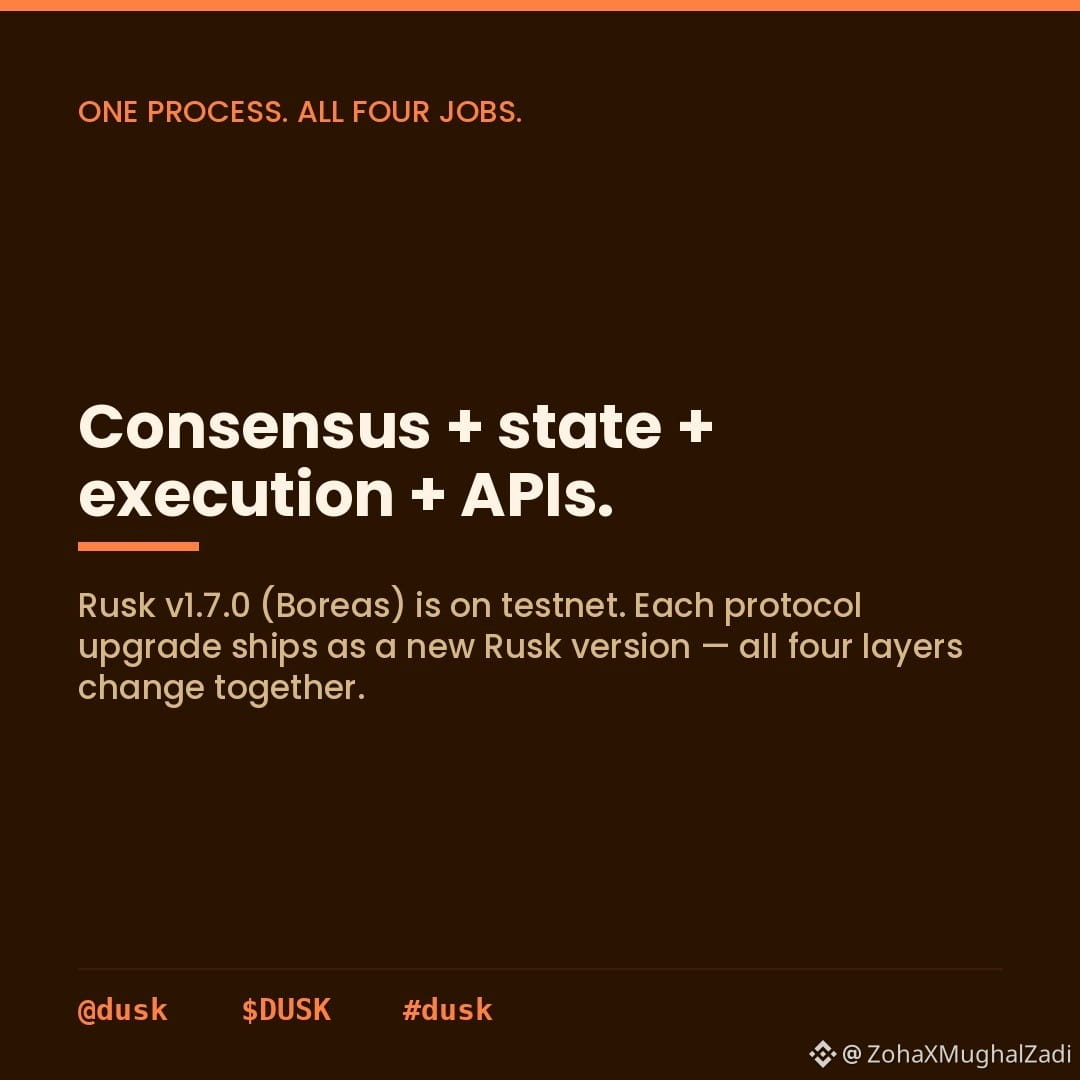
Surprising part: Rusk doesn't just relay blocks. It runs the entire consensus protocol, including block generation and committee voting. Maintains the full chain state. Executes DuskVM contracts. Exposes APIs and events for applications to consume.
The Boreas upgrade, which is Rusk v1.7.0, was on testnet as of mid-2026 — the next protocol-level update after Aegis (March 2026). Each upgrade is deployed to testnet before mainnet, giving operators time to validate.
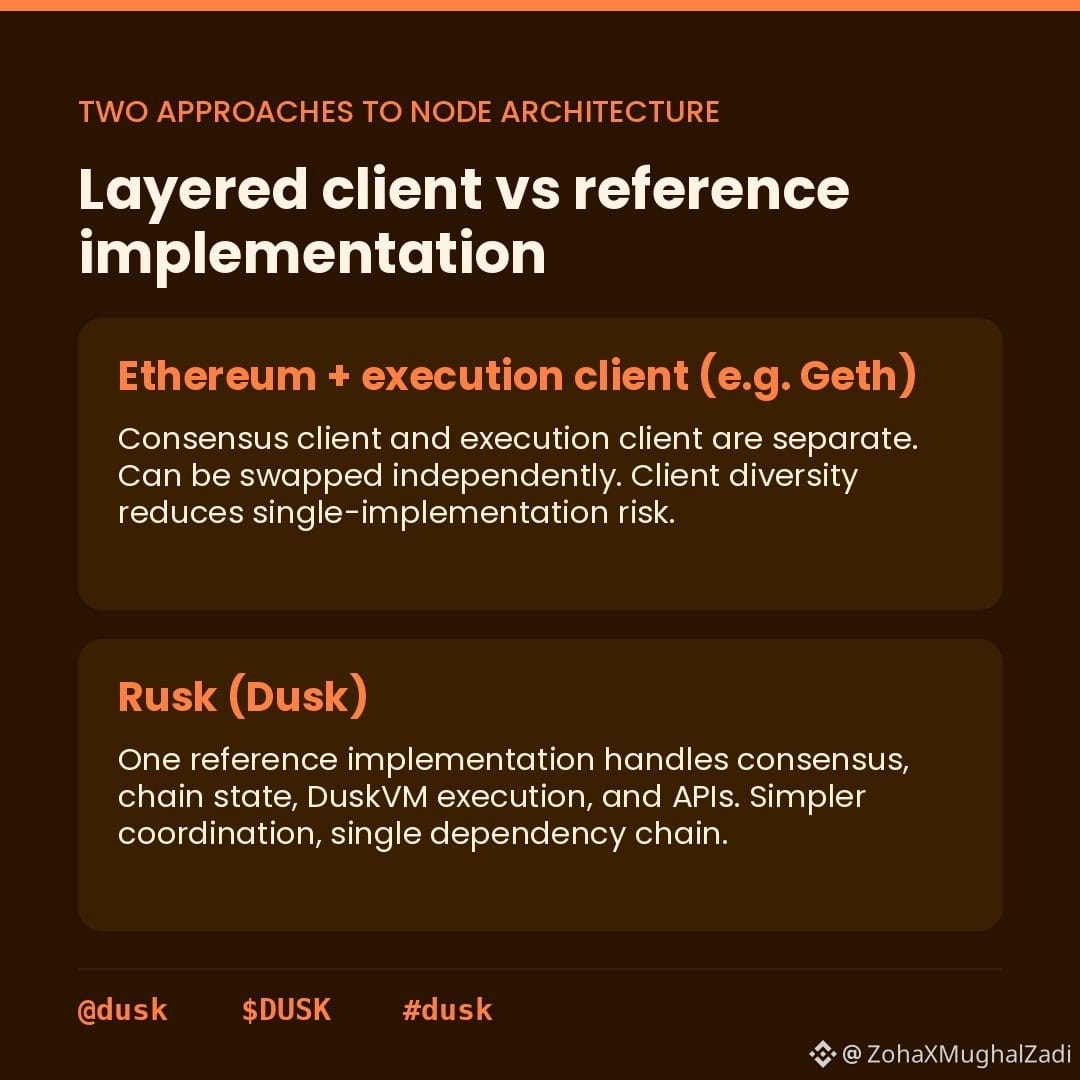
On Ethereum, the node software is separate from the execution client. Rusk combines both into a single reference implementation: it's the consensus participant AND the smart contract executor. Same process handles both layers.
Compare to a layered architecture like Ethereum+Geth: the protocol and execution client are separately maintained and can be swapped. Rusk is a single reference implementation. That makes upgrades simpler to coordinate but creates a single dependency chain for operators.
I actually find the single-reference-implementation choice interesting for a chain aiming at regulated markets — regulated infrastructure usually prefers client diversity to avoid single-implementation bugs.
Does Dusk have plans for alternative node implementations, or is Rusk the only production client by design? @Dusk
$DUSK #dusk
The name "Rusk" kept appearing in Dusk's documentation without a clear explanation of what it actually is. It's the reference node implementation — and understanding what a "node" covers in this context is worth being specific about.
Surprising part: Rusk doesn't just relay blocks. It runs the entire consensus protocol, including block generation and committee voting. Maintains the full chain state. Executes DuskVM contracts. Exposes APIs and events for applications to consume.
The Boreas upgrade, which is Rusk v1.7.0, was on testnet as of mid-2026 — the next protocol-level update after Aegis (March 2026). Each upgrade is deployed to testnet before mainnet, giving operators time to validate.
On Ethereum, the node software is separate from the execution client. Rusk combines both into a single reference implementation: it's the consensus participant AND the smart contract executor. Same process handles both layers.
Compare to a layered architecture like Ethereum+Geth: the protocol and execution client are separately maintained and can be swapped. Rusk is a single reference implementation. That makes upgrades simpler to coordinate but creates a single dependency chain for operators.
I actually find the single-reference-implementation choice interesting for a chain aiming at regulated markets — regulated infrastructure usually prefers client diversity to avoid single-implementation bugs.
Does Dusk have plans for alternative node implementations, or is Rusk the only production client by design? @Dusk
$DUSK #dusk