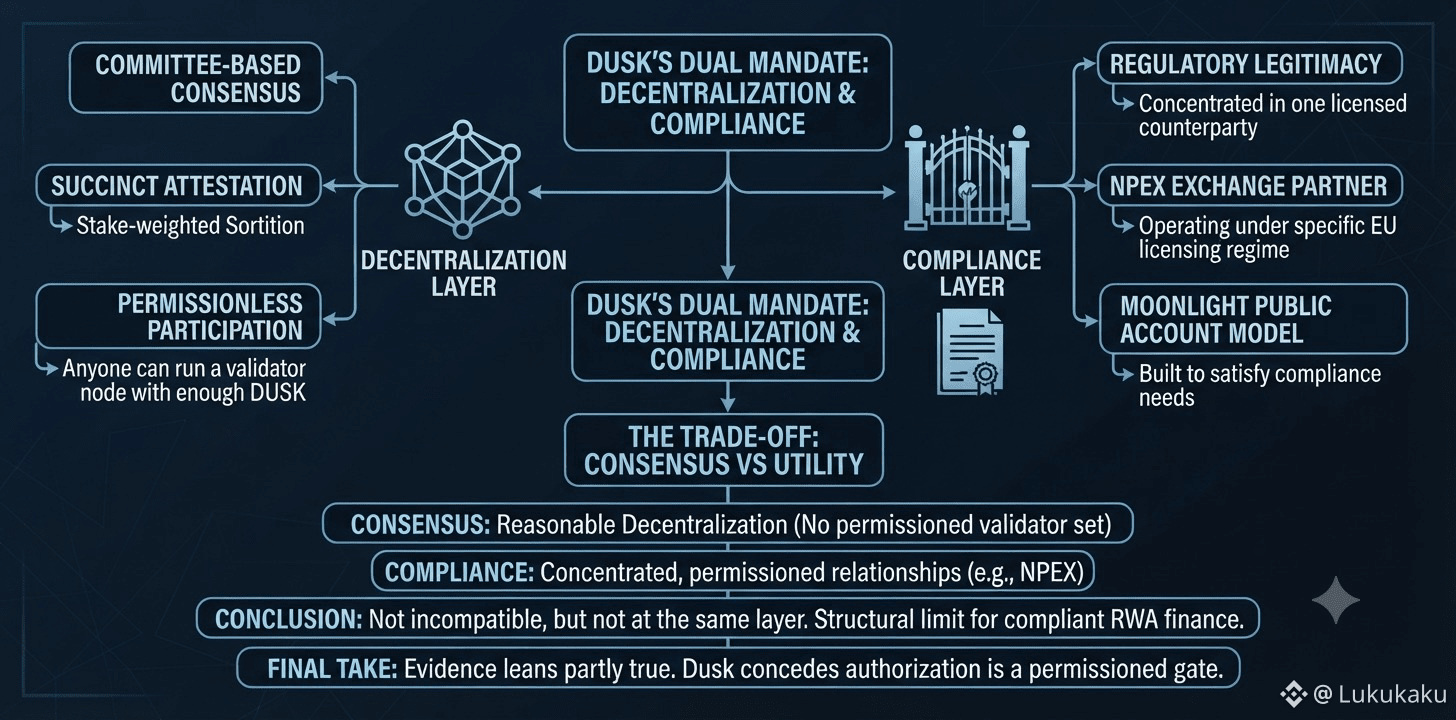
Is full decentralization actually incompatible with strict regulatory compliance, or is that just something people say to excuse projects that never tried very hard at either? I don't think there's a clean yes or no answer, but Dusk is a genuinely useful test case because it's tried harder than most projects at holding both at once.
On the decentralization side, Dusk uses a committee-based consensus, Succinct Attestation, where provisioners are selected through stake-weighted sortition rather than a fixed, permissioned validator set, which is a real attempt at permissionless participation. On the compliance side, its most significant real-world traction runs through exactly one regulated exchange partner, NPEX, operating under a specific EU licensing regime, with Moonlight's public account model built specifically to satisfy that relationship's compliance needs. Concentrating regulatory legitimacy in one licensed counterparty is a less decentralized dependency than a protocol with no institutional gatekeeper. Anyone can run a validator node with enough staked DUSK. Nobody becomes NPEX's licensed partner just by showing up with capital, and that asymmetry is the real shape of the tradeoff.
My honest take: the evidence leans partly true rather than false. Dusk's consensus layer stays reasonably decentralized, but the compliance layer that gives it real utility runs through concentrated, permissioned relationships, since no regulator licenses an anonymous validator set. That's not a flaw unique to Dusk. It's closer to a structural limit on how compliant RWA finance can work on any chain right now. Full decentralization and strict compliance aren't fully incompatible here, but they clearly aren't sitting at the same layer of the stack either. Dusk's own pitch already concedes part of this: its infrastructure is meant to carry native issuance workflows for regulated securities once institutions and venues have authorization in place, and authorization is a permissioned gate, not a decentralized one.
#dusk $DUSK @Dusk