#dusk $DUSK @Dusk
I used to think putting a regulated asset onchain was mostly about replecing the old record with a token.
Then I started looking at how @Dusk separates tokenization from native issuance, and the distinction became more interesting.
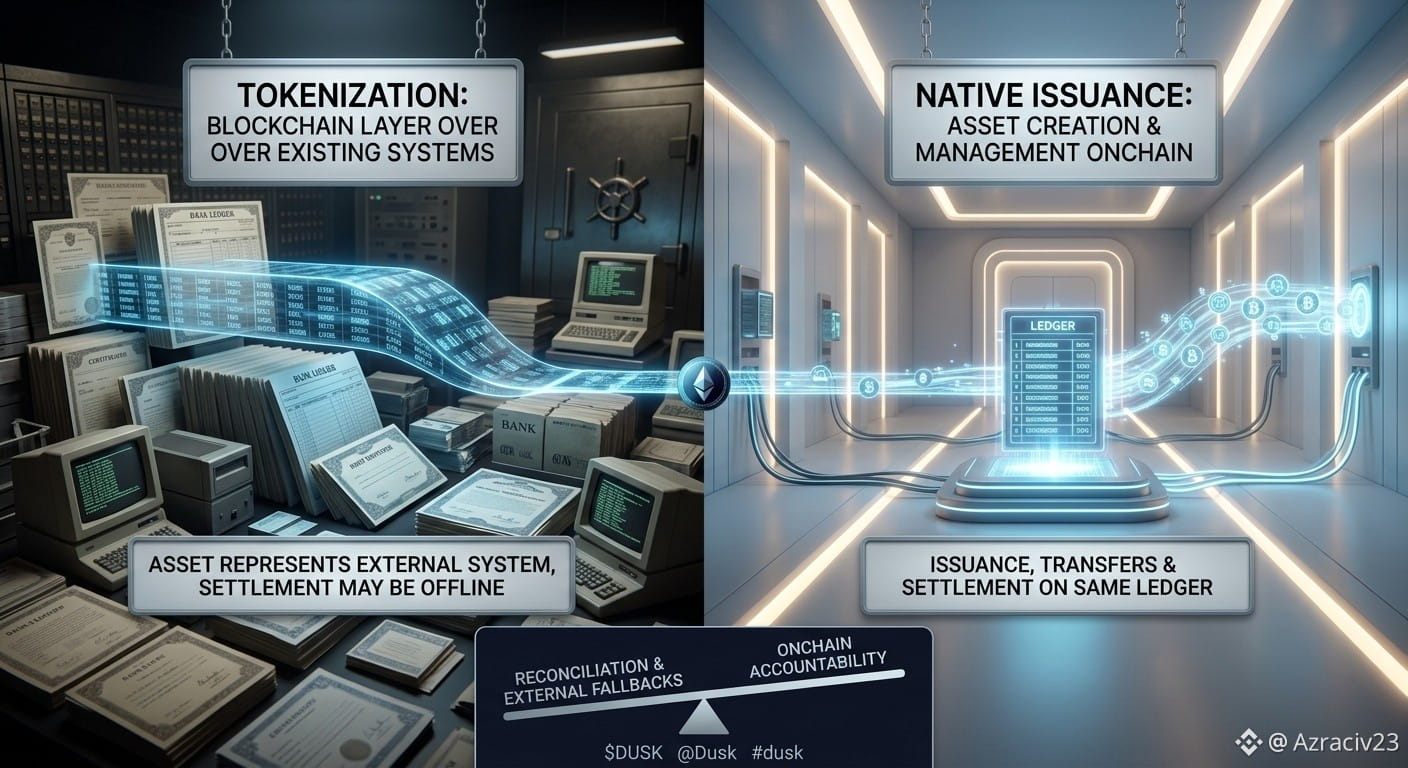
With tokenization, the token can represent an asset that still exists somewhere else The blockchain can make trading and integration easier, but the underlying ownership and settlement records may still live outside it.
Native issuance changes tha.
The asset itself is created and managed onchain, so issuance, transfers and settlement can be built around the same ledger.
That sounds like the obviuos better solution until you think about what you're actually moving onchain.
With tokenization, you keep the existing financial infrastructure underneath the token.
With native issuance, you're asking the blockchain to become part of that infrastructure itself
So the tradeoff isn't really “old system vs blockchain.”
It's:
keep the existing system and add a blockchain layer
or
move more of the financial lifecycle onto the blockchain and take responsibility for making that lifecycle work there
The second approach could remove a lot of reconcilation between separate systems.
But it also means there's less to fall back on outside the chain when something in the financial workflow needs to be handled.
Thats the part of Dusk s native issuance model I find more interesting than simply calling it RWA tokenization.
$DUSK #dusk $ZEC
I used to think putting a regulated asset onchain was mostly about replecing the old record with a token.
Then I started looking at how @Dusk separates tokenization from native issuance, and the distinction became more interesting.
With tokenization, the token can represent an asset that still exists somewhere else The blockchain can make trading and integration easier, but the underlying ownership and settlement records may still live outside it.
Native issuance changes tha.
The asset itself is created and managed onchain, so issuance, transfers and settlement can be built around the same ledger.
That sounds like the obviuos better solution until you think about what you're actually moving onchain.
With tokenization, you keep the existing financial infrastructure underneath the token.
With native issuance, you're asking the blockchain to become part of that infrastructure itself
So the tradeoff isn't really “old system vs blockchain.”
It's:
keep the existing system and add a blockchain layer
or
move more of the financial lifecycle onto the blockchain and take responsibility for making that lifecycle work there
The second approach could remove a lot of reconcilation between separate systems.
But it also means there's less to fall back on outside the chain when something in the financial workflow needs to be handled.
Thats the part of Dusk s native issuance model I find more interesting than simply calling it RWA tokenization.
$DUSK #dusk $ZEC