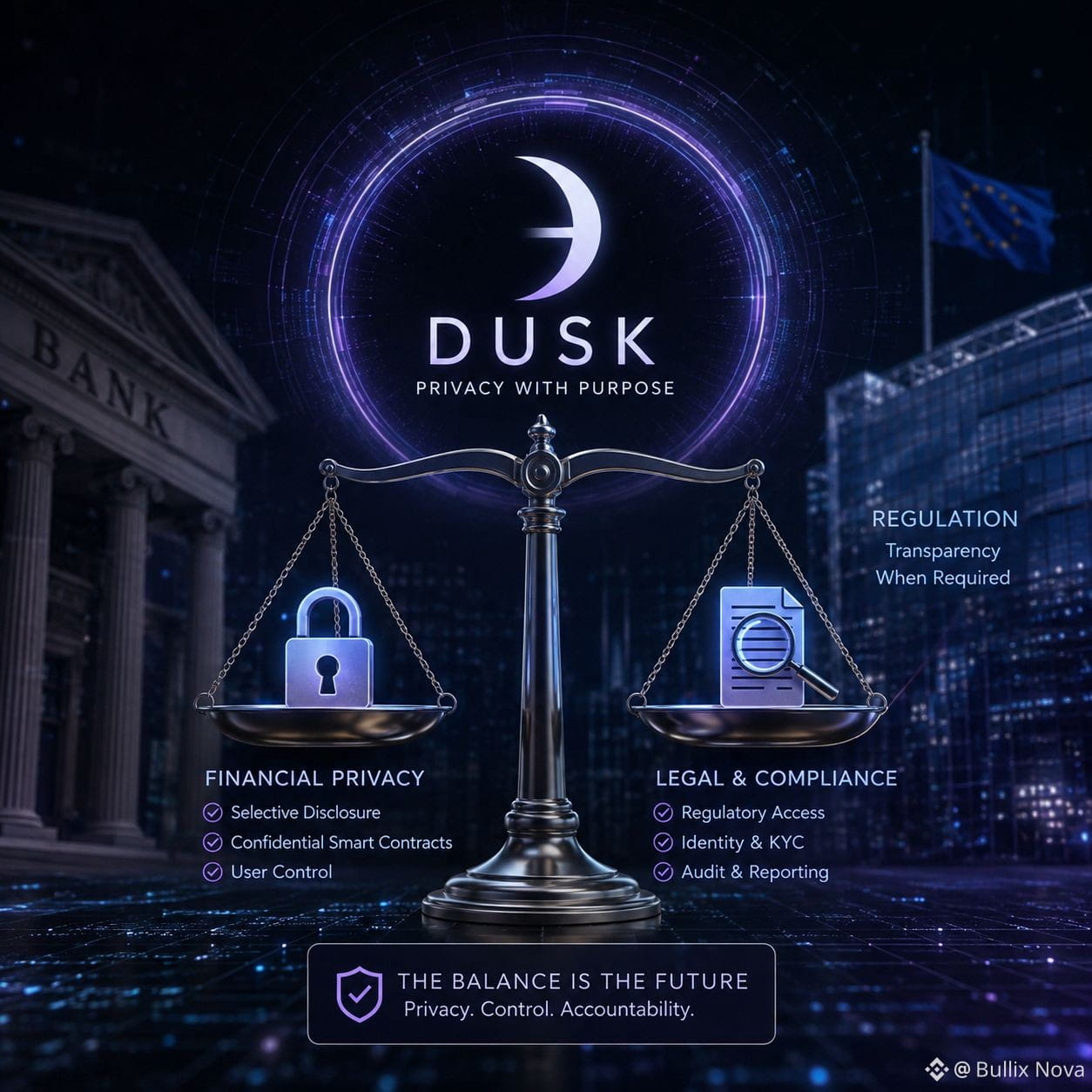
DUSK — The Part of Privacy Nobody Talks About
I’ve always found the interesting part of privacy blockchains isn’t the word privacy.
It’s what happens when privacy meets a real regulator.
Nobody wants every financial move visible on the internet.
But nobody serious wants:
“Can’t tell you. It’s private.”
That’s where Dusk gets interesting.
The idea isn’t simply to hide transactions.
It’s to keep sensitive activity away from public eyes while still allowing the right information to be proven or disclosed when it actually matters.
Sounds simple.
In practice, it gets messy.
Who gets to see what?
Who decides when disclosure is justified?
What happens when a court asks for information?
Those aren’t blockchain questions anymore.
They’re human questions.
And this is what I think people overlook with Dusk.
Its design is being shaped around things traditional finance actually cares about: identity, compliance, transfer restrictions, reporting and controlled access.
You’re no longer talking about “anonymous crypto.”
You’re talking about financial privacy with rules attached.
But there’s a catch.
The more useful selective disclosure becomes, the more important the person controlling that disclosure becomes.
Privacy can protect you.
Badly designed privacy can also become another form of control.
And then there’s permanence. European privacy regulators have highlighted the tension between immutable ledgers and rights like deletion and correction.
That irony matters:
You can build something extremely private…
and still store the wrong thing forever.
That’s why I watch Dusk less as a “privacy coin” and more as an experiment:
Can finance become private without becoming unaccountable?
Maybe the hardest part was never hiding the data.
It was deciding who gets to see it.
#dusk $DUSK @Dusk