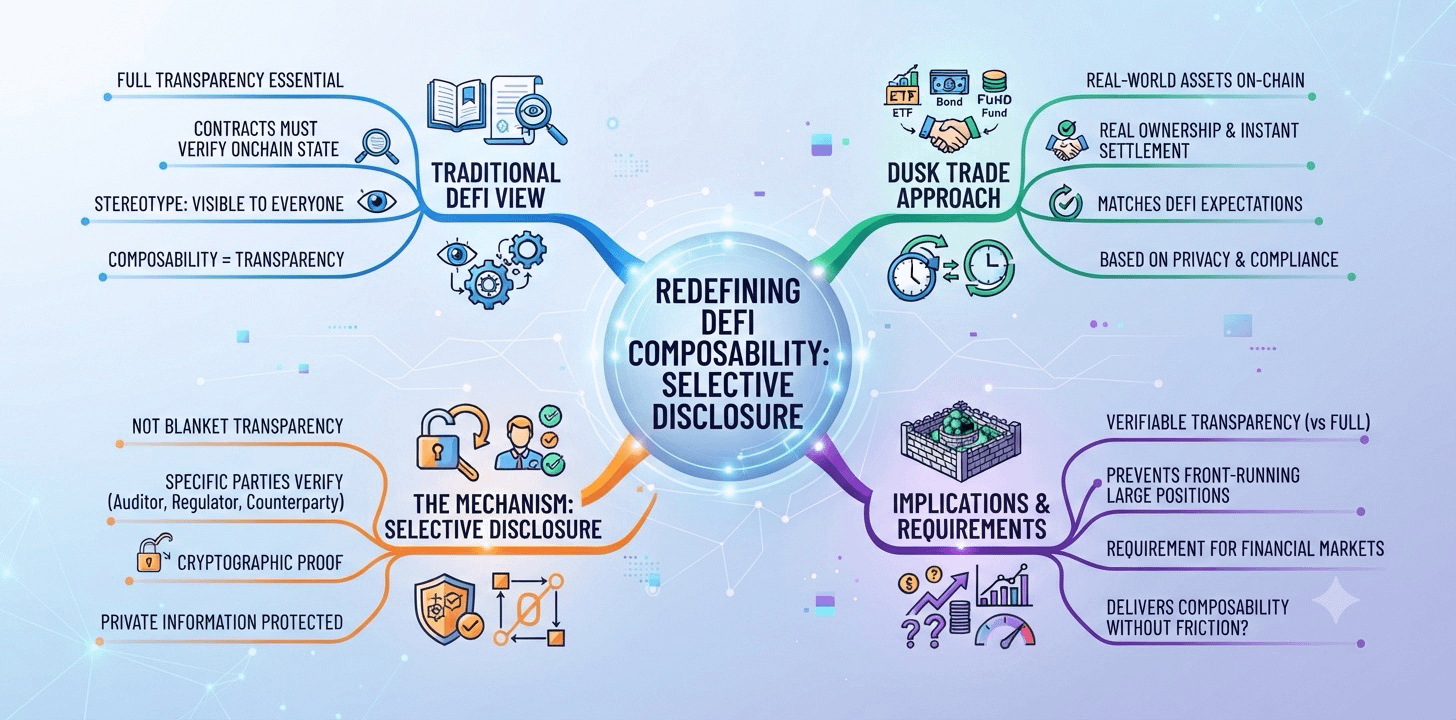
Ask a DeFi builder what makes composability work and most will say the same thing: everything has to be visible onchain, because a contract cannot safely interact with another contract's state if it cannot verify that state directly. Full transparency and composability have been treated as a package deal for so long that questioning the link feels almost naive. Dusk Network's approach to Dusk Trade is a direct challenge to that assumption.
Dusk Trade is meant to bring money market funds, ETFs, bonds, and other real-world assets onto Dusk with real ownership, instant settlement, and composability good enough to match what DeFi users expect. It does this on top of a base layer built around selective disclosure rather than blanket transparency, alongside privacy and deterministic settlement. Selective disclosure means the specific parties who need to verify a position, an auditor, a counterparty, a regulator, can do so with cryptographic proof, without that same information being broadcast to every other contract and observer on the network.
If this works as designed, composability does not require full transparency at all. It requires verifiable transparency to the parties who actually need it, a narrower and arguably more useful property for financial markets than the DeFi default of visible to everyone. A large fund does not want its position size composable in the sense that every other trader can see and front-run it.
The stereotype exists because it was true for most of DeFi's short history so far. Whether Dusk's selective disclosure model actually delivers composability at the speed and reliability DeFi protocols expect, without the friction of proof generation slowing things down, is the part still waiting on real transaction volume to confirm.
@Dusk $DUSK #dusk
Dusk Trade is meant to bring money market funds, ETFs, bonds, and other real-world assets onto Dusk with real ownership, instant settlement, and composability good enough to match what DeFi users expect. It does this on top of a base layer built around selective disclosure rather than blanket transparency, alongside privacy and deterministic settlement. Selective disclosure means the specific parties who need to verify a position, an auditor, a counterparty, a regulator, can do so with cryptographic proof, without that same information being broadcast to every other contract and observer on the network.
If this works as designed, composability does not require full transparency at all. It requires verifiable transparency to the parties who actually need it, a narrower and arguably more useful property for financial markets than the DeFi default of visible to everyone. A large fund does not want its position size composable in the sense that every other trader can see and front-run it.
The stereotype exists because it was true for most of DeFi's short history so far. Whether Dusk's selective disclosure model actually delivers composability at the speed and reliability DeFi protocols expect, without the friction of proof generation slowing things down, is the part still waiting on real transaction volume to confirm.
@Dusk $DUSK #dusk