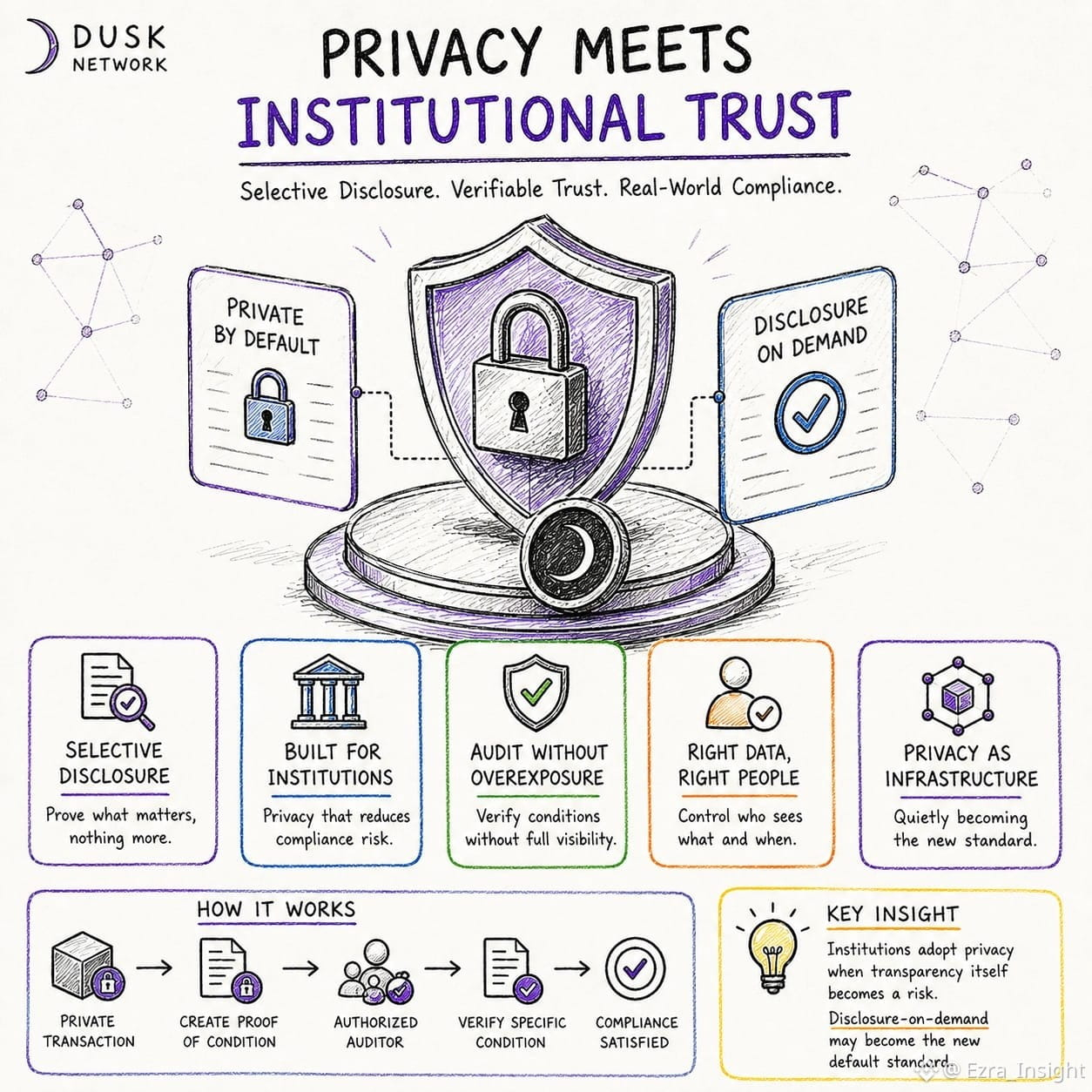
I kept thinking about how regulated finance and privacy technology seem almost designed to disagree. One asks for visibility, while the other starts from the idea that information shouldn't be exposed by default. At first, I assumed that tension was simply something privacy-focused networks had to work around. But the more I looked into Dusk, the more I started wondering if that tension is actually where the value sits. What caught my attention wasn't just the idea of keeping transactions private, but selective disclosure: an auditor can verify a specific condition without being handed the entire transaction history. That made me rethink what “privacy” actually means here. It isn't necessarily about hiding everything; it can mean deciding what gets revealed, when it gets revealed, and who has the right to see it. And that's where the institutional question gets interesting. Institutions rarely adopt privacy infrastructure for privacy alone. They move when transparency itself starts creating risk. So maybe Dusk's harder test isn't whether the cryptography works. It's whether compliance teams eventually decide that disclosure-on-demand is safer than disclosure-by-default and start using it as ordinary infrastructure without making much noise about it. If that shift happens quietly, would anyone notice until it was already normal?
@Dusk $DUSK #dusk
@Dusk $DUSK #dusk