I used to assume "neobroker" just meant a slicker app wrapped around the same old brokerage rails same custody, same settlement delays, just better UX on top. Then I looked into Dusk Trade, and that assumption started to fall apart.
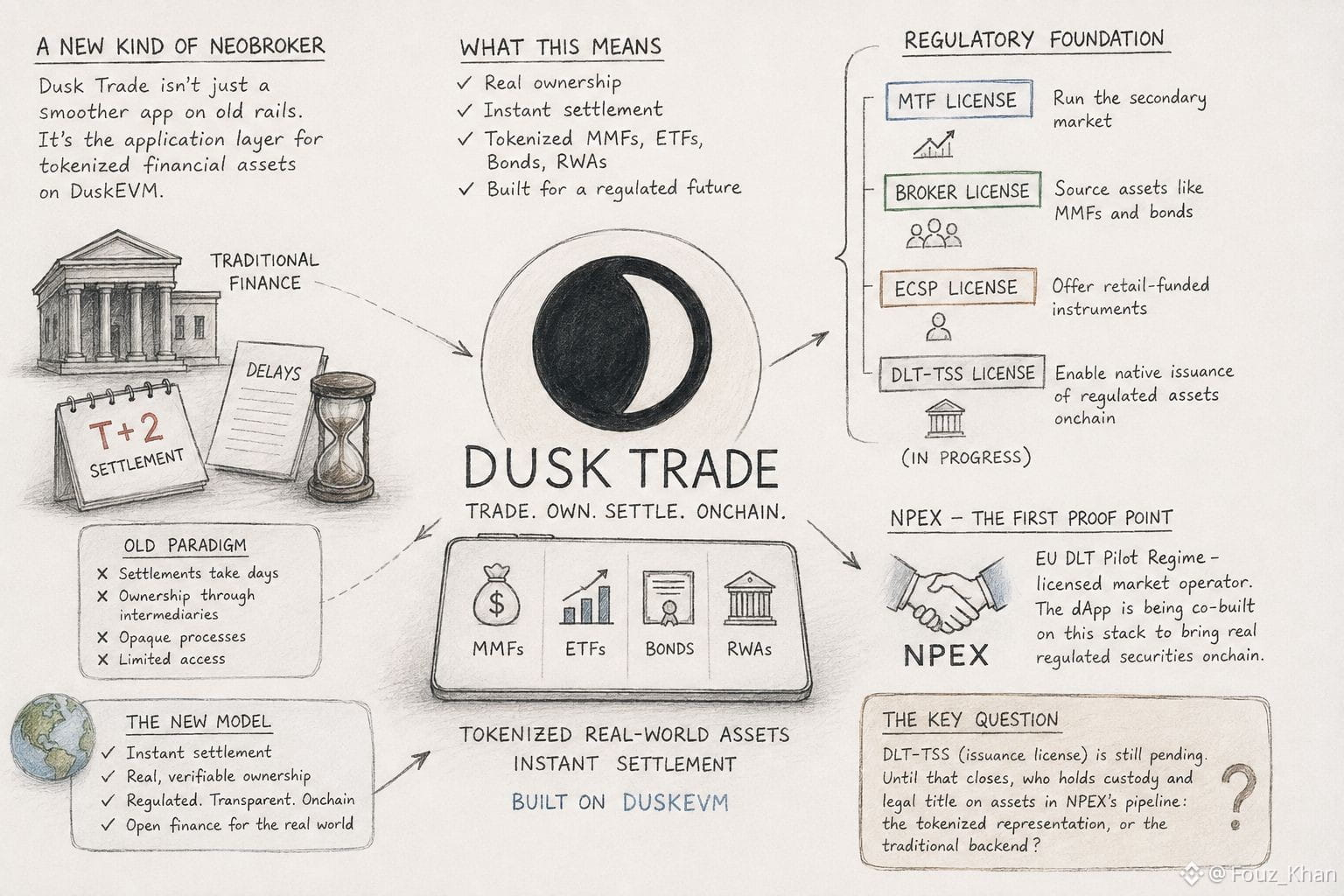
Dusk Trade sits as the application layer for tokenized financial assets on DuskEVM. That phrase alone made me pause. It's not positioning itself as another trading app bolted onto crypto it's positioning itself as the place where MMFs, ETFs, bonds, and RWAs actually become tradable as tokenized instruments, with real ownership and instant settlement instead of the usual T+2 lag we've all just accepted as normal.
What stood out more was how concrete the regulatory layer actually is. This isn't just a compliance mission statement Dusk's stack is built around a specific license bundle: an MTF license to run the secondary market, a Broker license to source assets like MMFs and bonds, an ECSP license for retail-funded instruments, and a DLT-TSS license still in progress meant to enable native issuance of regulated assets onchain. The first live proof point of this is NPEX, an EU DLT Pilot Regime-licensed market operator, whose dApp is being co-built on this stack to bring real regulated securities onchain.
That last detail is what sharpens the question for me. Three of those licenses are described as in place; one the DLT-TSS, the piece that governs native onchain issuance of regulated assets is still pending. Until that closes, who's actually holding custody and legal title on assets moving through NPEX's pipeline: the tokenized representation, or the traditional backend it's still leaning on? That gap between "licensed trading venue" and "licensed issuance" is exactly where I'd want more visibility before treating this as fully onchain finance rather than a regulated frontend to something still partly offline.
@Dusk $DUSK #dusk
$AAVE $ONG
Dusk Trade sits as the application layer for tokenized financial assets on DuskEVM. That phrase alone made me pause. It's not positioning itself as another trading app bolted onto crypto it's positioning itself as the place where MMFs, ETFs, bonds, and RWAs actually become tradable as tokenized instruments, with real ownership and instant settlement instead of the usual T+2 lag we've all just accepted as normal.
What stood out more was how concrete the regulatory layer actually is. This isn't just a compliance mission statement Dusk's stack is built around a specific license bundle: an MTF license to run the secondary market, a Broker license to source assets like MMFs and bonds, an ECSP license for retail-funded instruments, and a DLT-TSS license still in progress meant to enable native issuance of regulated assets onchain. The first live proof point of this is NPEX, an EU DLT Pilot Regime-licensed market operator, whose dApp is being co-built on this stack to bring real regulated securities onchain.
That last detail is what sharpens the question for me. Three of those licenses are described as in place; one the DLT-TSS, the piece that governs native onchain issuance of regulated assets is still pending. Until that closes, who's actually holding custody and legal title on assets moving through NPEX's pipeline: the tokenized representation, or the traditional backend it's still leaning on? That gap between "licensed trading venue" and "licensed issuance" is exactly where I'd want more visibility before treating this as fully onchain finance rather than a regulated frontend to something still partly offline.
@Dusk $DUSK #dusk
$AAVE $ONG