The more I look at @Dusk ’s cryptographic stack, the more interesting the primitives underneath it become.
At first I thought Dusk’s privacy was mostly about zero knowledge proofs.
But then I looked at what actually sits underneath.
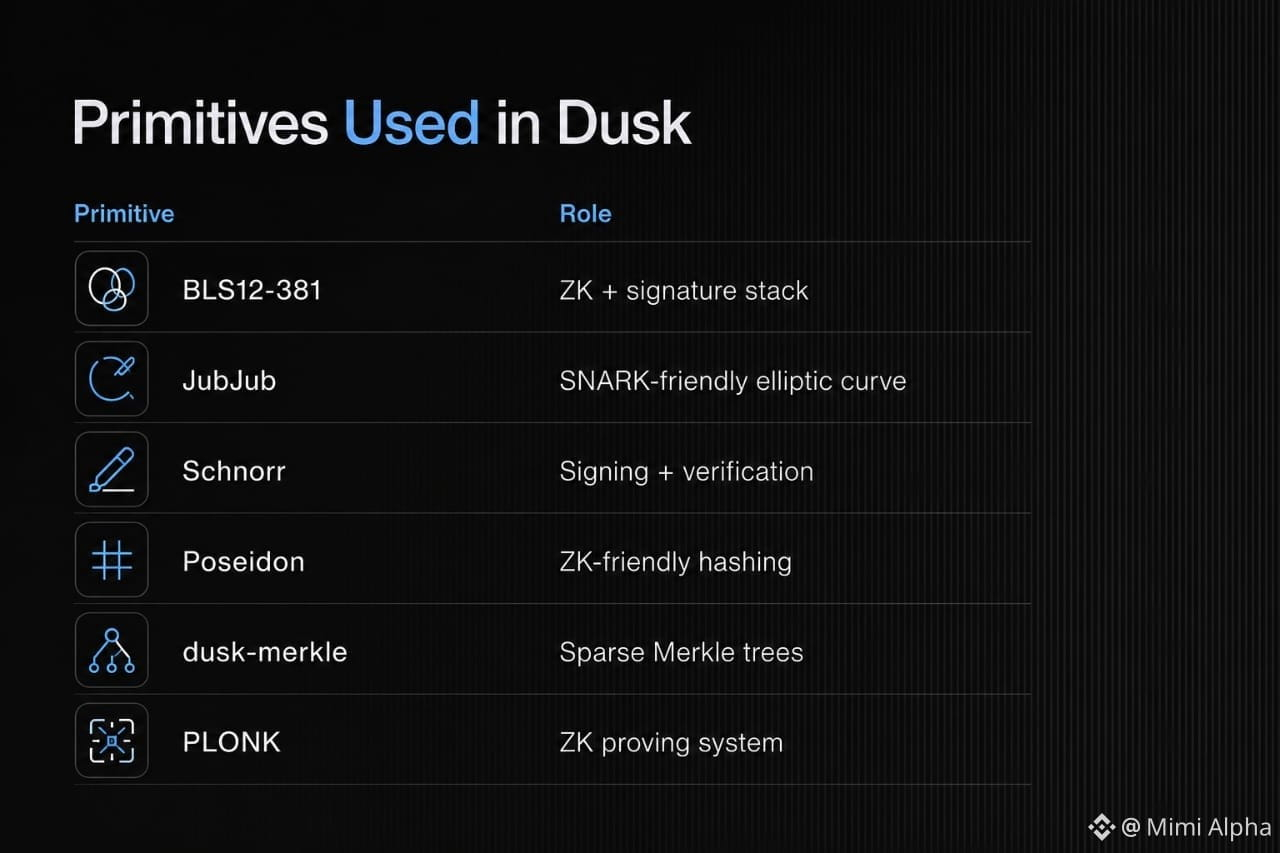
BLS12-381 is a pairing-friendly elliptic curve used in modern proof systems. In Dusk it appears as part of the zero-knowledge and signature stack.
Then there’s JubJub, an elliptic curve that is efficient in SNARK-friendly settings and commonly used in privacy-preserving designs.
Schnorr signatures are used for authentication and integrity, giving Dusk a foundation for signing and verifying protocol actions.
Poseidon is another piece that caught my attention.
It’s designed to be efficient inside zero-knowledge circuits and can be used for commitments and Merkle tree hashing.
$Dusk also has dusk-merkle, a sparse Merkle tree implementation that enables efficient membership proofs over large datasets.
And then there’s PLONK.
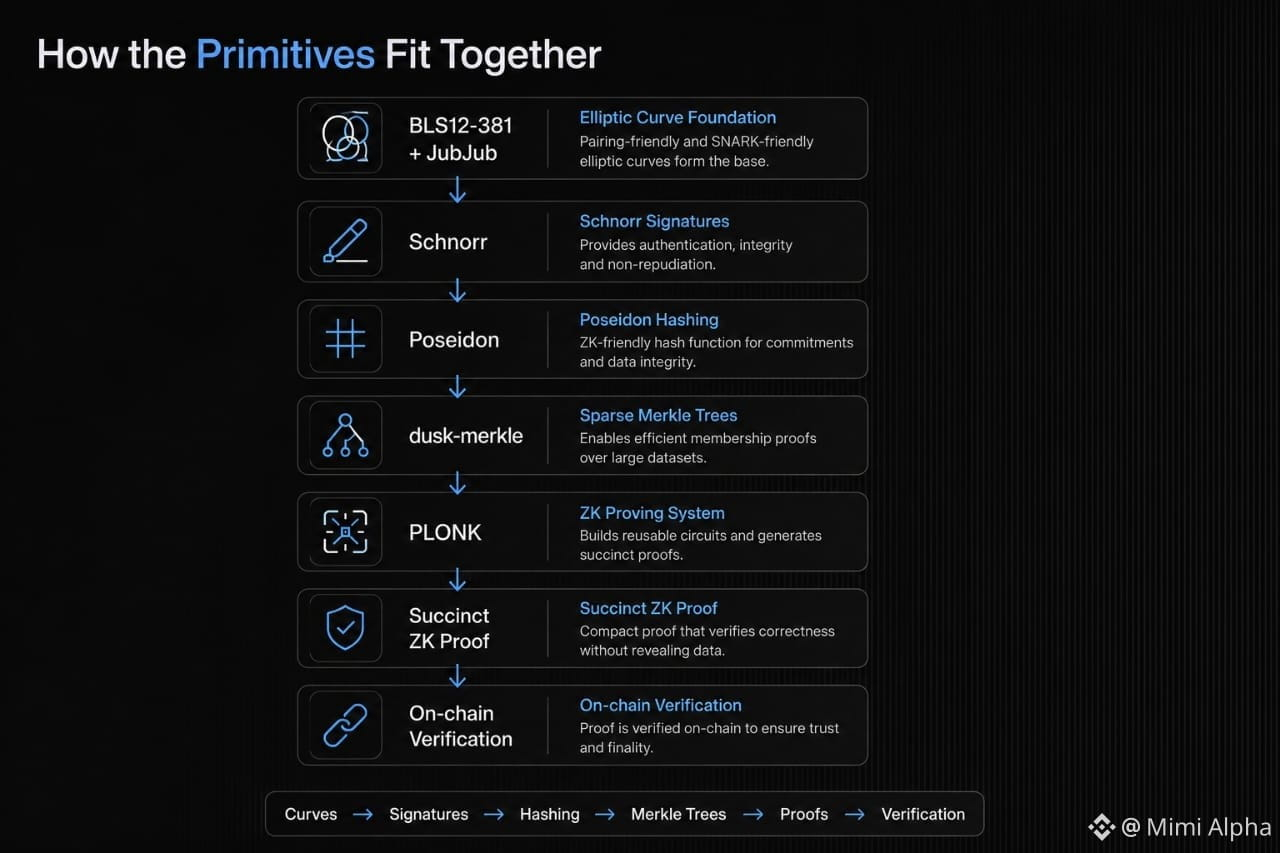
PLONK is the proving system used to build zero-knowledge proofs. Developers can define reusable circuits and generate succinct proofs that can be verified on-chain.
So it’s not really just “Dusk uses ZK.”
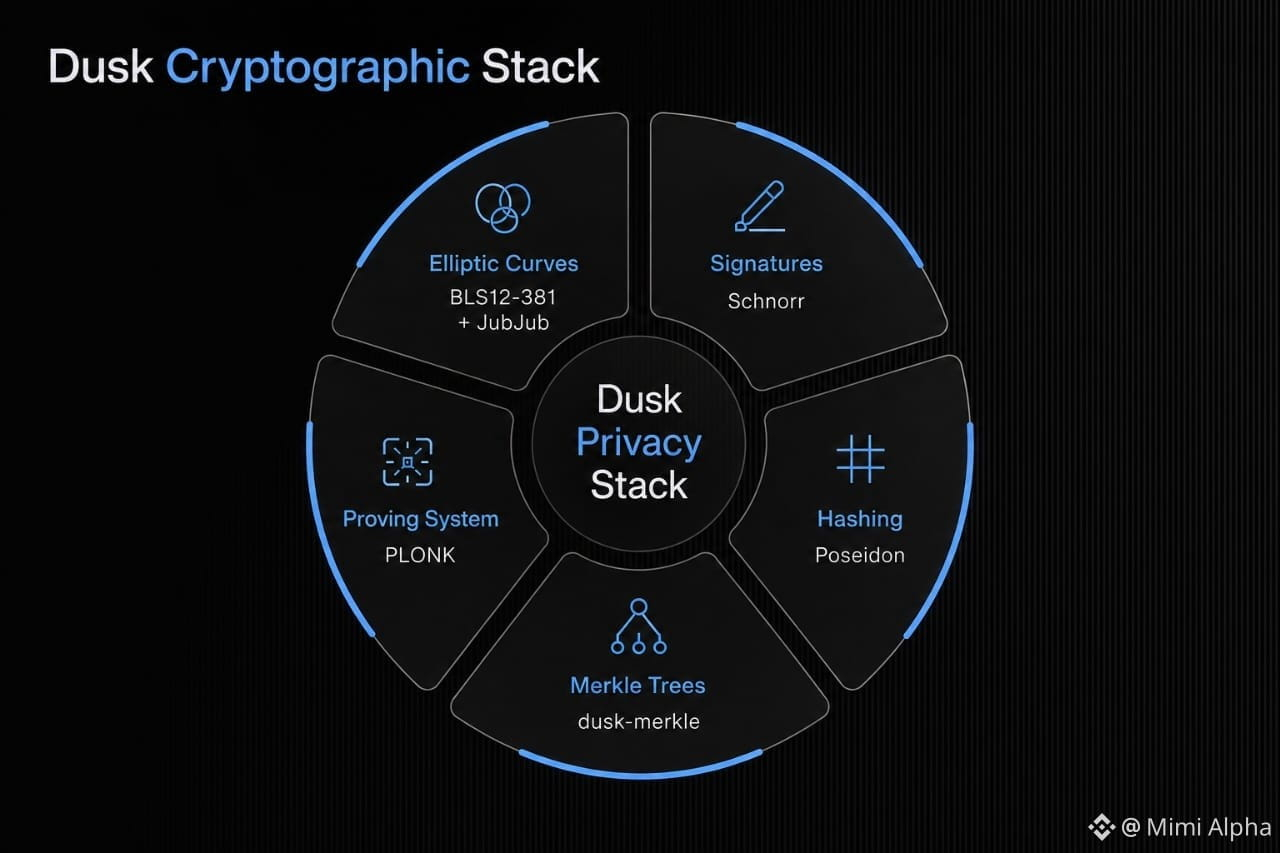
There are elliptic curves, signatures, hashing, Merkle trees and the proving system all working as different parts of the stack.
I think that’s the more interesting part to look at.
Not just the privacy feature itself, but what is actually making that privacy possible underneath.
#DUSK #dusk @Dusk $DUSK
At first I thought Dusk’s privacy was mostly about zero knowledge proofs.
But then I looked at what actually sits underneath.
BLS12-381 is a pairing-friendly elliptic curve used in modern proof systems. In Dusk it appears as part of the zero-knowledge and signature stack.
Then there’s JubJub, an elliptic curve that is efficient in SNARK-friendly settings and commonly used in privacy-preserving designs.
Schnorr signatures are used for authentication and integrity, giving Dusk a foundation for signing and verifying protocol actions.
Poseidon is another piece that caught my attention.
It’s designed to be efficient inside zero-knowledge circuits and can be used for commitments and Merkle tree hashing.
$Dusk also has dusk-merkle, a sparse Merkle tree implementation that enables efficient membership proofs over large datasets.
And then there’s PLONK.
PLONK is the proving system used to build zero-knowledge proofs. Developers can define reusable circuits and generate succinct proofs that can be verified on-chain.
So it’s not really just “Dusk uses ZK.”
There are elliptic curves, signatures, hashing, Merkle trees and the proving system all working as different parts of the stack.
I think that’s the more interesting part to look at.
Not just the privacy feature itself, but what is actually making that privacy possible underneath.
#DUSK #dusk @Dusk $DUSK