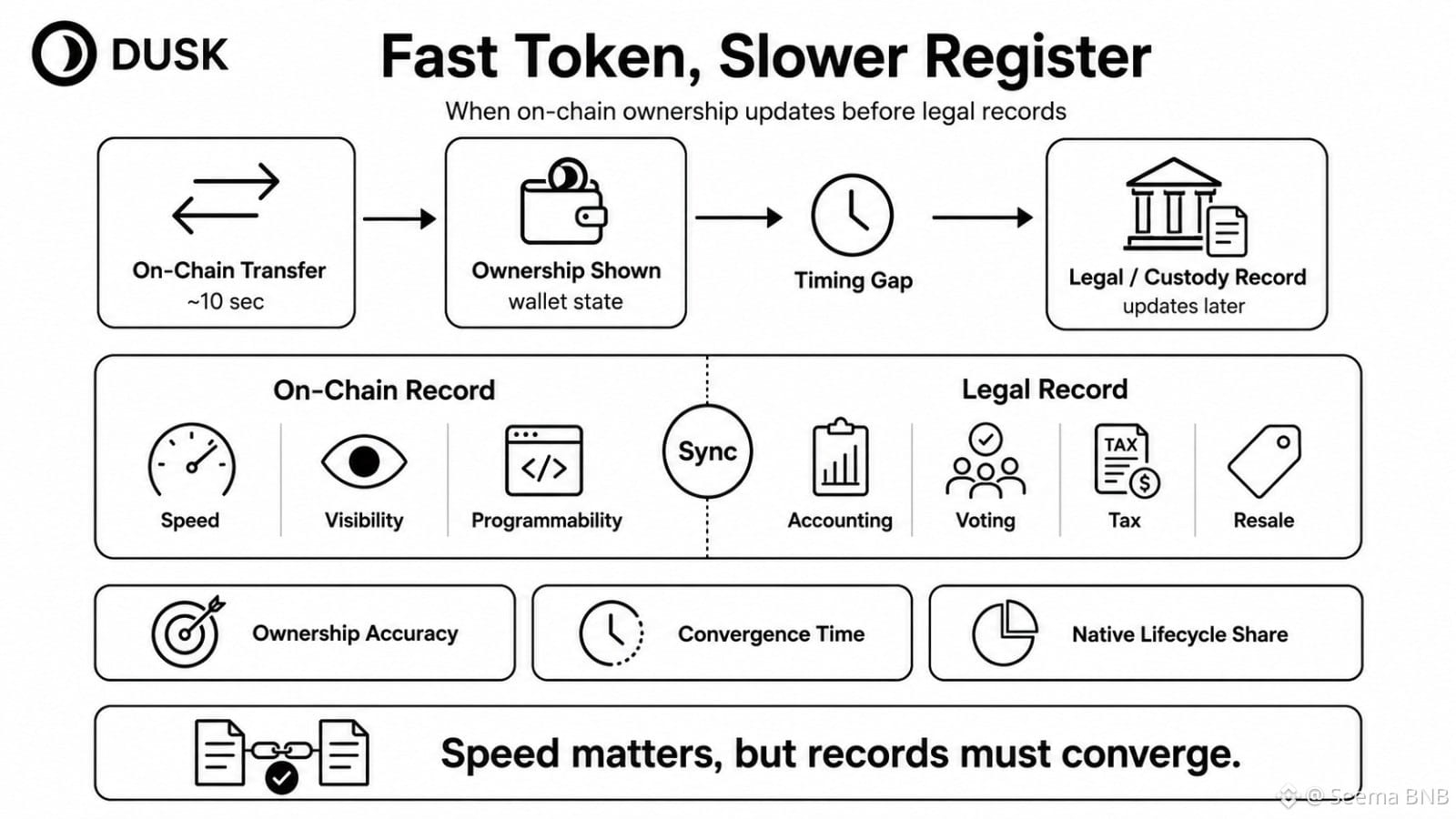
The part that bothers me most about DUSK is not whether a token can move fast. It is what happens when the token moves in 10 seconds and the legal register catches up tomorrow.
The obvious metric is settlement speed. I think that is incomplete.
If DUSK shows ownership on-chain at 23:59, but the custody or legal record updates at 00:01, which record controls accounting, voting, tax, or resale during that gap? Thirty minutes of disagreement may sound small. In regulated assets, small timing gaps create real exceptions.
That is why I would track something harder: on-chain ownership accuracy versus legal ownership accuracy, plus the share of lifecycle steps that are actually blockchain-native.
Minting can be instant while 90% of structuring happens before the first block. A 60% on-chain approval also does not mean every corporate action executes automatically. Some weakness here is normal; law will not disappear because settlement improves.
The real test for DUSK is reconciliation discipline. How quickly do both records converge, and who resolves conflicts?
My doubt is that faster tokens matter, but if legal truth still moves slower, then RWA speed is only partly on-chain.
#dusk $DUSK @Dusk